Skip to content
Desk & Dowel

HUB 05 · Small-Space Setups

Is a Standing Desk Worth It in a Small Apartment?

Worth it if you have a real reason to change position and 24 inches of depth to give it. Not worth it as a motivation purchase, which is what most of them turn out to be.

By Stephen V.Updated How we pick
#ad

We earn a commission when you buy through our Amazon links, at no extra cost to you. It never affects our rankings, and we say so when the cheaper product is the better buy. How this works.

It is worth it if you have a specific reason to change position— back or hip pain that eases when you stand, a long day you cannot break up, a shared desk two people at different heights use — and 24 inches of depth to give a frame. It is not worth it as a motivation purchase. The honest failure mode is not that standing desks do not work; it is that most people use the standing position for a few weeks and then own a heavy, deep, expensive fixed desk that cost twice what a fixed desk costs. In a flat where floor is the scarce thing, that is a worse outcome than it sounds.

If you want the position change but not the furniture, a converter on the desk you already own is the cheaper and much smaller answer, and it is the one we would steer most small-flat readers to first. What it costs you is desk depth while it is up, and a manual lift instead of a button.

What decides it, in order

One: depth, which is the cost nobody prices.Electric sit-stand frames are built around a two-leg frame and a crossbar, and the tops they ship with are overwhelmingly 24 inches deep — because a shallower top on a wide frame flexes. Twenty-four inches is four to eight more than a small writing desk, and in a room where you are counting inches that is the real price of the motor. The frames with 19 or 20-inch tops exist and we rank them in shallow standing desks, but they are the exception and you pay for them in top width.

Two: whether you can actually stand there.At standing height your head and shoulders occupy space a seated person does not, and in a small flat that often collides with something: a sloped ceiling, an upper cabinet, a wall shelf, a window that becomes a mirror at night, or a light fitting. Stand where the desk will go, hold your hands at elbow height — around 38 to 44 inches for most adults — and look around. Our standing desk in a small room guide covers the clearances.

Three: the floor you stand on.Standing on a hard floor for an hour is uncomfortable and standing on carpet is worse than people expect, because pile is uneven and your feet keep correcting. Either way a mat is not an accessory, it is part of the purchase, and it is one more object that lives permanently in a small room — see a desk on carpet.

Four: whether it has to move, ever. A sit-stand frame is the least movable piece of furniture in a flat: 60 to 90 pounds, awkward to carry, and a genuine two-person job up a stairwell. If you move every year or two, that matters more than the feature does. Everything in moving-friendly desk gear was chosen against this constraint, and standing frames are conspicuously absent from it.

Five: the neighbors, if you share a floor or a wall. Standing and walking at a desk transmits through a floor in a way sitting does not, and a motorised frame makes a low hum twice a day. Neither is a reason not to buy one; both are reasons to put a mat down and to not expect to pace.

Six: what the evidence actually says. Worth being precise here, because the category is sold on more than it can support. The strongest claims that hold up are about discomfortrather than disease: reviews of sit-stand workstations find reasonably consistent reductions in reported low-back and neck discomfort and no loss of productivity, and alternating between positions is what the evidence supports — not standing all day, which has its own costs for your legs and feet. Treat a standing desk as a way to change posture several times a day. If you want one number to design around: aim to break up long sitting regularly rather than to hit a standing target.

Who it pays off for, and who it does not

Worth itProbably not
You already know standing eases your back or hipsYou hope it will make you more disciplined
Two people share the desk at different heightsYou are the only user and the desk height is already right
Your desk is the wrong height and cannot be fixedA keyboard tray would fix it for $40
You are at the desk eight hours with no natural breaksYou are up and about through the day anyway
You have 24 in of depth and are staying putYou move often, or have under 20 in of depth

The short answer

Quick picks

#ProductBest forScorePrice
01
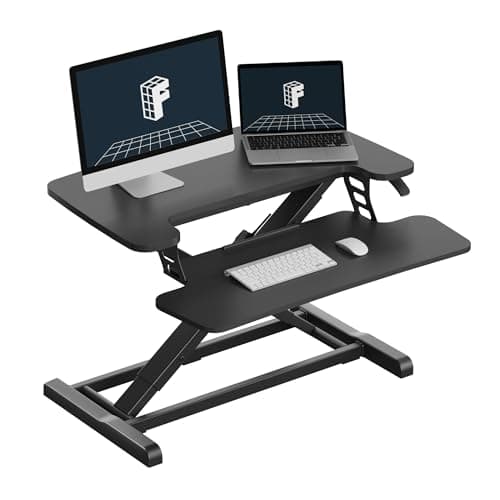
FLEXISPOT FLEXISPOT 28in Standing Desk Converter
FLEXISPOT 28in Standing Desk Converter

Start here. It buys the position change without buying a new desk, and in a small flat it is the cheaper experiment by every measure that matters — floor, money and the ability to change your mind.

Finding out whether you will actually use it
8.8
$119.99Amazon
02
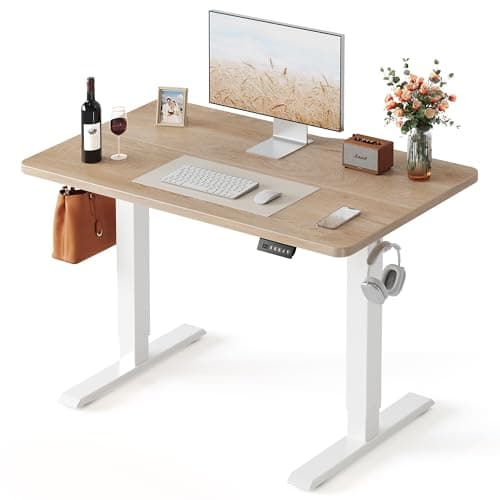
FEZIBO FEZIBO 40in Electric Standing Desk
FEZIBO 40in Electric Standing Desk

If you have decided, this is the sensible small-flat version: a published 28.3 to 46.5 inch range with three memory presets on a 40 by 24 inch top, which is about as small as a proper electric frame gets without compromising the frame.

Committing, without buying a big desk
7.4
$109.99Amazon
03
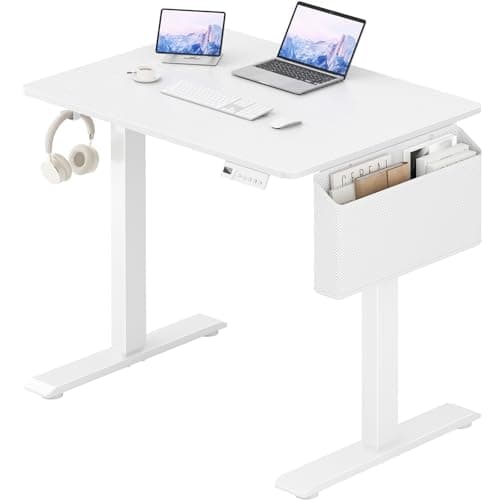
KLUVIS KLUVIS 32in Small Electric Standing Desk
KLUVIS 32in Small Electric Standing Desk

Thirty-two inches wide and electric, which makes it one of the few sit-stand desks that fits a genuinely small wall. The caveat is honest: this listing publishes less than the others here, including no height range.

The tightest wall that still wants a motor
7.2
$85.49Amazon
04
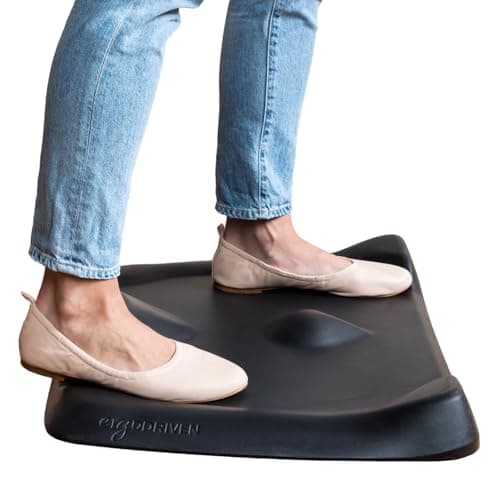
Ergodriven Ergodriven Topo Mini Not-Flat Standing Mat
Ergodriven Topo Mini Not-Flat Standing Mat

Not an accessory. Standing without a mat is the reason most standing desks stop being used, and the Topo Mini's contoured surface gives your feet somewhere to move to in 3.4 square feet.

The part of the purchase people skip
8.6
$79.00Amazon

#ad · Live prices from the Amazon Product API, as of October 11, 2026. Where we have no verified live price we show none — we would rather leave a gap than print a number that has rotted.

In detail

The picks, in full

01
FLEXISPOT FLEXISPOT 28in Standing Desk Converter

Finding out whether you will actually use it

FLEXISPOT 28in Standing Desk Converter

Width
28 in
Top capacity
33 lb
Keyboard tray
4.4 lb
Lift
Mechanical steel spring
Assembly
Attach tray only
8.8/10

Start here. It buys the position change without buying a new desk, and in a small flat it is the cheaper experiment by every measure that matters — floor, money and the ability to change your mind.

Floor cost
9.8
Reversibility
9.6
Lift quality
8.8
Surface
7
Value
8.6

Pros

  • Adds no floor footprint at all — it sits on the desk you already own
  • 33 lb published top capacity takes a monitor and a laptop together
  • Spring-assisted lift rather than a crank, so the change takes a few seconds
  • If you stop using it, you have lost a desk accessory, not a desk

Cons

  • Occupies desk depth and the whole rear area while it is up
  • A separate keyboard tray rated at 4.4 lb — fine for a keyboard and mouse, not a tablet and a book
  • 28 in wide is one screen, not two

Skip this if…

…your desk is under about 18 inches deep, or your desk top is rated well below 33 pounds. The converter plus a monitor is a real load applied in one place.

$119.99View on Amazon

Price as of October 11, 2026. Prices change — Amazon's is the one that counts.

#ad · we may earn a commission from this link to FLEXISPOT 28in Standing Desk Converter

02
FEZIBO FEZIBO 40in Electric Standing Desk

Committing, without buying a big desk

FEZIBO 40in Electric Standing Desk

Height range
28.3–46.5 in
Top
40 × 24 in
Frame
Electric, alloy steel
Presets
3 memory buttons
Range
18.2 in of travel
7.4/10

If you have decided, this is the sensible small-flat version: a published 28.3 to 46.5 inch range with three memory presets on a 40 by 24 inch top, which is about as small as a proper electric frame gets without compromising the frame.

Floor cost
6.4
Reversibility
4
Lift quality
9
Surface
8.8
Value
8.6

Pros

  • A published range starting at 28.3 in, so it also fixes a desk that was too tall for you seated
  • Three presets mean two people and two positions, which is the strongest case for buying one
  • 40 in wide fits a clear wall run of about 42 in
  • 18.2 inches of travel covers seated and standing for almost any adult

Cons

  • 24 inches of depth is the real cost in a small room — four to eight more than a writing desk
  • Single-motor frames flex more at full height than dual-motor ones
  • Heavy and awkward to move, and a two-person job on stairs

Skip this if…

…your wall cannot give up 24 inches of depth. A shallow 19 or 20-inch frame or a converter is the realistic answer.

$109.99View on Amazon

Price as of October 11, 2026. Prices change — Amazon's is the one that counts.

#ad · we may earn a commission from this link to FEZIBO 40in Electric Standing Desk

03
KLUVIS KLUVIS 32in Small Electric Standing Desk

The tightest wall that still wants a motor

KLUVIS 32in Small Electric Standing Desk

Width
32 in
Drive
Electric
Class
Mini sit-to-stand desk
Finish
White
Height range
Not published on listing
7.2/10

Thirty-two inches wide and electric, which makes it one of the few sit-stand desks that fits a genuinely small wall. The caveat is honest: this listing publishes less than the others here, including no height range.

Floor cost
8.6
Reversibility
4.4
Lift quality
7.6
Surface
6.4
Value
8.8

Pros

  • 32 in wide is narrower than almost any electric frame, which is the whole reason to consider it
  • Electric rather than crank at a price below most converters
  • White finish reads lighter in a small room than a black steel frame
  • Small enough to be a second desk rather than the only one

Cons

  • No published height range, so you cannot check it against your elbow height before ordering
  • No storage and a small top
  • Published specification is thinner than the FEZIBO's across the board

Skip this if…

…you are short or tall enough that the height range decides the purchase. Buy the desk that publishes one.

$85.49View on Amazon

$89.995% off

Price as of October 11, 2026. Prices change — Amazon's is the one that counts.

#ad · we may earn a commission from this link to KLUVIS 32in Small Electric Standing Desk

04
Ergodriven Ergodriven Topo Mini Not-Flat Standing Mat

The part of the purchase people skip

Ergodriven Topo Mini Not-Flat Standing Mat

Size
25.2 × 19.2 in
Footprint
~3.4 sq ft
Height
2.47 in at highest
Weight
4 lb
Warranty
16 years
8.6/10

Not an accessory. Standing without a mat is the reason most standing desks stop being used, and the Topo Mini's contoured surface gives your feet somewhere to move to in 3.4 square feet.

Floor cost
8.8
Comfort
9.2
Storability
7.8
Build
9.4
Value
7.8

Pros

  • Contoured rather than flat, so your feet and calves get small position changes without stepping off
  • 3.4 sq ft is modest for a contoured mat, which matters in a studio
  • 4 lb and stiff enough to stand on edge against a wall when not in use
  • A published 16-year warranty, which is unusual in the category

Cons

  • A 2.47-inch high point is a trip edge in a dark room
  • Firm rather than cushioned; some people want more give
  • Costs as much as a cheap converter

Skip this if…

…you want a flat mat you can roll a chair over. This one has to be moved aside to sit down, which is the honest cost of the contours.

$79.00View on Amazon

Price as of October 11, 2026. Prices change — Amazon's is the one that counts.

#ad · we may earn a commission from this link to Ergodriven Topo Mini Not-Flat Standing Mat

The cheaper experiment, in order

If you are not sure, spend in this order and stop when you have what you need. It costs less and it answers the question honestly.

StepWhat it testsFloor cost
Stand at a kitchen counter for a week, an hour a dayWhether you like standing at allNone
Add a matWhether the floor was the problem~3 sq ft, stored upright
Buy a converterWhether you use it at your own deskDesk depth only
Buy a frameNothing — this is the commitment24 in of depth, permanently

Most people who abandon a standing desk abandon it at step one or two, which is exactly why doing those steps first is worth the fortnight. If you get to step three and keep using it, the frame is an easy decision.

If you buy a frame, buy these specs

A published height range, at both ends. The bottom of the range matters as much as the top: a frame that starts at 28.3 inches suits a shorter user seated, and one that starts at 29.5 does not. Standing desks for short people ranks on exactly this, and our desk height guide has the by-height table.

Depth you can actually spare. Measure the floor, not the wall. Twenty-four inches of desk plus 36 inches of chair clearance is five feet of room claimed before anything else happens. Desk dimensions by room size does the arithmetic.

Presets, if two people use it. This is the feature that turns a shared desk from an argument into a button press, and it is the single strongest practical case for buying a frame over a converter.

And check the top rating before clamping anything to it. A monitor arm on a moving frame travels 18 inches twice a day with the cable in tow, which needs a service loop and a strip clamped to the desk rather than the wall. Monitor arms for standing desks and keyboard trays for standing desks cover what changes when the desk moves.

When the answer is simply no

Three cases where we would not buy one, in a small flat. If your desk is too talland that is the real complaint, a $40 keyboard tray and a footrest fix it for a tenth of the money — keyboard trays and the height guide. If you have under 20 inches of depth, a frame does not fit and a converter on a narrow desk is the honest answer. And if you move often, 70 pounds of steel frame is the wrong thing to own; the same money on a narrow desk, an arm and a good chair does more for how the room works.

Converter or frame, decided

We compare the two directly in standing desk vs standing desk converter. The short version for a small flat: the converter wins on floor, money and reversibility and loses on surface area and on the ten seconds it takes to clear the lower desk before raising it. The frame wins if the desk is shared, if the height was wrong seated as well as standing, or if you are staying in the flat for years. Our small converter picks and small standing desk picks rank each category, and under $200 is where most of this band lives.
How we picked

We do not run a testing lab

We compiled the published manufacturer specifications, did the footprint and clearance math ourselves, and read aggregated owner reviews, then scored each product against a published rubric. The scores are judgments from documented research — they are not measurements we took, because we do not have a lab and we are not going to pretend we do. Every spec traces back to a listing or manual named in Sources.

Questions

Frequently asked

Is a standing desk worth it in a small apartment?
Worth it if you have a specific reason to change position — pain that eases when you stand, a shared desk at two heights, or a desk height that is wrong seated as well — and 24 inches of depth to give a frame. Not worth it as a motivation purchase: the common outcome is an expensive, deep, heavy fixed desk, which is a worse trade in a small flat than anywhere else.
Is a standing desk converter worth it?
In a small flat it is usually the better first purchase. It adds no floor footprint, costs a fraction of a frame, and if you stop using it you have lost an accessory rather than a desk. What you give up is surface area while it is raised, a manual rather than motorised lift, and the need to clear the desk underneath.
Should you use a standing desk all day?
No. What the evidence supports is alternating — breaking up long periods of sitting with periods of standing — not replacing one static posture with another. Standing all day has its own costs for legs, feet and lower back. Treat the desk as a way to change position several times a day.
Do you need a mat with a standing desk?
Treat it as part of the purchase rather than an accessory. Standing on a hard floor is uncomfortable within the hour, and standing on carpet is worse than people expect because pile is uneven and your feet keep correcting. A mat is the cheapest thing that stops a standing desk going unused.
How much space does a standing desk need?
More than a writing desk, and depth is the cost. Most electric frames ship with 24-inch-deep tops because a shallower top on a wide frame flexes — four to eight inches more than a small writing desk. Add 36 inches of chair clearance and a 40 by 24 inch desk claims about 5 feet by 3 feet 4 inches of floor.
Can you put a standing desk in a bedroom or studio?
Yes, with three checks: that you can stand there without hitting a sloped ceiling, an upper cabinet or a shelf at 38 to 44 inches; that the floor you stand on gets a mat; and that you accept the frame is the least movable object in the room. Shallow 19 to 20-inch frames exist and are the right shape for a bedroom.

Keep reading

Receipts

Sources

We do not run a testing lab, and we do not pretend to. Specifications come from the manufacturer or retailer listing; the footprint and clearance math is ours and reproducible. Where we could not verify a number, we say so on the page rather than quietly leaving it out. Read our full method.