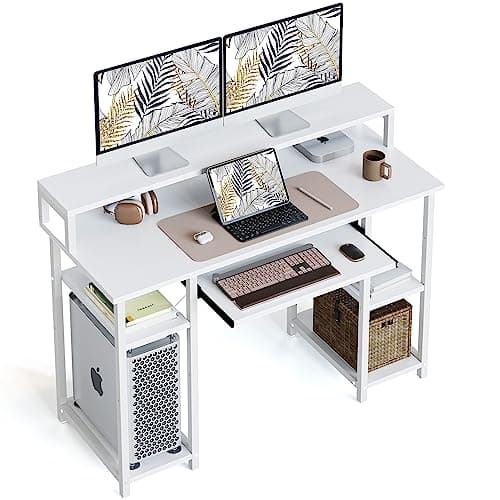
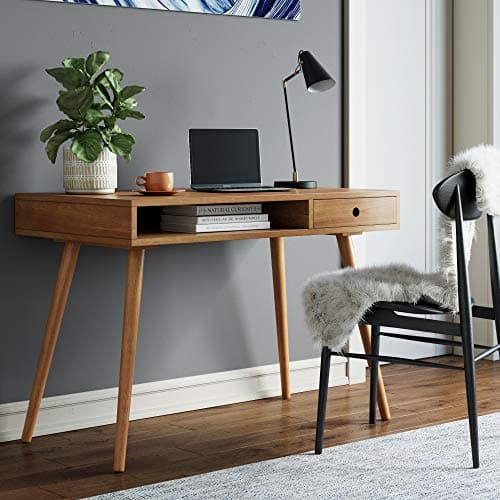
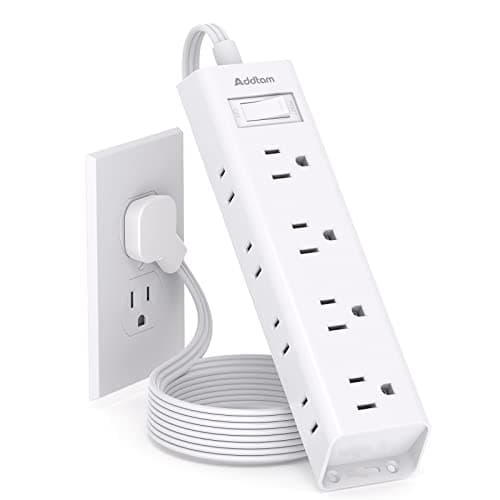
These two categories overlap enough that the labels look like marketing, but the difference is real and it is mostly about depth and what the desk assumes you will put on it. A writing deskis a flat top on legs, typically 16–24 inches deep, with a drawer and nothing else. A computer deskis built for equipment: 20–30 inches deep, usually with a keyboard tray, a monitor shelf, a CPU stand and cable routing.
The short answer
Buy a writing desk if the desk lives in a bedroom, studio or living room where it will be seen when you are not working, if you work mainly on a laptop, or if depth is your binding constraint. Buy a computer desk if you run an external monitor and a tower, if you want a keyboard tray and cable management without adding them yourself, or if the room is already a workspace and does not need the desk to be discreet.
The decision table
| Factor | Writing desk | Computer desk |
|---|
| Typical depth | 16–24 in | 20–30 in |
| Monitor on the desk | Only at 21in-plus depth | Yes, often on a built-in shelf |
| Keyboard tray | Rare | Common |
| Tower / CPU space | No provision | Usually a dedicated shelf |
| Cable management | None built in | Grommets and channels typical |
| Storage | A drawer | Shelves, cabinets, drawers |
| Looks in a bedroom | Reads as furniture | Reads as equipment |
| Weight / moving | Lighter, simpler | Heavier, more parts |
Depth is the argument
Everything else follows from this row. A computer desk is deeper because it assumes a monitor will sit on its stand at the back, and a stand claims 8–10 inches. A writing desk does not make that assumption, so it can be 16 inches deep — which in a small apartment is the difference between a desk that fits a walkway and one that blocks it. Our desk size guide has the clearance arithmetic, but the rule of thumb is that you want about 30 inches of walking path, and every inch of desk depth comes out of it.
The move that collapses the difference
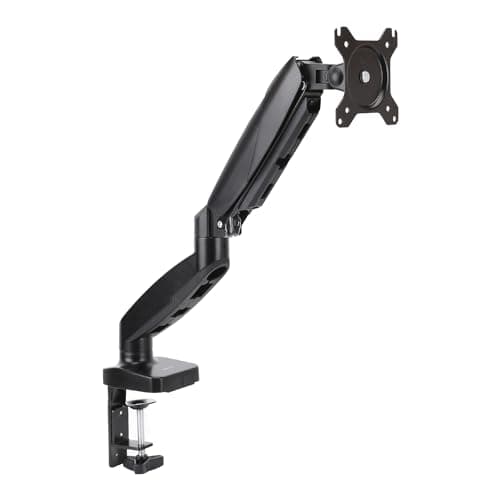
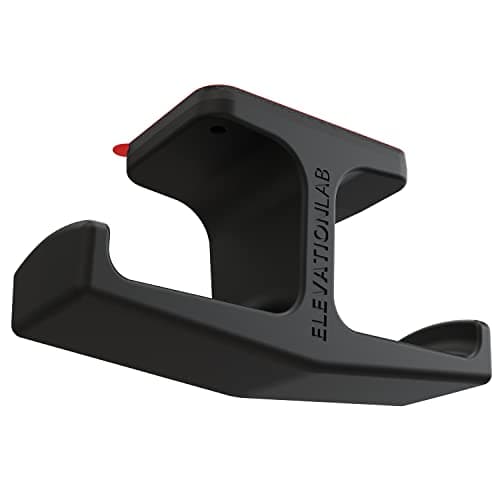
Put the monitor on a clamp armand the main reason to buy a computer desk disappears. The arm removes the 8–10 inches the stand needed, so a 16-inch writing desk suddenly hosts a full-size screen with room for a keyboard in front of it. Add a clamp-on keyboard tray and an under-desk CPU holder and you have every computer-desk feature on a desk that still looks like furniture. For a small room, that combination is usually the better answer than buying the deeper desk.
When the computer desk genuinely wins
Three cases. If your desktop is glass, very thin or hollow-core, a clamp arm may not be safe to fit, and a built-in monitor shelf solves the height problem instead. If you run two screens plus a tower, the integrated shelving and cable routing save you buying three accessories. And if the desk sits in a dedicated work corner where nobody needs it to look like furniture, the extra storage is free capability. Otherwise the writing desk plus accessories route wins on both floor space and looks.
How to decide in two minutes
- Measure the walkway.Wall to path, minus about 30 inches of clear walking room. If what is left is under 20 inches, you are buying a writing desk — the decision is already made.
- Count the screens. Laptop only, or one monitor you are willing to put on an arm? Writing desk. Two screens and a tower? Computer desk, unless you want to buy an arm, a tray and a CPU mount separately.
- Ask who sees it. If the desk is in a bedroom, studio or living room, the way it looks at 8pm is a real factor and the writing desk wins it comfortably.
The cost comparison people get wrong
A writing desk looks cheaper, and then you buy an arm, a tray and a CPU mount, and the totals converge. Run the arithmetic honestly before deciding on price alone. What the accessorized writing desk still wins on is depth— you end up with the computer-desk features on a 16-inch-deep footprint, which no computer desk can give you. That, rather than money, is the reason to go that route in a small room.
Whichever you buy, check the height
Both formats are built at the same 29–30 inches, sized for a six-foot user. If you are shorter, the desk will be too tall regardless of which category it came from, and the fix is the same: a keyboard tray to drop the typing surface, or a footrest to restore the floor under your feet. The numbers are in the desk height guide.