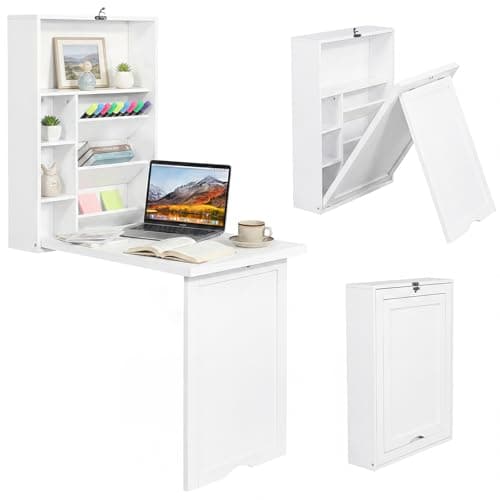
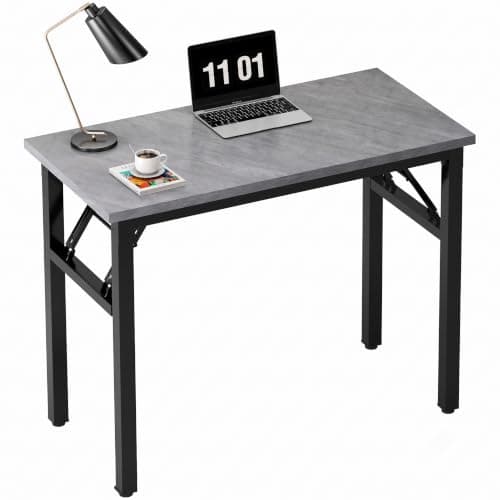
Both of these solve the same problem — a room that cannot spare permanent desk space — and they solve it in opposite directions. A freestanding folding desk collapses and gets stored somewhere else. A wall-mounted fold-down desk stays where it is and flattens against the wall. Which is right depends on three things: whether you can drill, where the folded desk would live, and what the desk has to carry.
The short answer
If you rent and cannot make load-bearing fixings, or you want the desk out of the room entirely between uses, buy the folding desk. If the desk lives in a spot you walk through and you can put screws into studs, buy the wall-mounted fold-down— it is the only option that claims literally zero floor when closed.
The decision table
| Factor | Folding desk | Wall-mounted fold-down |
|---|
| Floor space when not in use | Zero, but it has to be stored somewhere | Zero, and it stays put |
| Fixings needed | None | Load-bearing anchors, ideally into studs |
| Renting | Always fine | Needs permission; leaves patchable holes |
| Setup time per use | Carry it in, unfold (a minute) | Unlatch and lower (seconds) |
| Sturdiness under typing | Moderate — hinged legs flex | Good once anchored correctly |
| Weight limit | Higher (load goes to the floor) | Lower, and set by your wall |
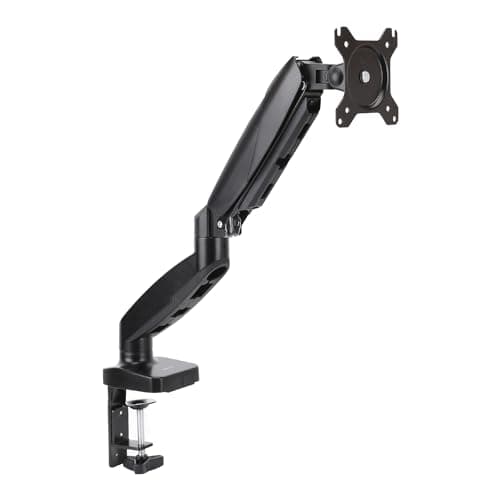
| Can it host a monitor arm? | Not ideally — clamping near a hinge | No — use a wall mount for the screen instead |
| Moves with you | Easily | Unmount, patch, remount |
Where each one actually wins
A folding desk wins in a shared or multi-use room— a bedroom that has to be a bedroom at 7pm, a living room where the desk is set up for a few hours a day. It also wins for anyone who moves often, because it is a suitcase, not an installation. The catch nobody mentions is storage: a folded 31-inch desk still needs a gap behind a door, beside a wardrobe or under a bed. Measure that gap before you buy, or the desk simply never gets folded.
A wall-mounted fold-down wins in a hallway, alcove or kitchen corner where there is a wall but genuinely no floor. Closed, it is a shallow box; open, it is a work surface. The real constraints are the fixings and the load: what a fold-down desk can carry is decided by what your wall can carry, so studs matter, drywall-only mounting does not count for a work surface, and a heavy monitor is a bad idea. Our wall-mounted and folding desk roundup covers the mounting question per model, and the renter-friendly guide covers what you can get away with in a rental.
What about the screen?
This is the question that decides it for a lot of people. Neither of these desks is a good host for a clamp-on monitor arm— a folding desk puts hinges where the clamp load goes, and a fold-down desk has to be able to fold. If you run an external monitor daily, either accept a laptop-only setup on these desks, put the screen on a wall-mounted arm beside the desk, or buy a conventional narrow desk that can take a clamp. That third option is the one most people are happiest with long-term.