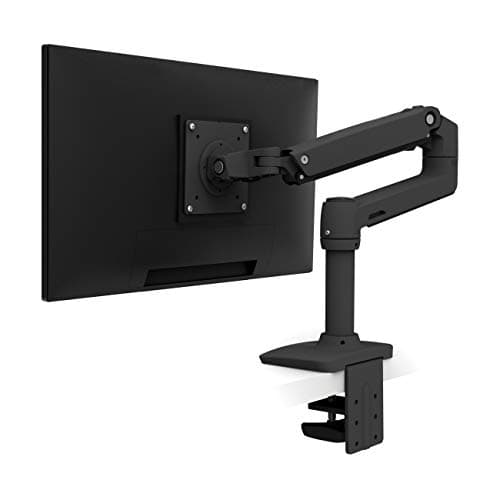
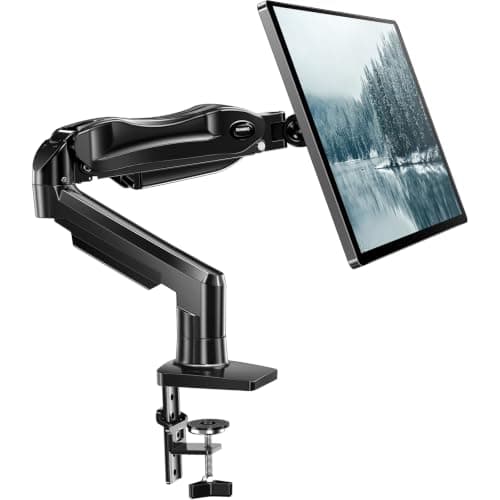
Almost every monitor arm sold ships with two mounting bases: a C-clamp that grips the desk edge like a workbench vise, and a grommet mountthat passes a bolt down through a hole in the desktop and clamps from underneath. Most people fit the clamp because it needs no hole and never think about it again. On a solid desk, that is fine. On a thin, hollow-core or laminate top — which describes most compact desks — the choice is the difference between a mount that holds for years and a dented desktop.
The short answer
Use the clamp if your desk is solid, between roughly 0.6 and 3 inches thick, you are renting, or you expect to move the arm. Use the grommetif your desk already has a cable hole, if the top is thin or hollow-core, if the screen is heavy, or if the arm will be at full extension — a grommet spreads load through the desktop instead of pinching a narrow strip of its edge.
The decision table
| Factor | C-clamp | Grommet |
|---|
| Hole required | None | Yes — existing or drilled |
| Typical desk thickness | 0.4–3.4 in depending on model | Usually up to ~2.2 in |
| Load spreading | Pinches a narrow strip of edge | Spreads through the top |
| Stability at full reach | Good | Better |
| Risk to a thin top | Denting or crushing | Low |
| Renter / reversible | Fully — leaves no mark | Only if the hole already exists |
| Repositioning | Move anywhere along the edge | Fixed at the hole |
| Rear clearance needed | Yes — for the clamp block | Minimal |
Why the load-spreading row matters most
A clamp concentrates the entire holding force into two small pads pressing on maybe two square inches of desk edge. On solid wood or a thick laminate top, that is no problem. On a hollow-core desk — a thin veneer over a cardboard honeycomb, which is how a lot of budget desks are built — those pads sit over an unsupported void, and a 17 lb screen on a 20-inch arm can crush the surface. The dent appears slowly, so it is usually blamed on the arm.
A grommet bolt passes through the desktop with a wide washer or plate on each face, so the load is carried by the full thickness of the material over a much larger area. That is the right answer whenever the top is questionable. If your desk has no hole and you are willing to drill one, a 1.5–2in hole saw through a laminate top is a five-minute job — but obviously not in a rental, and not in a desk you might resell.
The renter case
A clamp is completely reversible: unscrew the wing nut and the desk is exactly as it was. That is why our no-drill monitor arm picks are all clamp mounts, and why the clamp is the default recommendation for anyone whose desk came with the apartment. If a clamp is not safe on your desk and you cannot drill it, the remaining options are a wall-mounted arm or a freestanding stand — not a tighter clamp.
Three checks before you fit either
- Thickness.Measure your desktop and compare it against the arm’s published range. Note that the clamp and grommet ranges usually differ on the same arm — the ErGear here fits 0.39–2.76in by clamp but only 0.39–2.17in by grommet.
- Clearance.A clamp needs a few inches of clear space behind the desk for the block, and nothing underneath the edge — no drawer box, apron or cross-rail.
- What the top is made of. Tap it. A solid sound means solid material; a hollow one means a honeycomb core, and you want the grommet or a load-spreading plate. More detail in will a monitor arm fit my desk.
How to decide in one minute
- Does your desk already have a cable hole? If yes, and the arm fits it, use the grommet. It is the better mount and it costs you nothing.
- Are you renting, or is the desk not yours? Clamp. It leaves no trace.
- Tap the desktop. Hollow sound plus a heavy screen? Grommet, or a load-spreading plate under the clamp.
- Is there anything under the front edge? A drawer box, apron or rail blocks a clamp. Grommet, or a different mounting point.
The middle option people forget
If a clamp is your only choice but the top is marginal, spread the load rather than abandoning the mount. A flat steel plate or a large fender washer between the clamp pad and the desk surface distributes pressure over several times the area, which is often enough to make a thin laminate top safe. It costs a couple of dollars and it is what we would do before giving up on a clamp.
Neither works? Then the desk is the problem
Glass tops, very thin tops and desks with a full-width rear rail defeat both bases. Do not force it. The alternatives are a wall-mounted arm, which takes the desk out of the equation completely and frees even more surface, or a freestanding stand that needs no fixing at all. If neither appeals, a riser lifts the screen without asking anything of the desk edge.