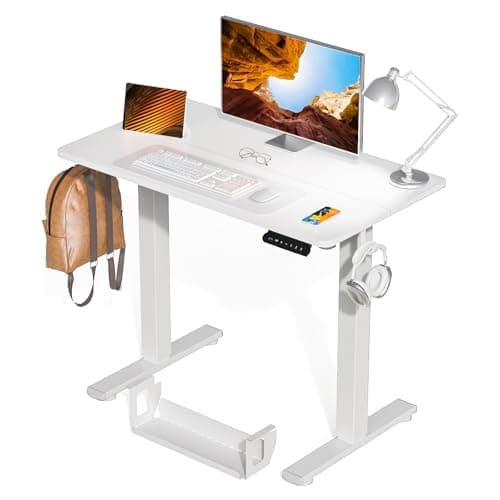
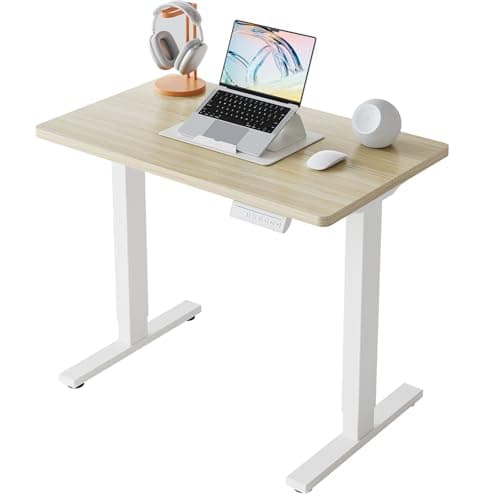
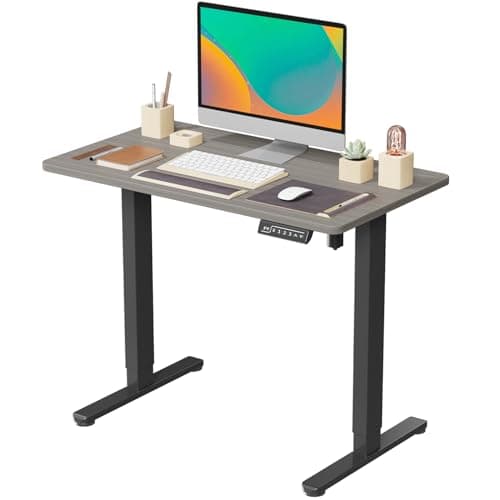
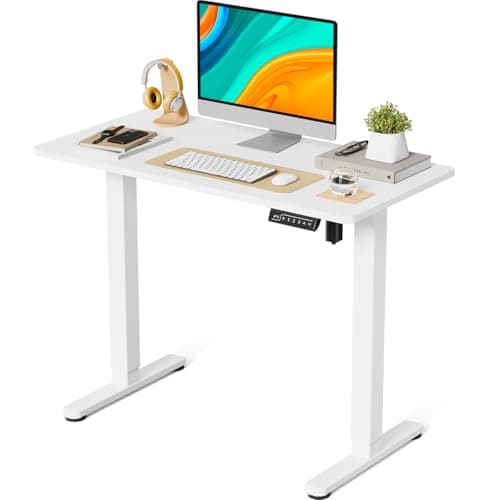
Almost every compact standing desk is 24 inches deep. That is the number the category settled on, and it is the number that keeps a sit/stand desk out of a hallway, a tight bedroom or the short wall of a studio. Our small standing desks page shrinks the width to 40 to 48 inches, but every pick on it is still 24 inches front to back. This page is for the other dimension: electric sit/stand desks that stop at 19 or 20 inches deep.
Four inches of depth sounds like nothing until you stand in the room. A desk against a wall claims its own depth plus the space to sit and stand behind it; the desk size guide puts that at roughly 24 inches at foot level for the chair alone. Take four inches off the desk and the whole chair zone moves four inches toward the wall, which in a 10-foot room is the difference between a walkway and a squeeze. It is the same trade our narrow desks page makes with fixed desks at 15.5 to 19.7 inches deep; this is the sit/stand version, and it does not go as thin, because a lifting column needs a wide enough foot to stay stable at 46 inches.
What separates the five desks here, in the order it matters:
- Width against your wall run. The depth is nearly identical across the field (19 to 20 inches), so width is the number you measure for: 32, 35 or 39.4 inches here. Measure the wall at about 29 inches off the floor, where baseboards, sills and plugged-in outlets steal inches.
- One piece or two. At this price most tops ship as two boards that bolt together under a strip, and the seam runs across the middle of the desk. Two of the picks here publish a whole-piece top; one publishes a two-piece top; two do not say. We rank a published one-piece top above an unstated one, because on a 19.7-inch-deep desk the seam sits exactly where the keyboard goes.
- What is published. Height range, load rating, lift-cycle testing and a noise figure. Every desk here publishes a height range and a load rating; the cycle tests run 50,000 to 60,000 where stated, and two makers state nothing. Warranty is the other gap: one maker publishes a real term, four publish none on their listings.
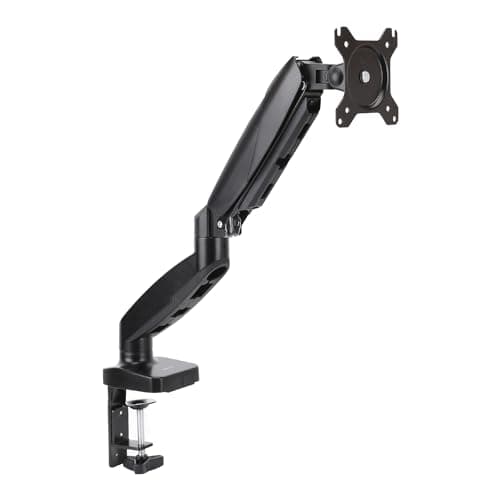
- The rear edge.A 19-to-20-inch desk needs the monitor on an arm, not on a stand — the monitor size and distance guide shows a 20-inch-deep desk takes a 22-inch screen on its stand but a 24-inch screen on an arm, because the arm holds the panel behind the desk line and removes the base. So the back edge has to accept a clamp: 2 to 3 inches of clear overhang with no crossbar under it. One desk here publishes that its rear edge is built for a C-clamp; the others need the check in will a monitor arm fit my desk.
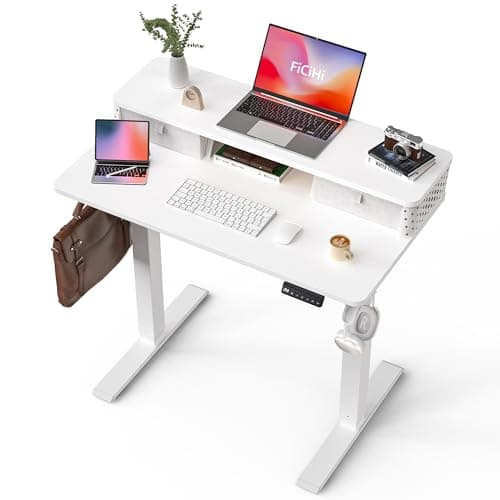
Our pick is the JOY worker 40-inch whole-piece desk, the widest top you can get at 19.7 inches deep with no seam in it. The Kingant 35 by 20 is the value pick with the highest published rating on the page. The FiCiHi 35 by 20 is the only one with drawers, the lowest minimum height and a rear edge built for a clamp. The HUANUO 32 by 19 is the desk for a 32-inch gap, and the only one with a published multi-year warranty. The JOY worker 35-inch whole-piece is the same one-piece construction as our pick, a foot narrower. Live prices below; the methodology explains the scoring.
The published numbers, side by side
| Desk | Top | Height range | Load | Testing / noise | Warranty |
|---|
| JOY worker 40″ | 39.4 × 19.7 in, one piece | 28.3–46.5 in | 176 lb | Not stated / <50 dB | None listed |
| Kingant 35 × 20 | 35 × 20 in, not stated | 28.3–46.5 in | 180 lb | 60,000 cycles / <45 dB | None listed |
| FiCiHi 35 × 20 | 35 × 20 in, clamp-ready rear edge | 27.9–46.9 in | 154 lb | 50,000 cycles / <55 dB | None listed |
| HUANUO 32 × 19 | 32 × 19 in, two-piece | 28.3–46.5 in | 176 lb | 50,000 cycles / not stated | 2 yr motor, 5 yr frame |
| JOY worker 35″ | 34.6 × 19.7 in, one piece | 28.3–46.5 in | 176 lb | Not stated / <50 dB | None listed |
Read the table for what is the same before what is different. Four of the five share the same 28.3-to-46.5-inch range and a 176-to-180-pound rating, which tells you they are built on the same class of single-column frame; the FiCiHi's range is the one outlier, and it buys that with a lower rating. So the decision is mostly about the top — how wide, and whether it has a seam — and about what each maker was willing to write down. Every cycle-count and decibel figure above is a manufacturer claim we have not measured, and we score the fact that a number was published, not the number.
Why depth, not width, decides the room
Width is the measurement everyone takes. Depth is the one that changes how the room walks. A desk needs its own depth plus the chair zone behind it, and the room-size guide works from about 36 inches behind the desk edge to stand up comfortably. A 24-inch desk therefore claims roughly five feet from the wall; a 20-inch desk claims four inches less. In a bedroom where the bed is fixed and the door swing is fixed, those four inches are frequently the only ones available.
The same arithmetic runs at standing height, where the desk is a tall narrow object. The standing desk in a small roomguide covers what changes when a desk goes up — the monitor on an arm can reach 65 to 70 inches from the floor, and the cables need about 18 inches of slack. A shallower desk does not change any of that; what it changes is that the desk no longer blocks the path past it while it is up.
At 20 inches deep, the monitor goes on an arm
This is the rule the page is built around. A monitor on its factory stand needs 8 to 10 inches of desk under the base, and the panel sits forward of that, so on a 20-inch top a 24-inch screen ends up closer than the 22-to-26-inch viewing distance it wants. On an arm the base is gone and the panel can sit at or behind the rear edge. Our screen size and distance table gives 18 to 20 inches of depth for a 22-inch screen on a stand, and the same depth for a 24-inch screen on an arm; a 27-inch screen wants 22 to 24 inches even on an arm, which rules it out on every desk here.
That makes the rear edge a specification, and it is one most listings ignore. A C-clamp needs 2 to 3 inches of clear overhang and no crossbar or control box in the way; on a shallow top there is less spare surface to absorb a clamp that has to sit forward of the edge. The FiCiHi is the one desk here that states its rear extension is built for a clamp. For the others, run the five checks in will a monitor arm fit my desk when the desk arrives, and choose the arm from monitor arms for standing desks, which are ranked on clamp range at both ends of a sit-stand frame. If the edge fails the check, a grommet mount through the top is the fallback, and the desk-thickness ranges for that are in desk thickness for clamp-on gear.
The seam, and why we rank it
Almost every electric desk at this price ships its top as two boards, joined underneath by a strip and a row of screws, because two short boards ship in a smaller box than one long one. On a 24-inch-deep, 48-inch-wide desk the seam runs across the middle and the keyboard sits in front of it. On a 20-inch-deep desk there is no “in front of it” — the seam is under your wrists. That is why a published one-piece top is the first thing we ranked on after width, and why the two JOY worker desks score where they do. The Kingant and the FiCiHi do not state their construction; the HUANUO's retailer listing states two-piece. If a listing does not say, assume two.
Every one of these is too high for a shorter user to sit at
The minimum heights here are 27.9 to 28.3 inches, and the desk height guideputs the seated target for a user around 5′4″ at roughly 25 to 26 inches. A 28-inch floor is a 5′10″ desk. If that is you, the fix is the same as for every other budget sit/stand frame: an under-desk keyboard tray to bring the typing surface down, or a raised chair with an under-desk footrest. A tray on a 20-inch-deep top needs the same rear-edge honesty as an arm: check the tray's clamp depth against what is left of the underside once the frame rail is under it. The desks that publish a genuinely lower floor are ranked in standing desks for short people, and all of them are 24 inches deep.
Shallow standing desk or a narrow fixed desk?
A fixed narrow desk goes thinner: 15.5 to 16 inches deep is common, and the narrow desks roundup ranks five at that depth. An electric frame cannot follow it there, because the foot has to be wide enough to hold a 46-inch-tall desk steady, which is why the shallow sit/stand class bottoms out around 19 inches. So the decision is honest: if the last four inches of walkway matter more than standing, buy the fixed desk and add a small converter later; if standing matters more, 19 to 20 inches is the floor, and this page is the field.
What we checked and did not rank
- ErGear 31 by 19.The same manufacturer part family as the HUANUO (ESD01B against ESD01N), with four presets and a claimed 100,000-cycle test, but the listing publishes no load rating at all, and a desk you cannot check against a monitor arm's weight is not one we will rank.
- FEZIBO 32 by 19.A well-known brand with a published 176-pound rating, 50,000-cycle test and a stated splice top, at the same width and depth as the HUANUO. It lost the slot on presets and warranty: three presets against the HUANUO's four, and no multi-year warranty we could find published for it against HUANUO's two and five.
- JOY worker 31.5-inch whole-piece. The same one-piece construction and frame as the two ranked JOY workers, half an inch narrower than the HUANUO, and priced above the 35-inch version when we checked. Worth knowing about if a one-piece top at 32 inches is the exact requirement.
- ExaDesk 35 by 20. Sold on the small-space angle, but the listing publishes no height range and no load rating. We do not fill those in.
- LongKe 32 by 20. The cheapest shallow electric desk we found, showing limited stock at the time of checking; we do not feature a product we cannot confirm is reliably purchasable.
- KLUVIS 32-inch. Already ranked on small standing desks under $200, and at 23.6 inches deep it is not a shallow desk despite the narrow width.