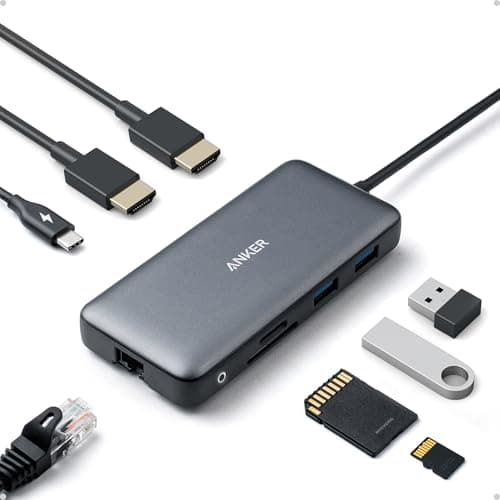
On a small desk, cable clutter is a space problem rather than an aesthetic one. Five leads to a laptop means five things to unplug when the desk becomes a dining table, five things draped over the back edge, and a bundle that fouls the desk every time it moves. A USB-C dock collapses that into one cable: video to the monitor, power to the laptop, data to the peripherals and often Ethernet, all through a single connector.
Two specifications decide which one you need. Power delivery— whether the dock charges the laptop through the same cable, and at what wattage. Without it, you still need the laptop's own charger and the “one cable” promise is two. And display support— how many external screens, at what resolution and refresh rate. Dual-display support in particular depends on your laptop as much as on the dock, and we explain why below.
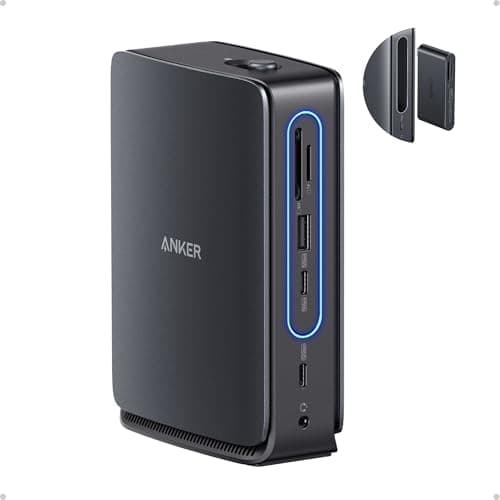
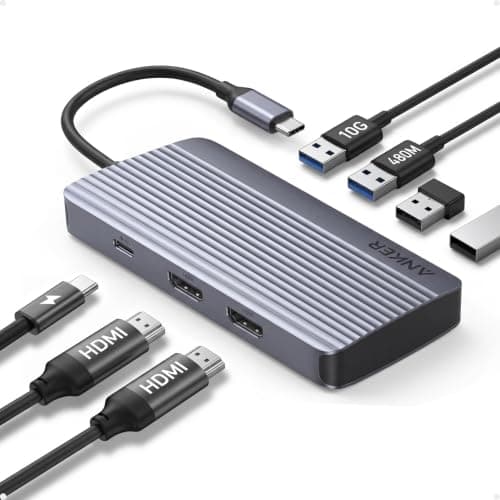
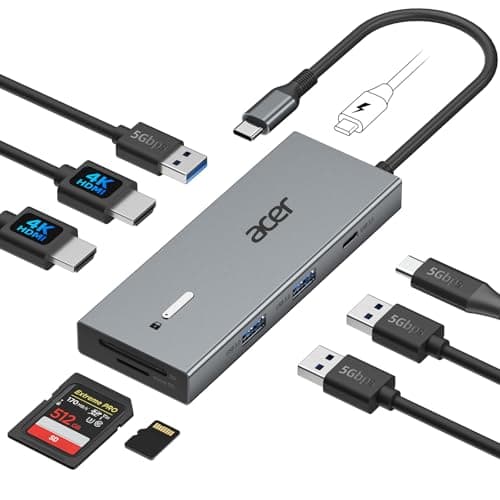
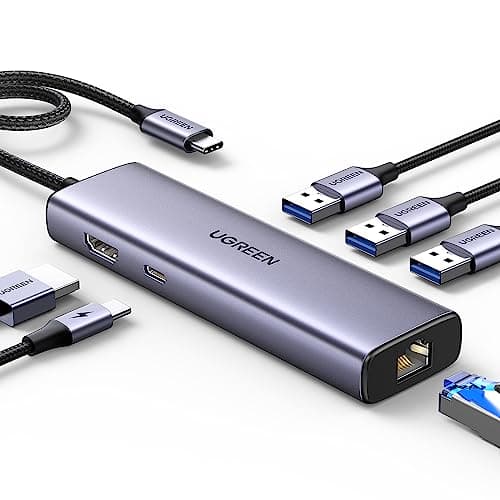
Our pick is the Anker 8-in-1 dual-monitor dock for the balance of ports and price. The Anker Nano 13-in-1 is the full-fat option with a detachable travel hub, the Anker 7-in-1 is the budget dual-display pick, the Acer 9-in-1 has two HDMI outputs, and the UGREEN Revodok is the compact single-display choice. Live prices below; the methodology explains the scoring.
Check your laptop first, not the dock
Two capabilities live in the computer rather than in the dock, and getting this wrong is the main reason docks get returned.
- Does the USB-C port carry video?Not all do. The port needs DisplayPort Alt Mode, and manufacturers do not always label it. If your laptop's USB-C port does not carry video, no ordinary dock will produce a picture from it.
- Does it charge over USB-C?Again, not all do, and a machine that charges only through a barrel connector will always need its own charger regardless of the dock's power delivery.
- How many independent displays does it support? This is the one that surprises people. Many Windows laptops support two external displays over one USB-C connection; base-model Apple Silicon MacBooks have historically supported only one external display natively, and docks that appear to do more use DisplayLink software rather than the port itself. Check your specific machine before buying a dual-display dock for it.
Bus-powered hub or mains-powered dock?
| Bus-powered hub | Mains-powered dock |
|---|
| Charges the laptop | Only by passing through your own charger | Yes, at its rated wattage |
| Cables to the wall | One (your laptop charger, into the hub) | One (the dock's own supply) |
| Desk footprint | Tiny — hides behind a stand | A visible object plus a power brick |
| Powers external drives | Marginally | Reliably |
On a small desk the hub form factor usually wins, because it hides. Take the mains-powered dock if you run bus-powered external drives, need full charging speed, or want to unplug exactly one cable when the desk changes jobs.
Where the dock should physically live
Not on the desktop. A dock is a small heavy object with cables radiating from it, which is the definition of clutter. The three good positions are: behind a monitor riser, where the riser hides it; adhesive-mounted under the desk near the back edge, which is the tidiest and takes two minutes; or on the underside of a wall shelf. Whichever you choose, the run to the laptop should be a short cable, and the run to the wall should go down through a cable channel rather than across the floor.
What a dock does for a small desk specifically
Three things beyond the cable count. It makes a vertical laptop dockpractical, since a closed laptop on its edge with one cable is tidy and the same laptop with five is not. It lets you buy a cheaper monitor, because HDMI plus a dock costs far less than a USB-C display and works with any screen you buy later — see our monitor picks. And it makes a folding or rolling desk genuinely usable, because packing the desk away becomes unplugging one connector.
Ethernet is the underrated port
In a flat with shared Wi-Fi and a router two rooms away, a Gigabit Ethernet port on the dock is often the single biggest improvement in daily working experience — calls stop dropping, large files stop stalling. Most laptops no longer have an Ethernet socket, so the dock is how you get one back. If your desk is anywhere near the router, run a cable; it is the cheapest performance upgrade in this entire category.