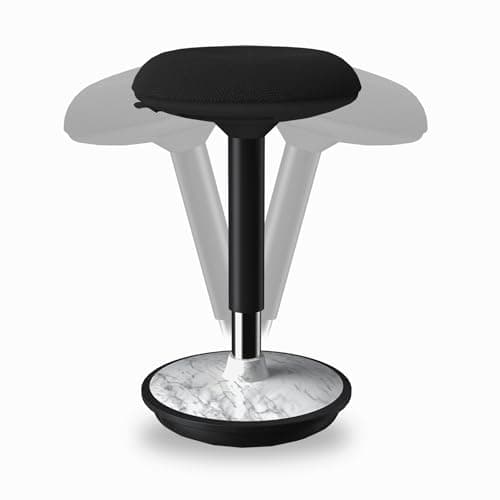
The problem a standing desk stool solves is not standing. It is the ten minutes after standing, when your legs have had enough, the chair is across the room, and the desk comes back down to sitting height because that is easier than fetching it. A stool that lives under the desk at perching height removes that decision: you lean on it, the desk stays up, and you stand again when you are ready.
In a small apartment the stool has to earn its floor space, and that is what this page ranks on. A five-star office chair base runs 24 to 26 inches across, as our chair fit guide explains; every stool here sits on a base between 13 and about 17.7 inches, which is the whole reason the category exists for a small room. Beyond that, four numbers decide which one:
- Seat-height range against your desk.A standing desk lands roughly 38–40 inches high for a 5′8″ user and 42–44 for someone at 6′2″, per the desk height guide. A perched seat sits well below that, but higher than a chair, because your thighs slope down instead of sitting level. The stools here top out between 29 and 34.6 inches, and that spread matters: the Vari and the Backerz stop at 29 and 31 inches, which is a perch for a shorter user or a low converter and a sit for everyone else. The Mount-It! reaches 34.6.
- Base footprint, and what it is made of.The listing dimensions run from 13 by 13 inches (ERGO COLLECT) to 17.7 by 16.1 (IWMH). Every pick has a rubber or silicone base rather than casters, which is the renter's detail: nothing rolls, and nothing marks a laminate floor the way hard nylon casters do.
- Published capacity. Three of the five publish a load rating (220, 248, 275 and 300 pounds appear on this page). Two do not, and we say so on the pick rather than filling the gap.
- Weight, because you will carry it. A stool that is used at a standing desk and then parked in a closet, or moved to the kitchen table on a pack-down day, gets lifted a lot. The published weights here run from 11.9 pounds to 17.6, and one maker publishes nothing.
There is a research reason to want one of these, and it is narrower than the listings suggest. Cornell's ergonomics group is blunt that “standing all day is unhealthy” and that “simply standing is insufficient” — the recommendation is to sit, then “every 20 minutes stand for 8 minutes AND MOVE for 2 minutes.” A 2016 study in Applied Ergonomicsfrom Ohio State's Spine Research Institute compared seated, standing and perching workstations and found the perching posture produced lower loads on the low back than standing while still allowing more postural movement than a chair. A perch stool is not a replacement for a chair, and it is not a way to stand longer. It is the third posture, for the part of the day where the other two have both run out.
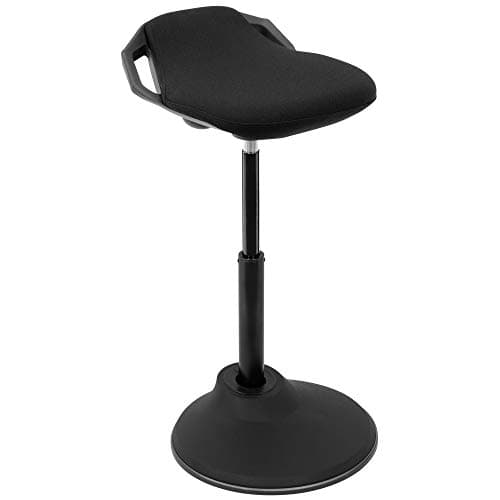
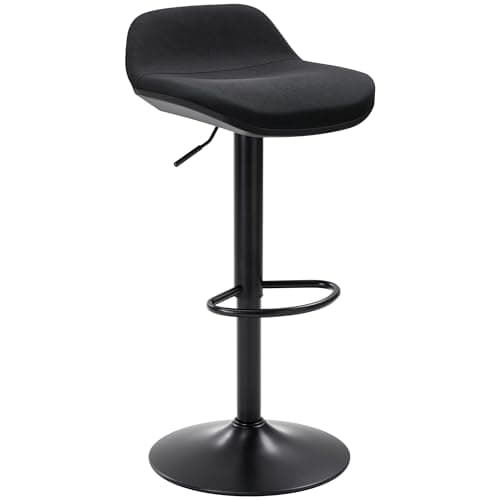
Our pick is the ERGO COLLECT wobble stool: the smallest base on the page, the lightest to carry, the highest published capacity and a 9.8-inch height range that covers a real perch. The Mount-It! MI-931 reaches higher than anything else here and carries a lifetime warranty, for a price. The IWMH D05M011 is the cheapest and the only one with a backrest and footrest. The Vari Balance Stool publishes every number, including a BIFMA durability test, but stops at 29 inches. The Backerz is the pick for a shorter user or a low converter. Live prices below; the methodology explains the scoring.
The published numbers, side by side
| Stool | Seat height | Base | Capacity | Weight | Motion |
|---|
| ERGO COLLECT HKOC02100 | 22.8–32.6 in | 13 × 13 in | 300 lb (maker claim) | 11.9 lb | Rocking, rubber feet |
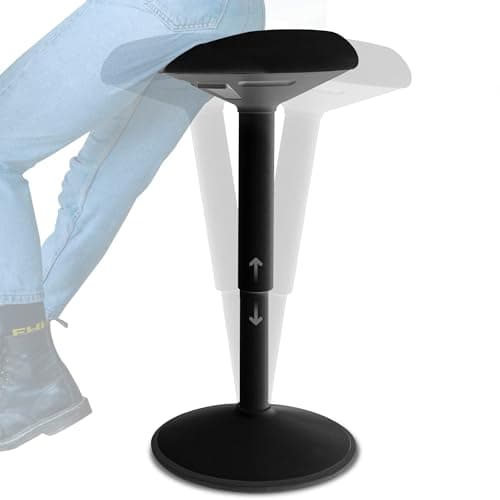
| Mount-It! MI-931 | 24.8–34.6 in | ~15 × 16 in (listing) | 248 lb | Not published | 360° tilt, weighted base |
| IWMH D05M011 | 25.6–33.5 in | 17.7 × 16.1 in | Not published | 17.6 lb | Fixed swivel, backrest + footrest |
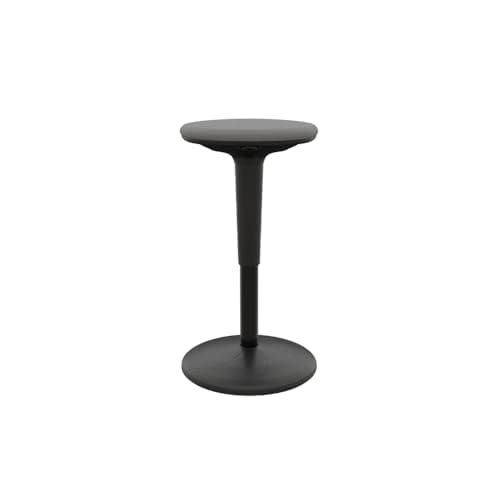
| Vari Balance Stool | 22–29 in | 15.5 in dia. | 275 lb (BIFMA X5.1) | 16.1 lb | 10° tilt, rocking base |
| Backerz 21–31 | 21–31 in | 13.8 × 13.8 in | 220 lb (this listing) | 13.2 lb | Rocking, rubber footplate |
Two things stand out. The top of the height range is the number to read first, and it is the one most listings bury: the spread from 29 to 34.6 inches is the difference between a stool you can perch on at full standing height and one you can only sit on. And the footprint column is why any of these belong in a small room at all. The largest base here, the IWMH at 17.7 inches, is still six to eight inches narrower than the 24-to-26-inch five-star base under a typical office chair.
Perching is a third posture, not a longer stand
The category is sold as a way to stand longer. The research says something more useful. The 2016 Ohio State study in Applied Ergonomicsput the same people through seated, standing and perching workstations and found that perching kept spinal loads below what standing produced, while still allowing more postural shifting than a chair. Cornell's sit-stand guidance, meanwhile, is that “standing all day is unhealthy” and that the goal is variety — sit, stand for a while, move for a couple of minutes, repeat.
Read together, that means a stool earns its place as the posture between the other two. Use it when your legs are done but the desk is still up, and then get off it. The wobble and tilt bases exist to keep you shifting rather than settling, which is also why the fixed-swivel IWMH scores as a chair here rather than as a perch. None of this makes a stool a substitute for a real chair over a full day; the small office chairs page is where that decision lives.
How to find your perch height
No maker publishes a table of desk height to perch height, and we are not going to invent one. The method that works uses the desk you already have set up:
- Set the desk first. Put it at your standing height using the elbow rule in the desk height guide: forearms level, desktop an inch or two below the elbow.
- Then raise the stool until the desk still fits. Sit back onto the seat with your feet flat and your thighs sloping down. If your elbows now land above the desktop, the seat is too high; if you have to reach up, it is too low. The right seat height is whatever keeps the elbow rule true with the desk left where it was.
- Check the floor and the base. Both feet should reach the floor with weight on them. If they dangle, you are sitting on a bar stool, not perching, and the base is taking your whole weight on a rocking surface.
That is why the top of the range matters. A taller user at a 42-inch desk will run out of stool on the Vari and the Backerz before the elbow rule is satisfied; the Mount-It! and the ERGO COLLECT have the headroom. A shorter user at a 36-to-38-inch desk, or anyone on a converter at a mid-rise, is inside every range on the page and can choose on footprint and price instead.
Floors, casters and the deposit
Every stool here sits on rubber or silicone rather than wheels, and in a rental that is the feature. Hard nylon casters are what mark laminate and engineered wood, which is the whole subject of our chair wheels page; a stool with a grip base has no casters to swap. The trade is that it does not roll: you lift it to move it, which is why product weight is a ranking column and why the Mount-It!'s side handles are worth more than they look. If the floor under your desk is also where an anti-fatigue matlives, set the stool beside the mat, not on it — a rocking base on a soft mat is a different and worse kind of wobble.
Where it lives when you are standing
The small-room question is not the stool's footprint while you are on it but where it goes when you are not. At minimum height every pick here is between 21 and 25.6 inches tall, which tucks under a desk raised to standing height with room to spare, and under most desks at sitting height too — check your desk's underside clearance against the stool's minimum before assuming. The other option is the closet: at 11.9 to 17.6 pounds and three parts, most of these break down and pack flatter than any chair, which is why they also show up in our moving-friendly desk gear thinking. The five realities of running a standing desk in a tight room, including the roughly 18 inches of cable slack the desk needs, are in standing desk in a small room.
What we checked and did not rank
- Learniture Active Learning Stool.A well-documented wobble stool (265 lb rating, 12.6-inch seat, 13-by-13 base) whose 18.5-to-28-inch range stops an inch below the Vari's. It is a classroom seat at desk height, not a perch for a raised desk.
- ERGO COLLECT HKOC02103 (the 440 lb version). A higher rating and a 15.7-inch silicone base, but a 19.7-to-27.5-inch range, which is a sitting stool. The HKOC02100 ranked above is the one with standing-desk height.
- IWMH saddle wobble stool. A 13-inch base and a 25.8-to-32.9-inch range, but the listing publishes no weight capacity and lists 20.3 pounds, the heaviest on the shortlist. The IWMH with the backrest was the stronger IWMH.
- Uncaged Ergonomics Wobble Stool and Tervo Model W.Both are established names in this category, and both showed limited stock (“only 5 left” and “only 11 left”) when we checked availability. We do not feature a product we cannot confirm is reliably purchasable.
- Yonsaeik standing stool. A 250 lb rating and a weighted base, but the listing publishes no seat-height range, which is the first number this page ranks on.