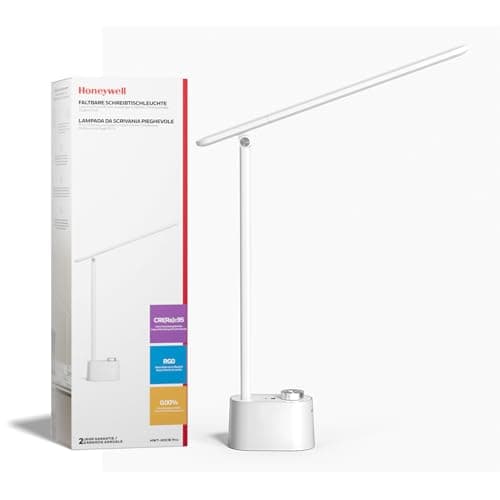
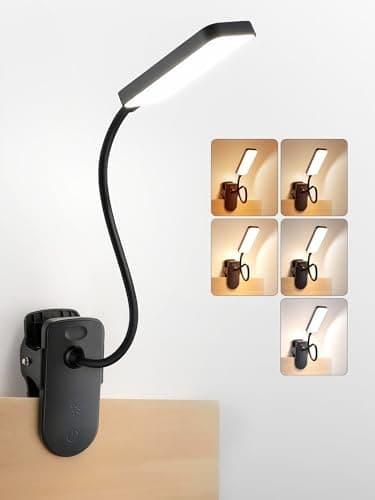
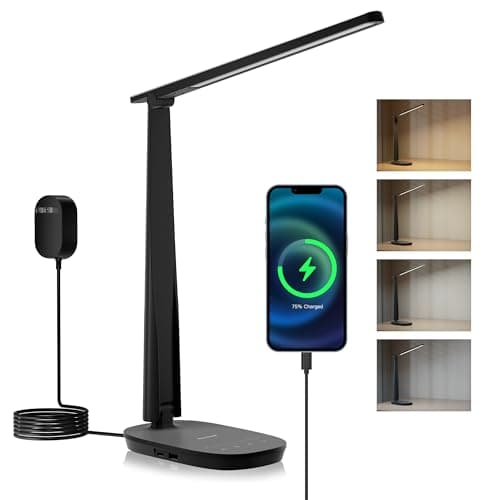
Almost everyone who describes tired eyes at a desk is describing the same physical situation: a bright screen surrounded by a much darker room. Your pupils spend the day adjusting between the two, and the muscles that do it get tired. That is the strain, and it is a lighting problem before it is a screen problem — which is good news, because it is fixable for the price of a lamp.
Three lamp specifications address it directly. Where the light goes: a lamp that puts light on the desk without reflecting off the screen raises the surrounding brightness and lowers the contrast ratio your eyes have to bridge. Flicker: cheap LED drivers pulse at mains frequency, which some people perceive as fatigue rather than as visible flicker. Color rendering: a high-CRI light makes edges and text easier to resolve, so you squint less.
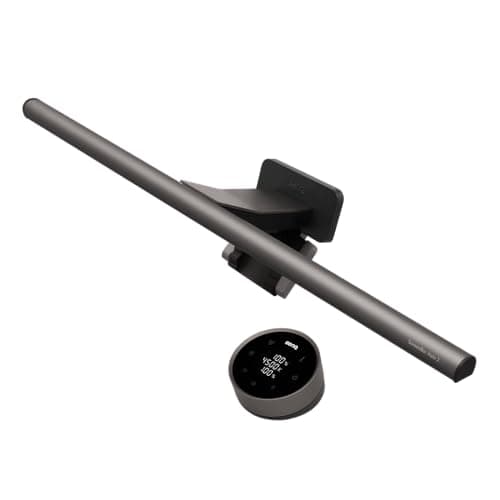
What a lamp cannot fix is the rest of it — screen distance, screen brightness, and the fact that you have not blinked properly since lunch. We cover those below, because the honest answer is that a lamp is one of four things and not the whole answer. Our pick is the BenQ ScreenBar Halo 2, which is the only format here that puts light on the desk and none of it on the screen.
The contrast problem, and the fix
A monitor at a comfortable brightness in a dark room can be many times brighter than the wall behind it. Your pupils cannot be two sizes at once, so they settle somewhere between, and the constant readjustment is what people report as tired, aching eyes by mid-afternoon. The correction is not to dim the screen into uselessness — it is to raise everything else. Light the desk, light the wall behind the monitor, and the ratio your eyes bridge drops sharply.
This is why the BenQ ranks first here despite being a light bar rather than a lamp: its rear glow lights the wall behind the screen, which is the single most effective change you can make. A cheaper version of the same idea is a warm LED stripfixed behind the monitor or under a shelf — bias lighting costs very little and addresses exactly this.
Flicker: what to look for when nothing is published
LEDs are driven by a converter, and cheap converters let mains ripple through as a pulsing output. Most people cannot see it, but sustained exposure to flicker at these frequencies is associated in the published literature with headaches and visual fatigue. Almost no budget listing publishes a flicker figure, so use two proxies. First, prefer lamps with continuous dimming over ones with a few fixed steps — smooth dimming usually implies a constant-current driver rather than crude switching. Second, use the camera on your phone: point it at the lamp at its lowest setting and look for banding on the preview. It is a rough test, not a measurement, but it reliably catches the worst offenders.
What the lamp cannot do
| Cause of strain | Fixed by a lamp? | What actually fixes it |
|---|
| Dark room, bright screen | Yes | Task light plus bias light behind the monitor |
| Reflections on the panel | Partly | Aim the lamp; move the desk out of a window's line |
| Screen too close | No | Correct viewing distance — an arm buys the depth back |
| Not blinking enough | No | Breaks; the 20-20-20 habit |
| Uncorrected vision | No | An optometrist |
Screen distance is the one small-desk buyers most often get wrong, because a shallow desk physically forces the monitor closer than it should be. Our guide on monitor size and viewing distance works out what depth each screen size needs, and a monitor armis often the only way to find it on a 20-inch-deep top — pushing the screen back over the desk edge is exactly what an arm makes possible.
Color temperature through the day
Cool light around 5000–6000K keeps you alert and suits focused daytime work. Warm light around 2700–3000K is more comfortable in the evening and less likely to interfere with winding down. That is why four of the five picks here are tunable; a lamp you set once is a lamp that is wrong for half the day. The full explanation of which number to pick and when is in our color temperature guide.
Brightness: enough, not more
Over-lighting a desk is its own kind of strain. The target is a desk surface bright enough that the screen no longer dominates — not a lamp that makes you squint. Our lumens guide sets out the ranges by task, and the practical rule is simple: dim the lamp until the screen and the desk look like they belong in the same room. That point is usually lower than people expect.