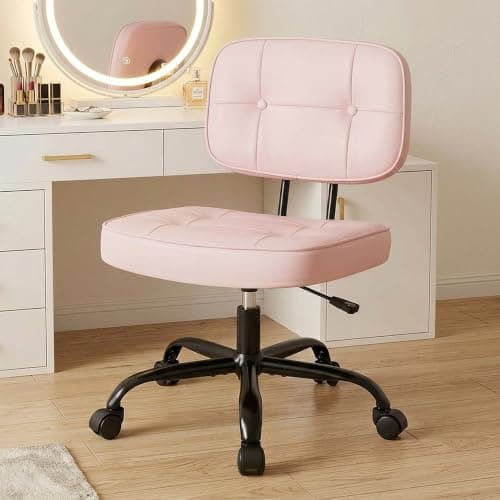
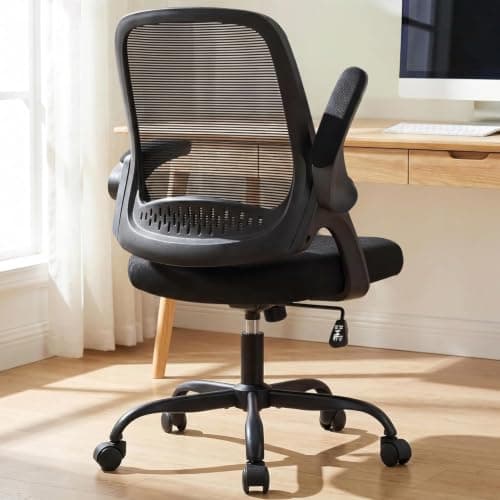
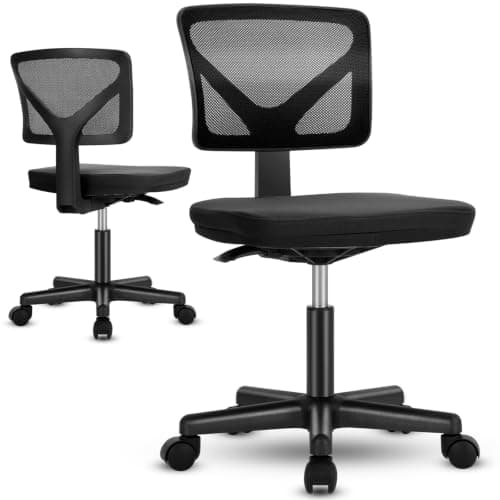
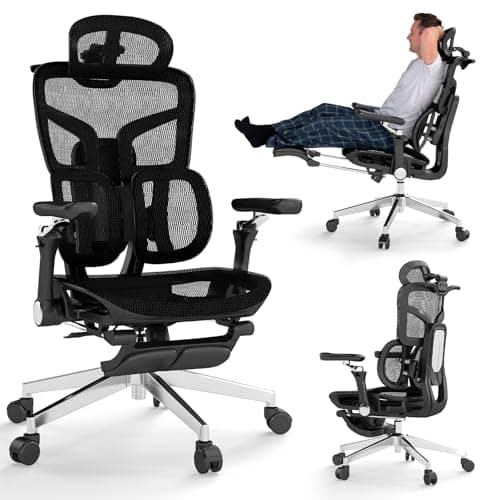
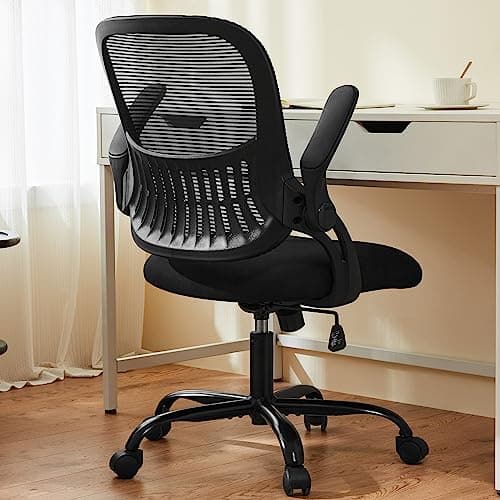
In a small apartment the chair is the piece of furniture that never goes away. The desk can fold, the monitor can go on an arm and the storage can go up the wall — but the chair sits in the room, and if it does not slide fully under the desk when you stand up, it occupies a meter of walkway permanently.
That makes tuck-under the specification that matters most here, and it is decided by the arms. Fixed arms hit the desk edge and stop the chair four to six inches out. Armless chairs and chairs with flip-up arms go all the way in. That single characteristic changes how a small room feels more than any other chair feature, which is why four of the five picks below are armless or flip-arm.
The second specification is the base diameter. A five-star office base is typically wider than the seat, and in a tight corner it is what catches the bed frame or the radiator. And the third, which nobody lists: caster type. Standard hard nylon casters mark laminate and engineered wood, which in a rental is a deposit question. Rubber or polyurethane casters, or a chair mat, are the fix. Live prices below; how we score is published in full.
Measure the tuck, not the chair
The measurement that decides whether a chair works in a small room is how far it protrudes when pushed in as far as it will go. Take three numbers: your desk height to the underside (the apron, not the top), the chair's armrest height, and the seat back depth. If the armrests are higher than the desk underside, the chair stops when they hit — typically four to six inches out, which is exactly enough to block a walkway.
Armless chairs solve this absolutely. Flip-up arms solve it conditionally: the arms have to clear the desk when raised, and an under-desk keyboard tray reduces that clearance, so if you have a tray, measure to the underside of the tray rather than the desk.
What a small chair legitimately gives up, and what it should not
| Feature | Fine to lose | Keep |
|---|
| Headrest | Yes, for desk work | — |
| Fixed armrests | Yes — they are the tuck-under problem | — |
| Recline | Yes, in a small room | — |
| Seat height adjustment | No | Always — it sets your elbow angle |
| Lumbar support | No | Always, if you sit for more than an hour |
Seat height adjustment is the one to defend hardest, because it is what makes the chair match the desk. Our desk height guideworks through the arithmetic: with your feet flat and elbows at about 90 degrees, the desk should meet your forearms. If the desk is fixed and too tall — which most are, and worse if you are short — the chair comes up and an under-desk footrest restores the floor.
Casters, floors and deposits
This is the small-space detail nobody warns renters about. Standard office casters are hard nylon, designed for commercial carpet. On laminate, vinyl or engineered wood they scuff and eventually score the surface, and the damage shows up as a visible arc where the chair moves most. Three fixes, in order of preference: buy a chair with rubber or polyurethane casters; replace the casters, which is a pull-out-push-in job on nearly every office chair and costs very little; or use a chair mat, which works but adds a large object to a small room. In a rental, do one of the three before the arc appears, not after.
The base diameter problem
Five-star bases are wider than they look and they are what catch on a bed frame, a radiator or a wardrobe door. If your desk sits in a corner or an alcove, measure the clear floor width and compare it against the base, not against the seat. This is the same mistake people make with desks, and the sizing guide covers the clearance numbers a workspace needs around it.
When the answer is not an office chair at all
If the desk is used for an hour a day — a hallway console, a bedroom writing desk, a closet office — a dining chair you already own may be the honest answer, and the money is better spent on the things that hurt in an hour: screen height, light and keyboard position. If you work full days, the chair is the wrong place to economize, and the MOJAY above is the pick that reflects that. Do not buy a full-day chair for a two-hour desk, or the other way round.
One more case this page does not solve: if your problem is not the chair’s footprint but whether it will go lowenough, you are asking a different question. Seat height, seat depth and whether your feet reach the floor decide that, and almost no chair in this price band publishes the numbers — we have ranked the ones that do in best office chairs for short people.
And if the desk is a gaming desk, the armrest question changes shape: a fixed armrest at the wrong height is worse than no armrest once your mouse hand travels, which is the case for a flip-up arm over a racing seat’s fixed wings. Gaming desk ergonomics works through that, plus the two other places a gaming setup breaks the standard rules. For the office version of the same sequence, see seated desk ergonomics.