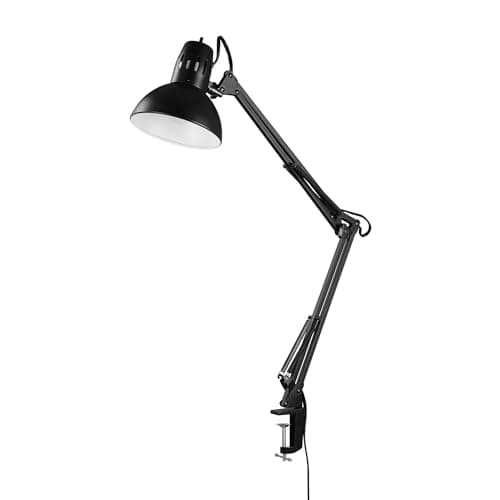
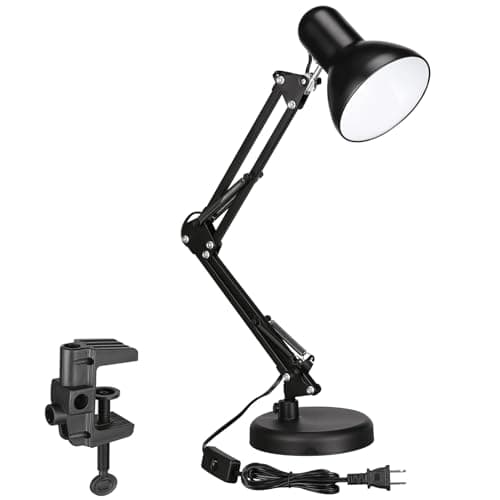
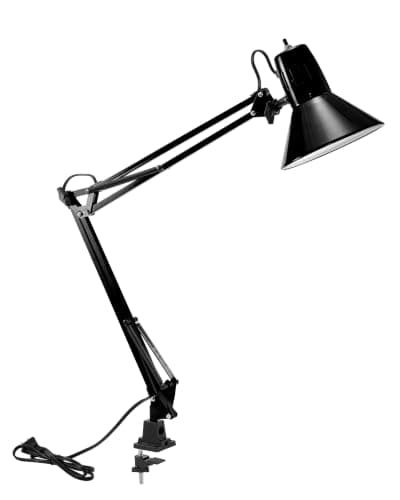
A swing-arm lamp — the architect or draftsman format — solves a problem specific to small desks. A base lamp has to stand somewhere, and on a 40-inch desk the only places it can stand are the places you were going to put something else. A swing-arm lamp clamps at the edge and reaches over the work, so the light arrives from where you want it and the desktop stays empty.
The number that separates these lamps is reach: how far the head travels from the clamp. Anything under about 20 inches lights a book but not a keyboard-and-monitor layout. Around 30 inches covers a 40-inch desk from one side. The Bostitch below publishes 36 inches, which is the most reach in the roundup and enough to light the far corner of a 48-inch desk from a single clamp point.
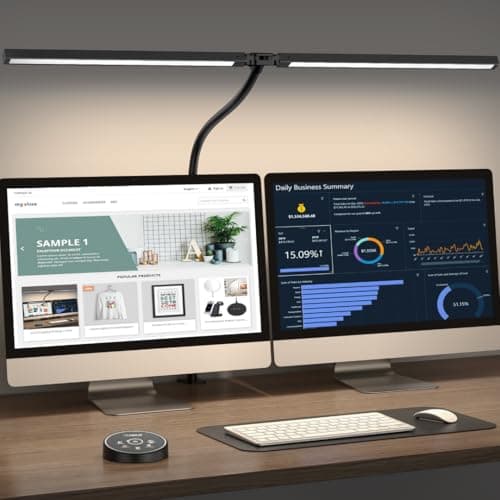
Our pick is the Bostitch VLF100 for that reach at the lowest price here. The Globe Electric Architect is the classic 32-inch arm with an integrated LED, the Pzloz is the wide-head option for a dual-screen desk, the TORCHSTAR takes a standard E26 bulb so you choose the light yourself, and the Globe multi-joint is the one with the most articulation per dollar. Live prices below; how we score is published in full.
Reach is the spec, and almost nobody publishes it properly
The useful measurement is the horizontal distance from the clamp to the center of the head with the arm extended. Manufacturers sometimes quote the sum of the arm sections instead, which flatters the number, because a two-section arm never extends dead straight in practice. Read it as a ceiling rather than a working figure, and match it to your desk:
| Desk width | Reach you want | Why |
|---|
| Up to 32 in | 20–24 in | One clamp at the side covers the whole top |
| 40 in | 28–32 in | Reaches past the monitor to the far side of the keyboard |
| 48 in | 32–36 in | Below this you are lighting half the desk |
Where to clamp it
The instinct is to clamp the lamp at the back of the desk, and it is usually wrong. A lamp behind the monitor throws light forward into your eyes and casts your own shadow over the keyboard. Clamp it at the side, slightly forward of the screen, and aim the head inward and downward across the work. Left side if you are right-handed and vice versa, so your writing hand does not cast a shadow on the page.
Check the clamp's jaw range against your desk before ordering. Most swing-arm clamps take a top somewhere between about half an inch and two and a half inches; a thick solid-wood top or a desk with a lip at the back can fail either end of that. The same thickness question decides monitor arms, and that guide covers how to measure it.
Swing arm, clamp lamp, or light bar?
The three zero-footprint formats do different jobs. A swing arm puts a movable point source above the work: best when you write on paper, do detail work, or want light in one specific place. A clamp gooseneck lampis the compact version — less reach, less money, easier to tuck away; our clamp lamp roundup covers those. A monitor light bar sits on the screen and lights the desk without reflecting off it, which is the format to choose if your work is entirely on screen; see monitor light bars and the direct comparison.
Bulb-your-own versus integrated LED
Two of the lamps here take a standard E26 bulb and the rest have LEDs built in. The trade-off is straightforward. An integrated LED gives you a designed optic, usually some dimming, and a fitting that is dead when the LED is. A socket lamp lets you fit exactly the light you want — a high-CRI bulb for color work, a warm bulb for an evening desk — and outlives any number of bulbs. If you take the socket route, our color temperature guide and lumens guide cover which numbers to buy.
Heat, and the small-room caveat
Architect lamps put the head close to your face, which makes warmth noticeable in a way a ceiling fitting never is. LED heads run far cooler than the incandescent lamps this format was designed around, but a metal shade still gets warm to the touch after an hour. In a small room this is worth knowing before you clamp it a foot from your ear: aim the head so the shade edge is not the thing your temple is next to, and prefer models whose switch is not on the hot part.