Skip to content
Desk & Dowel

HUB 01 · Compact Desks

The Best Small Desks with a Keyboard Tray

A keyboard tray moves the keyboard below the desk, which on a shallow top is the difference between working and perching. Five desks, plus the tray that fits the desk you already have.

By Stephen V.Updated How we pick
#ad

We earn a commission when you buy through our Amazon links, at no extra cost to you. It never affects our rankings, and we say so when the cheaper product is the better buy. How this works.

A keyboard tray is the most underrated feature on a small desk. Moving the keyboard onto a sliding platform below the top does two things at once: it hands back the front six to ten inches of surface, which on a 20-inch-deep desk is most of your usable area, and it drops the typing height by two to four inches — which happens to be exactly the amount the standard 29–30in desk is too tall for most adults.

Our pick is the Bestier 47-inch desk: a sliding tray, a door cabinet for the clutter and an X-frame that resists the wobble a sliding tray otherwise finds. The VERMESS adds a monitor stand and a CPU shelf on the same idea; the Giantex hutch desk is the value option at 35 inches wide; the VECELO is the corner version for a room with no clear wall. And if you already own a desk you like, skip to the VIVO clamp-on tray, which adds the feature for a fraction of a new desk.

Every dimension and rating below is from the manufacturer listing; the methodology covers the scoring. The buying guide under the picks covers the two numbers that decide whether a tray will actually work for you: knee clearance and travel.

The short answer

Quick picks

#ProductBest forScorePrice
01
Bestier Bestier 47in Office Desk with Cabinet & Keyboard Tray
Bestier 47in Office Desk with Cabinet & Keyboard Tray

The best-balanced of the built-in-tray desks: a 47.2 × 21.7in top, a door cabinet that hides the clutter, and an X-frame that keeps the desk still while the tray slides.

Best overall
8.4
$71.99Amazon
02
VERMESS VERMESS 48in Desk with Keyboard Tray & Monitor Stand
VERMESS 48in Desk with Keyboard Tray & Monitor Stand

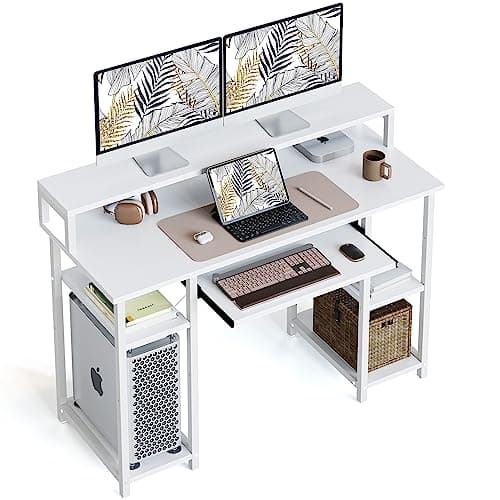
The one that stacks every space-saving trick at once: pull-out tray, a full monitor stand across the back, two storage shelves and a CPU shelf, on adjustable feet.

Best all-in-one
8.2
$115.99Amazon
03
Giantex Giantex White Desk with Hutch & Keyboard Tray
Giantex White Desk with Hutch & Keyboard Tray

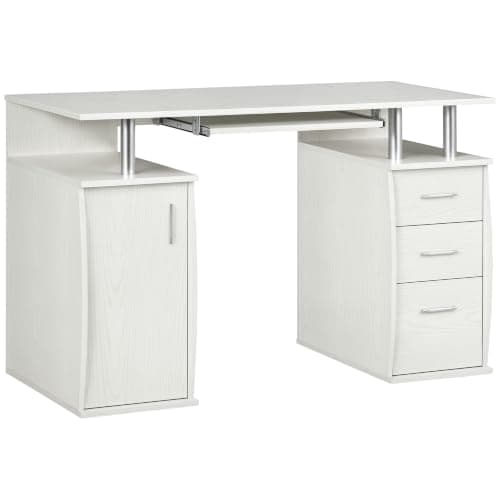
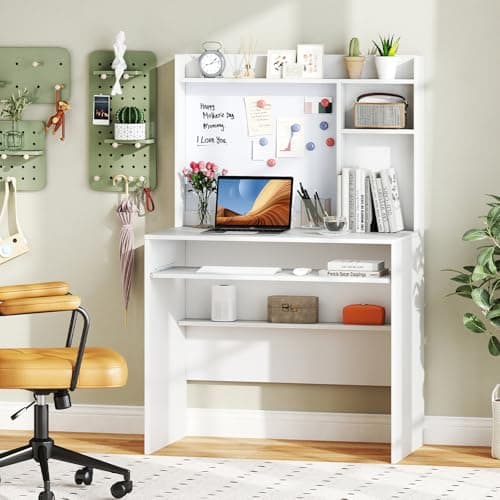
The compact one: 35 inches wide with a pull-out tray, a hutch for vertical storage and published load ratings — 110 lb on the tabletop, 215 lb overall.

Best for a small wall
8.6
$95.00Amazon
04
VECELO VECELO Corner Desk with Keyboard Tray
VECELO Corner Desk with Keyboard Tray

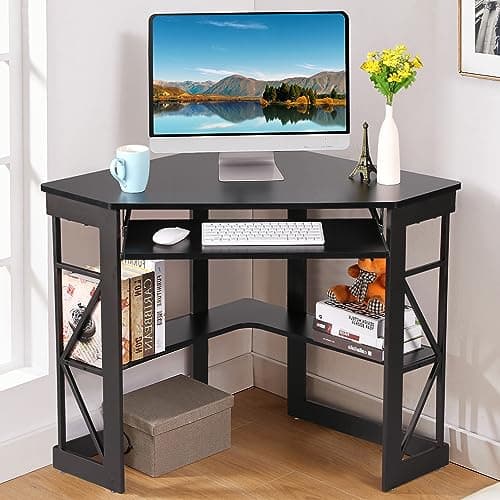
The corner answer: a 41 × 28in triangular top with a smooth tray and two side shelves, which turns the dead corner most small rooms have into the workspace.

Best corner desk
7.8
$99.99Amazon
05
VIVO VIVO Large Clamp-On Keyboard Tray
VIVO Large Clamp-On Keyboard Tray

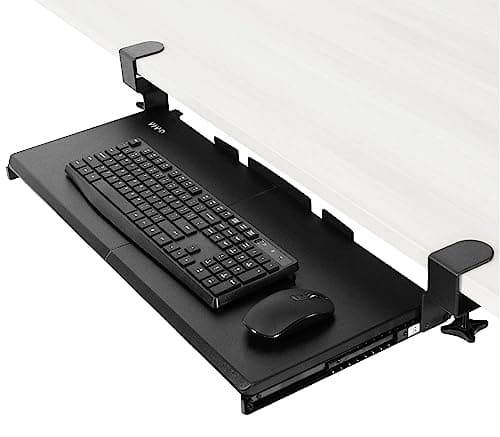
Not a desk — the reason you may not need one. A 26.8 × 11in sliding platform that C-clamps to any desk under 1.25in thick, adding the feature to the desk you already own.

Best retrofit
7.9
$49.99Amazon

#ad · Live prices from the Amazon Product API, as of Aug 12, 2026. Where we have no verified live price we show none — we would rather leave a gap than print a number that has rotted.

In detail

The picks, in full

01
Bestier Bestier 47in Office Desk with Cabinet & Keyboard Tray

Best overall

Bestier 47in Office Desk with Cabinet & Keyboard Tray

Width
47.2 in
Depth
21.7 in
Height
30 in
Storage
Door cabinet + open legroom
Frame
X-braced metal
8.4/10

The best-balanced of the built-in-tray desks: a 47.2 × 21.7in top, a door cabinet that hides the clutter, and an X-frame that keeps the desk still while the tray slides.

Surface freed
8.8
Storage
8.6
Sturdiness
8.4
Footprint
7.4
Value
8.8

Pros

  • Sliding tray frees the front of a 21.7in-deep top
  • Door cabinet hides binders and chargers, unlike open shelving
  • X-frame resists the rocking a sliding tray provokes
  • Fits a bedroom or apartment corner at 47in wide

Cons

  • 64 lb boxed — a two-person carry upstairs
  • Cabinet is fixed to one side, so layout is not reversible

Skip this if…

your wall run is under about four feet. Drop to the 35in Giantex or the VECELO corner desk.

$71.99View on Amazon

$99.9928% off

Price as of Aug 12, 2026. Prices change — Amazon's is the one that counts.

#ad · we may earn a commission from this link to Bestier 47in Office Desk with Cabinet & Keyboard Tray

02
VERMESS VERMESS 48in Desk with Keyboard Tray & Monitor Stand

Best all-in-one

VERMESS 48in Desk with Keyboard Tray & Monitor Stand

Width
47.2 in
Depth
20.9 in
Height
30.3 in
Extras
Monitor stand + CPU shelf
Feet
Adjustable levelers
8.2/10

The one that stacks every space-saving trick at once: pull-out tray, a full monitor stand across the back, two storage shelves and a CPU shelf, on adjustable feet.

Surface freed
9
Storage
8.8
Sturdiness
8
Footprint
7.2
Value
8.2

Pros

  • Tray plus monitor stand — two ways to reclaim the surface
  • CPU shelf keeps the tower off the floor and out of the footwell
  • Adjustable feet stop the rock on uneven apartment floors
  • Metal legs on an MDF top rather than an all-particleboard build

Cons

  • Fixed monitor stand height — no adjustment to your eye level
  • The shelving makes it visually heavy in a small room

Skip this if…

you plan to use a monitor arm. The built-in stand and shelving occupy the back edge an arm needs to clamp to.

$115.99View on Amazon

Price as of Aug 12, 2026. Prices change — Amazon's is the one that counts.

#ad · we may earn a commission from this link to VERMESS 48in Desk with Keyboard Tray & Monitor Stand

03
Giantex Giantex White Desk with Hutch & Keyboard Tray

Best for a small wall

Giantex White Desk with Hutch & Keyboard Tray

Width
35 in
Depth
19.5 in
Height
54.5 in
Tabletop rating
110 lb
Extras
Hutch + magnetic whiteboard
8.6/10

The compact one: 35 inches wide with a pull-out tray, a hutch for vertical storage and published load ratings — 110 lb on the tabletop, 215 lb overall.

Surface freed
8.6
Storage
8.2
Sturdiness
7.8
Footprint
8.8
Value
9.4

Pros

  • Only 35in wide — fits walls the 47in desks cannot
  • Tray matters most here, on the shallowest top in the group
  • Published weight ratings at a budget price
  • Hutch adds storage without adding floor footprint

Cons

  • 19.5in depth is tight for a monitor on its own stand
  • Hutch is open, so storage stays on display

Skip this if…

you want a low-profile desk. The hutch takes this to 54.5 inches tall, which dominates a small bedroom.

$95.00View on Amazon

$129.9927% off

Price as of Aug 12, 2026. Prices change — Amazon's is the one that counts.

#ad · we may earn a commission from this link to Giantex White Desk with Hutch & Keyboard Tray

04
VECELO VECELO Corner Desk with Keyboard Tray

Best corner desk

VECELO Corner Desk with Keyboard Tray

Overall width
41 in
Depth
28 in
Height
30 in
Storage
2 open side shelves
Material
MDF
7.8/10

The corner answer: a 41 × 28in triangular top with a smooth tray and two side shelves, which turns the dead corner most small rooms have into the workspace.

Surface freed
8.4
Storage
7
Sturdiness
7.6
Footprint
8.2
Value
7.8

Pros

  • Uses a corner, which is usually wasted floor in a small room
  • Wide tray leaves room to move between the left and right sides
  • Two side shelves without adding a separate unit
  • Reaches a working area no 40in straight desk can match

Cons

  • 28in of depth at the corner needs the room to give it up
  • MDF top — treat it kindly

Skip this if…

you have a clear wall run. A straight desk gives you more usable width per square foot of floor — see our corner-versus-L comparison.

$99.99View on Amazon

Price as of Aug 12, 2026. Prices change — Amazon's is the one that counts.

#ad · we may earn a commission from this link to VECELO Corner Desk with Keyboard Tray

05
VIVO VIVO Large Clamp-On Keyboard Tray

Best retrofit

VIVO Large Clamp-On Keyboard Tray

Platform
26.8 × 11 in
With clamps
32.5 in total
Extension
8.5 in from the edge
Load
11 lb
Fits tops
Up to 1.25 in thick
7.9/10

Not a desk — the reason you may not need one. A 26.8 × 11in sliding platform that C-clamps to any desk under 1.25in thick, adding the feature to the desk you already own.

Surface freed
9.2
Storage
3
Sturdiness
8.2
Footprint
9.6
Value
9.4

Pros

  • Adds the tray to a desk you already like
  • No drilling — C-clamps, so it suits a rental
  • Extends 8.5in out, then slides fully away
  • Far cheaper than replacing a desk

Cons

  • Needs 32.5in of clear desk edge for the clamps
  • Hard 1.25in desktop thickness limit

Skip this if…

your desk has a front apron, a drawer box or a rail under the front edge — the tray needs a clear underside to clamp to and travel through.

$49.99View on Amazon

Price as of Aug 12, 2026. Prices change — Amazon's is the one that counts.

#ad · we may earn a commission from this link to VIVO Large Clamp-On Keyboard Tray

What a tray actually buys you

Two things, and the second is the one people do not expect.

Depth.A keyboard and a place for your wrists occupy roughly 6–10 inches of the front of a desk. Move them below the top and that area comes back for a notebook, a mug and the job in front of you. On a 19–22in-deep desk — every desk on this page — that is between a third and a half of the usable surface.

Height.The standard desk is built at 29–30 inches for a six-foot user. A tray sits 2–4 inches below the top, which is almost exactly the gap most adults have to close. If you have been raising your chair to fix your arms and then losing the floor under your feet, a tray fixes the cause rather than the symptom. The numbers by height are in our desk height guide.

The clearance check, before you buy

A tray takes its space from your knees. Measure the distance from the floor to the underside of your desk, then subtract the tray thickness — you want roughly 24 inches of clear height left at knee level and 15 inches of clear depth. On a desk under 29 inches tall, or one with a drawer box under the top, a tray can leave you nowhere to put your legs. That is the single most common reason a keyboard tray gets removed a week after it is fitted.

Built-in versus clamp-on

FactorBuilt into the deskClamp-on tray
RigidityPart of the frame — no flexDepends on the clamp and the top
CostIncluded in the deskSmall fraction of a new desk
Fits your desk?You buy the whole deskNeeds a clear edge and a top under 1.25in
Height adjustableUsually fixedUsually fixed, some tilt
Renter-friendlyYes — it is furnitureYes — no drilling with a C-clamp version

If you like your current desk, the clamp-on route is obviously better value. The full field is in best under-desk keyboard trays.

A tray and a monitor arm are the same strategy

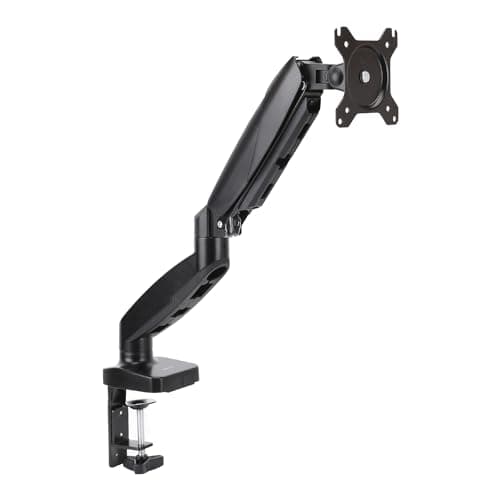
Both are moves to get objects off a small desktop. A tray removes the keyboard from the front; a monitor arm removes the screen base from the back. Do both on a 20-inch-deep desk and the entire surface becomes free area, which is the closest thing to buying a bigger desk without buying one. Watch for one conflict: desks with a built-in monitor stand or hutch (the VERMESS and Giantex here) occupy the back edge a clamp arm needs, so pick one approach or the other.

Sliding trays and desk wobble

Pulling a tray toward you applies a forward force to the desk every single time. On a light frame that shows up as a rock, and it gets blamed on the tray when the desk was always the weak part. Buy a braced frame if you can — the Bestier’s X-brace is there for exactly this — and if your existing desk already moves, fix that before you add a tray. Our wobble guide covers the leveling and bracing order.
How we picked

We do not run a testing lab

We compiled the published manufacturer specifications, did the footprint and clearance math ourselves, and read aggregated owner reviews, then scored each product against a published rubric. The scores are judgments from documented research — they are not measurements we took, because we do not have a lab and we are not going to pretend we do. Every spec traces back to a listing or manual named in Sources.

Questions

Frequently asked

Is a keyboard tray worth it on a small desk?
On a shallow desk it is one of the highest-value features available. Moving the keyboard below the top returns 6-10 inches of depth - a third to a half of the usable area on a 20-inch-deep desk - and drops the typing height 2-4 inches, which is roughly how much the standard 29-30in desk is too tall for most adults.
Can I add a keyboard tray to a desk I already own?
Usually, yes. A clamp-on tray like the VIVO here fits tops up to 1.25 inches thick and needs about 32.5 inches of clear desk edge, with nothing (drawer box, apron or rail) under the front. No drilling, so it works in a rental. The full field is in best under-desk keyboard trays.
How much clearance do you need under a desk for a keyboard tray?
Measure from the floor to the underside of the desk and subtract the tray thickness. You want roughly 24 inches of clear height at knee level and 15 inches of clear depth remaining. Desks under 29 inches tall, or with a drawer box under the top, often cannot give you that - which is why trays get removed a week after fitting.
Do keyboard trays make a desk wobble?
The tray does not, but pulling it toward you applies a forward force to the desk every time, which reveals a frame that was already weak. A braced frame handles it. If your desk already moves, fix that first — see how to stop a desk from wobbling.
Can you use a monitor arm and a keyboard tray together?
Yes, and on a shallow desk it is the best combination available — the tray clears the front, the arm clears the back. The exception is a desk with a built-in monitor stand or hutch, which occupies the rear edge a clamp arm needs. Check the edge with our desk-fit guide first.

Keep reading

Receipts

Sources

We do not run a testing lab, and we do not pretend to. Specifications come from the manufacturer or retailer listing; the footprint and clearance math is ours and reproducible. Where we could not verify a number, we say so on the page rather than quietly leaving it out. Read our full method.