Every other storage format on this site takes something from you. Drawers take legroom, a hutch takes desktop depth, a rolling cart takes floor. A shelf on the wall above the desk takes none of the three, which makes it the cheapest square footage in a small apartment — provided you can fix to the wall, and provided the shelf holds what you put on it.
Those two provisos are the whole buying decision. Screwed shelves into studs hold real weight and leave holes. Adhesive and acrylic shelves leave nothing behind and hold considerably less than the packaging implies. We rank both here and are explicit about which is which, because the failure mode of getting this wrong is a shelf of books landing on a monitor.
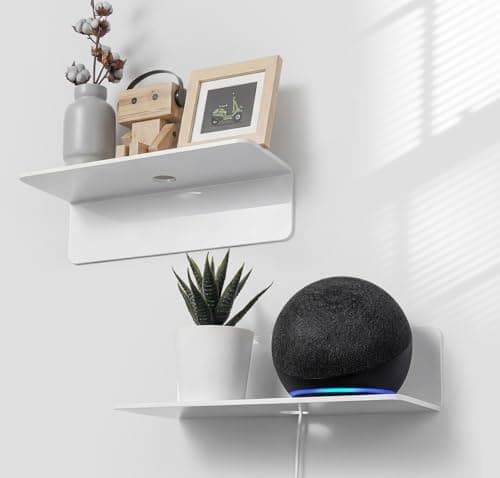
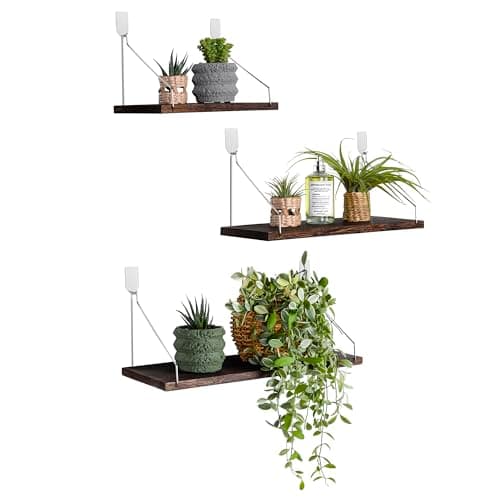
Our pick is the MITIME wood shelf set for a wall you can fix to, and the OAPRIRE acrylic no-drill pair for one you cannot. Live prices below; the methodology explains the scoring, and our no-drill guide covers what adhesive systems genuinely carry.
Height: where the shelf goes matters more than what it is
Put a shelf too low and you cannot get behind the monitor; too high and you cannot reach it without standing up, which means nothing lives there. The working range is 16 to 22 inches above the desktop. Check it against your own screen: the shelf must clear the top of the monitor at its highest position, including whatever a light bar adds to the bezel, and including the full travel if the desk is a sit/stand desk— that last one catches people out, because the desk rises and the shelf does not.
What each fixing method actually holds
| Fixing | Realistic load | Leaves behind |
|---|
| Screwed into studs | Books, files, a printer | Screw holes to fill |
| Plasterboard anchors | Light items, evenly spread | Larger holes to fill |
| Adhesive / acrylic | One light object per shelf | Nothing, if removed carefully |
None of the adhesive shelves here publishes a load rating, and we will not guess one. Treat them as a home for a speaker, a router, a small plant or a phone stand — not for anything whose fall would matter. If you need to store weight above a desk, the honest answer is screwed shelving into studs, and if you cannot do that, the storage should go under the desk instead: our under-desk storage picks cover that.
Adhesive shelves and the wall you actually have
Adhesive mounting is a bond between the shelf and the paint, not between the shelf and the wall — so it is only as strong as the weakest layer. Freshly painted walls are the most common failure, because emulsion needs weeks to fully cure and an adhesive pad will pull it off. Textured, matt and chalk-finish paints hold poorly. Wallpaper holds the shelf well and the wall poorly, which is worse. Clean the area with isopropyl alcohol, press firmly for the time the maker specifies, and leave it to bond before loading — and check what your tenancy says about adhesive removal before deciding it is the risk-free option. The full detail is in no-drill wall storage.
Above the desk, or beside it?
The wall directly above a monitor is often the worst place for a shelf, because it is where the screen wants to be at a comfortable height and where a wall-mounted arm would go. In many small setups the better answer is a shelf to one side of the screen at desk-eye level, which is reachable seated and does not compete with the monitor for the same wall. Sketch it before you drill.
What actually earns a shelf
Wall shelves fill up with objects that were not solving a problem on the desk and do not solve one on the wall. The things that genuinely belong up there are the ones you touch rarely but need to keep: a router, a hard drive, reference books, a paper tray, a plant that wants the light. The things that do not are anything you use hourly, because a shelf you have to stand up to reach quietly stops being used. Our desk organization guide works through that sorting exercise, and desks with a hutch is the alternative when the wall is not available at all.