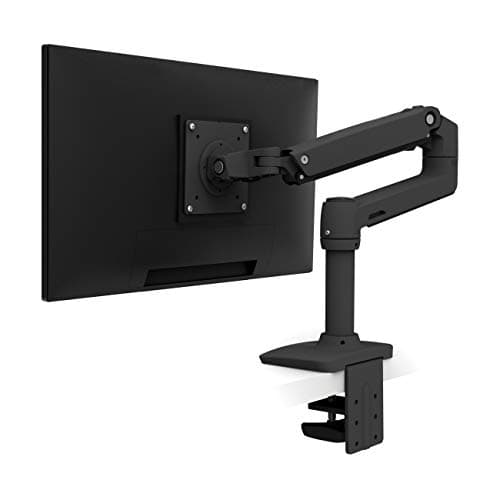
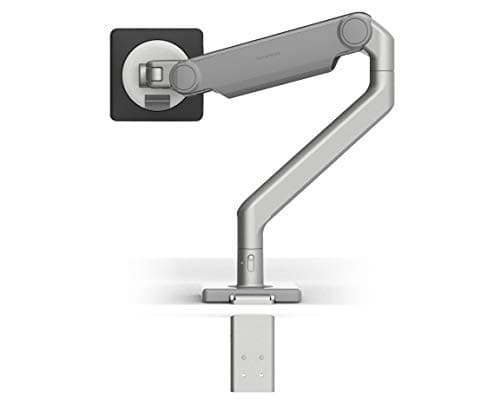
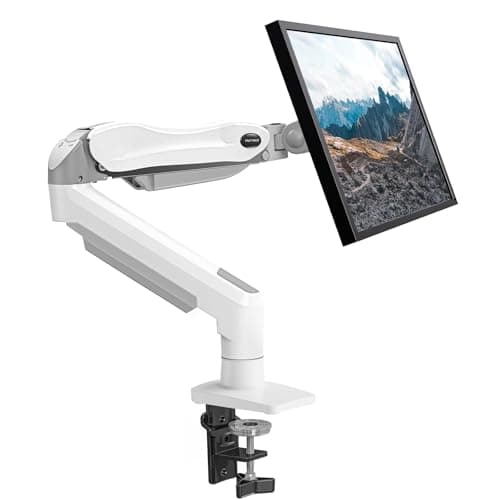
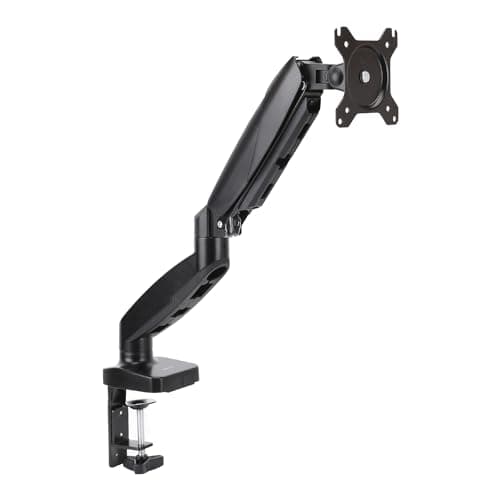
Every counterbalanced monitor arm does the same job: it stores energy when you push the screen down and gives it back when you lift, so the monitor floats instead of falling. There are only two ways of storing that energy in a consumer arm, and almost nobody explains which one they have bought. A gas spring is a sealed cylinder of compressed nitrogen. A mechanical spring is a steel coil, usually a constant-force ribbon wound on a drum. They feel similar on day one and diverge over the years that follow.
The short version: gas springs dominate the sub-$60 market, are smooth, and slowly lose pressure. Mechanical springs dominate the premium end, cost two to six times as much, and hold their tension effectively indefinitely. On a small desk both work; the deciding factors are how heavy your screen is, how often you move it, and how long you expect the arm to outlive the monitor.
How each mechanism works
A gas spring is a sealed steel tube containing nitrogen under pressure and a piston on a rod. Pushing the screen down compresses the gas; the gas pushes back. Because gas compresses smoothly, the action feels continuous, and because the cylinder is a single sealed part it is cheap to make. Tension is set by a screw that changes the mechanical advantage of the linkage rather than the pressure itself.
A mechanical spring is a coiled steel ribbon or a helical spring working through a cam. Ergotron calls its version Constant Force, which describes what the cam is for: a plain spring gets stronger the more you compress it, so the cam profile cancels that out and keeps the lifting force even through the travel. Steel under repeated flexure within its elastic limit does not meaningfully fatigue, which is why manufacturers put ten-year warranties on these arms.
The comparison in one table
| Gas spring | Mechanical spring |
|---|
| Typical price | $25–$70 | $130–$400 |
| Ageing | Cylinder loses pressure over years; screen droops | Negligible within design life |
| Temperature | Stiffer in a cold room, softer in a warm one | Unaffected |
| Tension setting | One screw, easy to reach | Stiff hex adjustment, or none at all |
| Feel | Smooth and slightly soft | Firm and very precise |
| Typical warranty | 1–3 years | 5–10 years |
Which one for a small desk?
Small-desk buyers should weigh two things the general reviews ignore. The first is that on a compact desk you are more likely to movethe screen — pushing it back to clear space for paperwork, swinging it aside to eat, rotating it to show someone something. Frequent movement is where the smoothness of a gas arm is genuinely pleasant and where a stiff mechanical arm feels like work. The second is that on a thin apartment desk, the clamp is often the weak link rather than the spring. A premium arm on a flexing particle board top does not deliver premium stability; fixing the desk comes first. Our arm compatibility guide covers the thickness and material limits.
So: light screen, tight budget, small desk you rearrange often — gas spring, and spend the difference on something that solves another problem. Heavy screen at the top of the range, a desk that will outlast several monitors, or a screen you want to stay exactly where you put it for a decade — mechanical.
Weight is the variable that decides it
Both mechanisms behave well in the middle of their weight range and badly at the edges. The failure everyone describes as “my monitor arm sags” is nearly always a screen near the top of a gas arm's range on a cylinder that has lost a little pressure. Weigh your monitor — the figure is usually on the manufacturer's spec page, and it excludes the stand you are about to remove — then pick an arm whose range puts your screen comfortably in the middle. Our weight capacity guide works through this in detail, including why an ultrawide loads an arm harder than its weight alone suggests.
Can you fix a sagging gas arm?
Partly. Tighten the tension screw first — most arms have several turns of adjustment in reserve and a sagging arm is often simply under-tensioned rather than worn out. If the screw runs out of travel and the screen still drifts down, the cylinder has genuinely lost pressure and it is not user-serviceable. That is the point at which the price difference between the two mechanisms stops being abstract: a $30 arm is replaced, a $250 arm is repaired under warranty.