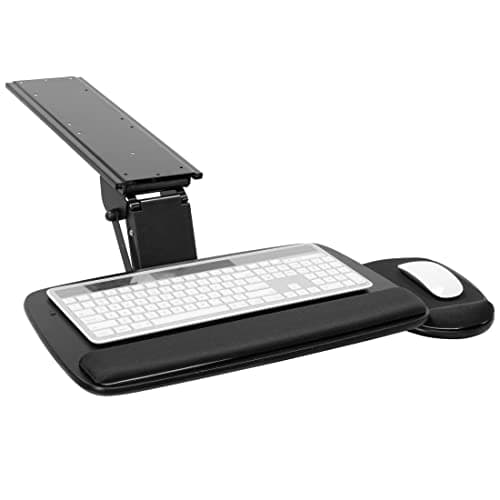
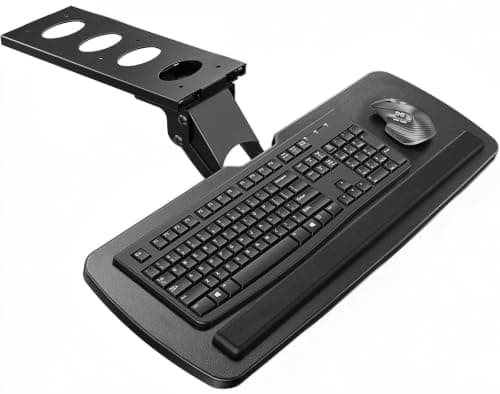
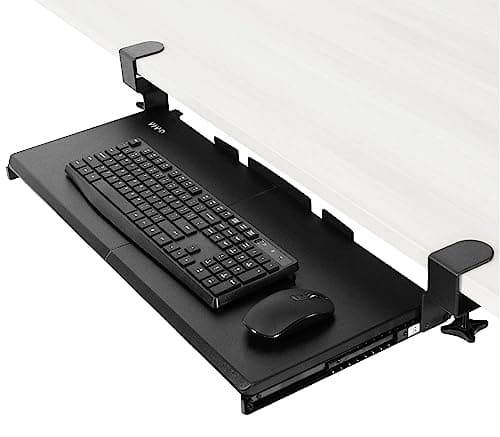
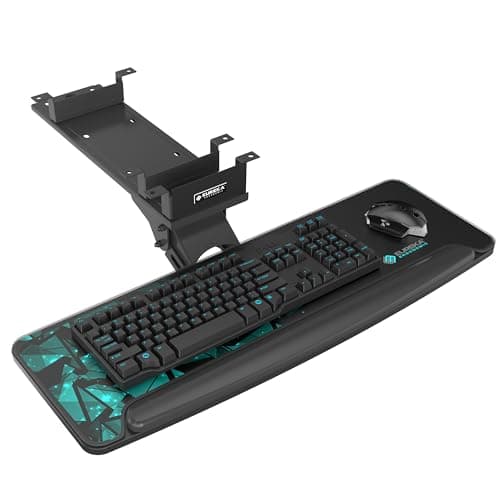
Our pick is the EUREKA ERGONOMIC slide-out tray, and the reason is written on its own listing: it is the one tray here that says in plain terms that it fits desks with beamsand that you should check it will not interfere with the desk motors. Everything else in this category is designed for a flat, clear underside, which a sit-stand desk does not have — it has a crossbar, two lift columns and usually a controller box somewhere in the middle of the span.
The Mount-It! slide-out is the pick if you want the tray bolted rather than clamped: screws into the underside of the top, so it rises and falls with the desk and there is nothing at the edge to work loose. The HUANUO has the most height adjustment of the four at 6.3 inches and publishes exact crossbar clearances, and the VIVO clamp-onis the budget option — with the caveat that it needs 32.5 inches of uninterrupted desk edge.
What a sit-stand desk changes
One: the tray must attach to the top, not the frame. Bolt it to a crossbar and the keyboard stays where it is while the desk goes up, which is exactly backwards. Every tray below fixes to the underside of the top or clamps its edge.
Two: it has to clear the hardware.Measure from the front edge of the desk back to the first obstruction — crossbar, cable tray, controller box, motor housing. HUANUO wants no crossbar or at least 14.17 inches to it (16.22 if the tray must slide all the way under); EUREKA publishes a 17.8-inch bracket depth and asks for a desk at least 20 inches deep. That number, not the tray size, is what decides compatibility.
Three: it needs its own height adjustment.The correct typing plane standing is not the correct one seated — the desk changes but your forearm angle requirement does not, and a tray fixed at one drop below the top will be right in one posture and wrong in the other. Three of the four here adjust (6.3 in, 5.5 in, and the EUREKA’s continuous range); the VIVO does not.
The three measurements to take before you order
| Measure | How | Why it decides the purchase |
|---|
| Front edge to first obstruction | Tape measure under the desk, front to crossbar or controller | HUANUO needs 14.17 in; EUREKA’s bracket is 17.8 in deep |
| Top thickness at the mount point | Calipers or a ruler at the front edge | HUANUO ≥0.6 in, EUREKA ≥0.71 in, VIVO ≤1.25 in |
| Clear width under the top | Between the lift columns, at the front | HUANUO needs 25 in, or 35.4 in to rotate the tray |
Why a keyboard tray is worth more on a standing desk, not less
People assume a height-adjustable desk makes a tray redundant. It does the opposite. A sit-stand desk sets one height for the whole surface, and the correct height for your screen is 4–6 inches above the correct height for your keyboard— which is why the standing posture that puts the monitor at eye level usually has you typing slightly uphill. A tray splits those two planes, so the desk can serve the screen and the tray can serve your forearms. That is the same argument our desk height guide makes for a fixed desk, and it gets stronger when the desk moves.
The second gain is depth. A sit-stand desk in a small apartment is usually a shallow one — the models in our shallow standing desk roundup are 19 to 20 inches deep. Moving the keyboard and mouse below the top gives back about 11 inches of that, which is the difference between a monitor at a sensible distance and a monitor in your face. Pair it with an arm rated for a standing desk and the whole top is free.
Clamp or bolt, on a desk that moves
On a fixed desk this is mostly a question of whether you are allowed to drill. On a sit-stand desk there is a mechanical argument too: the desk cycles up and down thousands of times, and a clamp at the front edge sees a small amount of load reversal every cycle. Bolted brackets (Mount-It!) do not move at all; clamps (VIVO) want a check with the supplied key every few months. Neither is a reason to avoid clamping — it is a reason to put the tightening check on the same list as the rest of your renter-friendly setup.
Cables: the thing that actually fails first
A tray adds 8–15 inches of travel to the keyboard and mouse leads, on a desk that already adds 18 inches of vertical travel to everything else. Wired keyboards get pulled taut at full desk height with the tray fully out, and the connector is what gives. Leave a deliberate service loop at the back of the desk and route the tray’s cables down the lift column rather than across the crossbar — our cable management picks cover the sleeve and raceway options, and the no-damage version covers doing it without adhesive on the wall.
Where this page stops
If your desk is a normal fixed one, the constraints above do not apply and the field is wider — go to best under-desk keyboard trays, which ranks on tray size and clamp range instead. If you are still choosing the desk, desks that come with a tray fitted avoids this problem entirely, and small standing desks is where the desk decision starts.