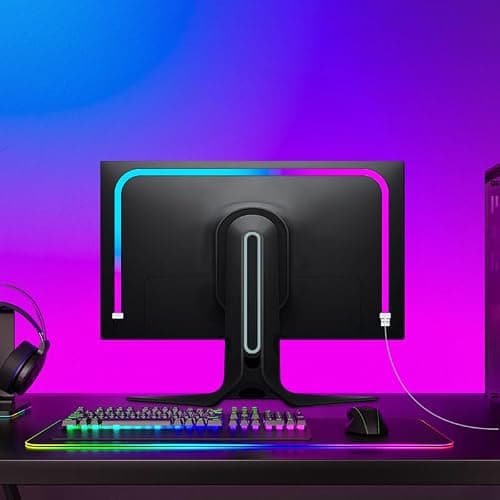
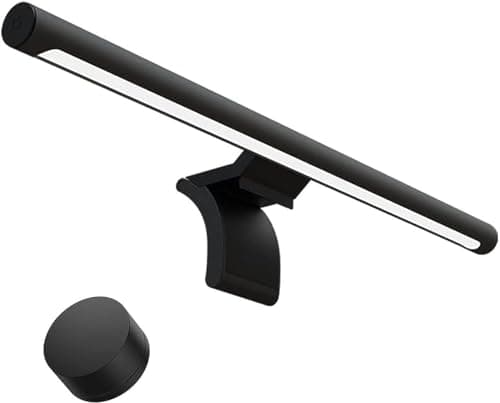
These two get compared constantly, and the comparison is usually framed wrongly. A monitor light bar sits on top of the screen and throws light forward onto the desk, using an asymmetric optic so none of it lands on the display. An LED strip stuck behind the monitor throws light backward onto the wall, producing a soft halo. The first is task lighting. The second is bias lighting. They solve different problems, and knowing which problem you have is the whole decision.
The short answer
If you cannot see your keyboard, your paperwork or your desk clearly, you need a light bar (or a lamp). If the desk is lit fine but your eyes are tired after evening screen work and the display feels like it is glowing in a dark room, you need a stripbehind the monitor. If both are true — which on a small desk in an apartment is common — buy the strip first, because it costs a fraction as much, then add the bar.
The decision table
| Factor | Monitor light bar | LED strip |
|---|
| Lights | The desk in front of you | The wall behind the screen |
| Glare on the screen | None — asymmetric optic | None — it faces away |
| Desk footprint | None — rests on the bezel | None — adhesive |
| Helps you read paperwork | Yes | No |
| Eases evening screen contrast | Partly | Yes — this is its job |
| Typical cost | Mid | Lowest of any desk light |
| Needs a compatible bezel | Yes | No |
| Works with a laptop only | Rarely — needs a monitor | Yes, anywhere behind the screen |
Why the asymmetric optic is the light bar’s real feature
Any lamp can put light on a desk. The difficulty next to a screen is doing it without throwing a reflection across the display, which washes out contrast and is the reason a badly placed desk lamp makes screen work worse rather than better. A light bar’s optic is cut so that the beam falls forward and down onto the desk and essentially nothing goes backward onto the panel. That is engineering you cannot replicate with a strip, and it is what you are paying the difference for.
What bias lighting actually fixes
Working on a bright screen in an otherwise dark room forces your eyes to keep adapting between two very different brightness levels, which is fatiguing over a long evening. A strip behind the monitor raises the brightness of the wall immediately around the screen and narrows that gap. It does nothing for your ability to see the desk — but for the specific complaint of tired eyes at night, it is the correct and much cheaper fix.
The small-desk angle
Both options share the property that makes them right for a compact desk: neither one touches the surface. A base lamp claims six to eight inches of desktop permanently; a light bar rests on a bezel you already own, and a strip sticks to a surface you already own. On a 40-inch desk that difference is worth more than a few extra lumens. If you want the full argument for footprint-first lighting, it is in best desk lamps.
When neither is the answer
If you work on a laptop with no external monitor, a light bar has nothing to sit on, and a strip behind a laptop lid does very little. Use a clamp lampinstead — it takes no desk surface either, and it puts light where you actually need it. And if there is no outlet at the desk at all, a rechargeable lamp is the only one of these options that works.
Diagnose the problem first
- “I cannot see what I am writing.” Task light problem. Light bar, or a clamp lamp if you have no monitor.
- “My eyes are sore after two hours at night.” Contrast problem. Strip behind the screen.
- “There is a reflection across my monitor.”Glare problem. The light causing it is in the wrong place — a light bar is designed not to, and the strip faces away entirely.
- “The desk is dark and so is the room.” Both, and start with the strip because of the price.
Buying both is the normal outcome
These are complements more than competitors, and together they cost about what one decent base lamp costs — while taking none of the surface a base lamp would. On a compact desk with a monitor, a bar on the bezel plus a strip behind the screen is close to the ideal setup: task light where you work, bias light behind the display, and a desktop with nothing on it.
Check the bezel before you buy a bar
Light bars sit in a groove on the top edge of the monitor and are counterweighted for a typical bezel thickness. Very thick bezels, sharply curved screens and some ultrawides do not take them reliably. If yours does not, the strip route plus a clamp lamp gets you the same result. Our full rankings are in best monitor light bars and best LED strip lights for desks.