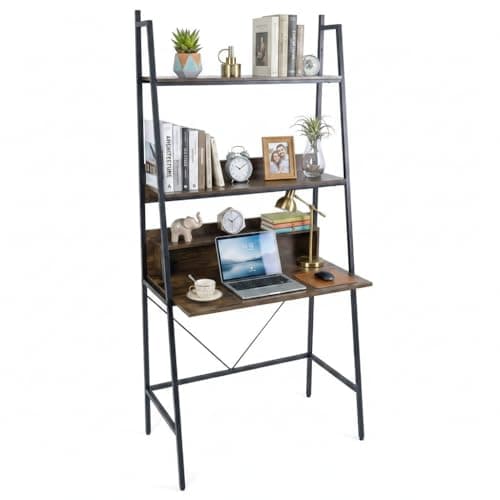
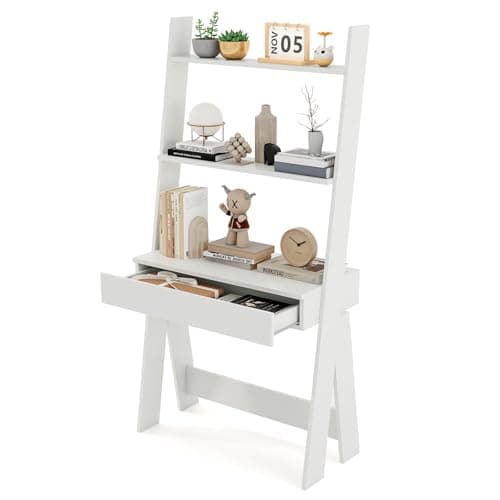
A ladder desk leans against the wall and stacks its storage above the work surface instead of beside it. That is the whole idea, and in a small apartment it is a genuinely good one: you get a desk and a bookcase for about 15.5 inches of floor depth, which is less than most desks claim on their own.
Two things about the format are worth knowing before you commit. First, the desktop is usually shallow and narrow— a laptop and a notebook, not a laptop and two monitors. Second, the shelves are light-duty: these are leaning frames, not built-in shelving, and every one of our picks ships an anti-tip kit that anchors the top shelf to the wall for a reason. Use it. A ladder desk that is not anchored is a genuine hazard in a home with kids or pets, and the anchor is a single small screw into drywall — about the most renter-friendly fixing there is.
Our pick is the Giantex 3-tier ladder desk with drawer: three open shelves, a 28 × 12-inch pull-out drawer and 33 inches of width on a 15.5-inch footprint. The Tangkula 3-tier is the alternative if you want a genuinely usable desktop rather than the smallest footprint, and the Nathan James Theois the one to buy if you can drill, because wall-mounting removes the leaning compromise entirely. Dimensions are the manufacturers’ published figures.
What a ladder desk is good at
Turning vertical spaceinto storage without claiming floor. In a studio or a dorm the wall above a desk is usually empty, and a ladder desk uses it without any drilling. It also has a soft advantage that is easy to miss: because the frame is open, it does not read as a heavy piece of furniture, so a small room stays visually light. If your problem is “I need a desk and somewhere for books, and I have one narrow wall,” this format is the most efficient answer on the site.
What it is bad at, honestly
Three things. Depth— at 15.5 inches, a monitor on a stand does not fit with a keyboard, so plan on a laptop or a wall-mounted screen. Rigidity— a leaning frame transmits typing into the shelves above, and if you type hard you will see your monitor nod. Load— these shelves take books and a router, not a printer and a stack of textbooks. If any of those three is a deal-breaker, a conventional narrow desk plus a separate shelf is the better buy, and usually cheaper.
Anchor it, and use the wall for the screen
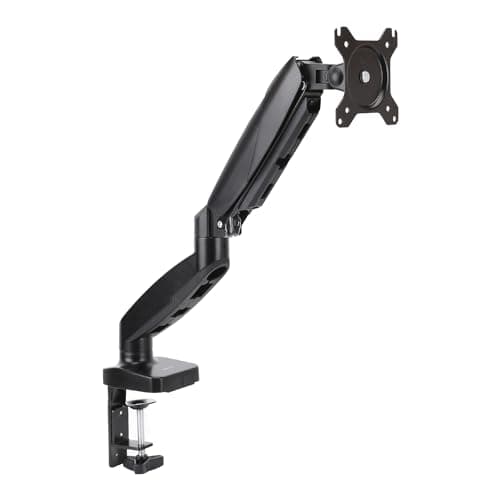
Every leaning desk here ships anti-tip hardware, and every one of them needs it. The anchor is one small screw into a stud or a drywall plug — a fixing most leases tolerate, and one you can patch with filler on the way out. While you are at the wall, consider whether the monitor should go there too: a wall-mount monitor arm solves the shallow-desktop problem completely by taking the screen off the desk entirely, which is the single best pairing for this desk type. Where drilling is out, our renter-friendly setup guide covers the no-drill alternatives.
Ladder desk versus wall-mounted desk
Both use the wall; they use it differently. A ladder desk leans and needs one small anchor screw, so it suits most rentals and moves easily. A wall-mounted fold-down desk claims zero floor when closed but needs real load-bearing fixings and, ideally, studs. Rule of thumb: if you want storage and a desk from one purchase, buy the ladder; if you want the floor back when you are not working, buy the fold-down. Our folding vs wall-mounted comparison covers the fixings question in more detail.