There is an honest problem with this category, and it is better said before the picks than after. An L-shaped standing desk is the biggest piece of furniture on this entire site. The default size is 63 by 55 inches — five feet three of one wall, four feet seven of the other — and most of what turns up when you search for a corner sit-stand desk is built for a corner office, not for a corner of a one-bedroom apartment.
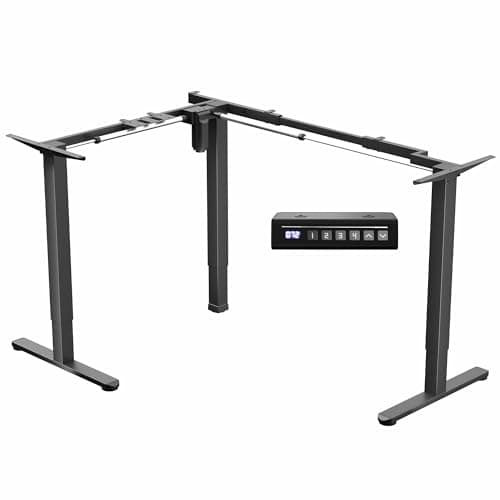
The category does get smaller than that, but not by much and not from many brands. The smallest complete L-shaped electric desk we could verify measures 47.24 inches along its long side. Below that, the only way to get a sit-stand corner is to buy the frame and put your own tops on it. That is the real shape of this market, and any page that pretends otherwise is selling you a corner office.
Why buy the corner at all
Because of what it does to the wall. A rectangular desk wants one uninterrupted run of wall — and in a small apartment the long walls are already spoken for by a bed, a sofa or a radiator. An L-shape asks for two shorter runs instead, and it puts them in the corner, which is the part of the room nothing else wants. That is the same argument our small corner desks roundup makes for fixed-height desks; everything here adds the sit-stand column to it.
It is also the cheapest way to get two work surfaces at standing height. A second surface that rises with the first is what an L buys you over a rectangular desk plus a side table, and it is why people with a PC tower, a printer or a second screen keep coming back to the format.
The three numbers that decide it
Wall run per leg.Not the diagonal, not the square footage — the length of each straight side, because that is what has to fit between a door frame and a window. The five here run from 43 inches per leg (the VIVO frame, with the tops VIVO recommends) to 63 by 55 inches. Measure both walls at desk height rather than at the baseboard: baseboards, radiator pipes and window sills all steal inches at exactly the wrong height.
Return depth. The second most useful number and the one nobody quotes. The OffiGo below is 31.5 inches deep in total, which is shallow enough to leave a walking route past it; the FEZIBO is 55 inches deep, which in a 10 by 11 foot bedroom means the desk owns the corner and about a third of the floor. Multiply the two sides for the honest figure: the picks here claim between 12.0 and 24.1 square feet.
Minimum height, not maximum.Standing desks are sold on how high they go and returned over how low they do not. All five here start between 27.56 and 28.4 inches, which is a comfortable seated height for someone around five foot ten and too high for a lot of people below that. If you are shorter, the minimum is the spec that decides whether you can sit at the desk at all — our desk height guide has the arithmetic, and standing desks for short people covers the rectangular desks that go lower.
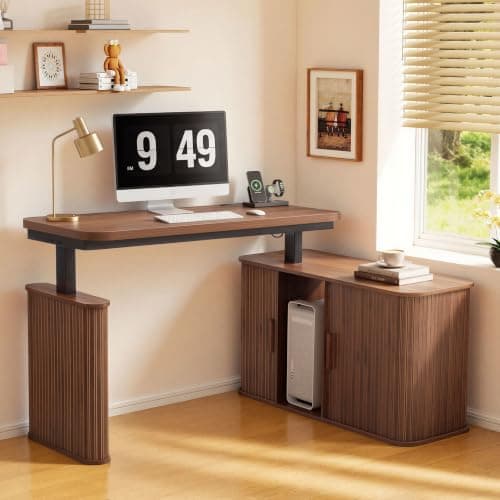
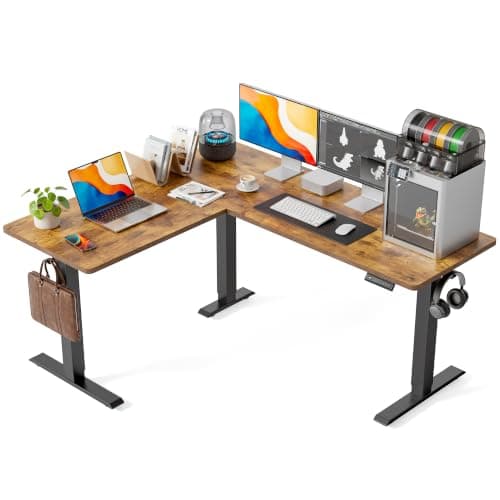
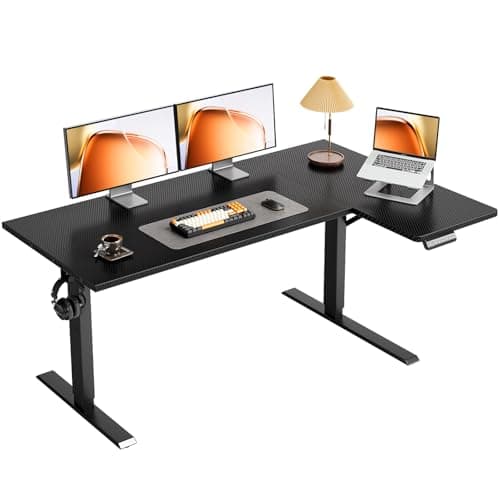
Our pick for most small rooms is the OffiGo 55-inch: the shallowest complete desk here, the only reversible one, and the cheapest electric L we verified. The SHW has the track record, the VIVO frame gets the corner smaller than any assembled desk can, the Henstatech is the smallest complete desk with storage built in, and the FEZIBO is the one to buy if the corner is genuinely big. Every dimension below is read off the manufacturer listing; our methodology explains what our scores are and are not.
Measure two walls, and measure them at desk height
The mistake specific to this format is measuring one wall. An L-shape has to satisfy both, and it has to satisfy them at the height the desktop will sit rather than at the floor. Baseboards push a desk one to two inches off the wall. A radiator, a window sill, a thermostat or a floor outlet with a plug in it does the same at exactly desk height. Run the tape at about 29 inches off the floor, along both walls, and write down the two numbers you actually have.
Then subtract for the door. A corner that a door swings into is not a corner you can put a desk in, and a desk that blocks a closet is a desk you will resent by the second week. The wider walk-through of this arithmetic is in our desk size guide for small spaces, and corner desk vs L-shaped desk covers the difference between a true corner unit and an L, which the listings use interchangeably and which are not the same shape.
Minimum height is the spec that gets a desk returned
Every desk on this page adjusts. Not every desk on this page adjusts to you. The minimums run from 27.56 inches (Henstatech) to 28.4 inches (OffiGo), with the VIVO frame at 27.7 and the SHW at 28. For a seated posture where your forearms are level and your feet are flat, a person around five foot ten wants roughly 28 to 29 inches; someone around five foot four wants closer to 25 to 26. Nothing here goes that low.
There are two honest fixes and one bad one. The good ones: raise the chair and add an under-desk footrest so your feet are supported rather than dangling, or buy a rectangular desk with a lower range from our short-people roundup and add the second surface separately. The bad one is telling yourself you will get used to it. You will get shoulder pain instead.
Reversible or fixed-hand: the renter question
A fixed-hand desk decides which wall the return goes on. That is fine in a house you own and a real constraint in a rental, because the next apartment will not have the same corner. Of the assembled desks here the OffiGo is reversible and the SHW is right-facing only; the FEZIBO is a spliced top, which in practice means the short leg is assembled onto whichever side you build it on. If you expect to move inside two years, treat reversibility as a feature worth paying for rather than a detail. The rest of the moving-out calculus is in our renter-friendly desk setup guide.
Frames, motors and what the capacity number means
Two of the desks here publish capacities in the middle of the range (154 lb OffiGo, 176 lb SHW), the Henstatech publishes 198 lb, the VIVO frame publishes 225 lb, and the FEZIBO publishes nothing at all. Treat the published figure as a static rating for evenly distributed weight, not as an invitation to load the far corner of the return. On an L-shape the load is rarely balanced — the tower goes under one leg, the monitors sit over another — and it is the imbalance rather than the total that produces the wobble people complain about at full standing height.
Motor count is the other frame spec, and it is the one listings are vaguest about. The VIVO runs one motor across three legs. The rest do not clearly publish a motor count at all, which is normal at this price and worth knowing before you assume you are buying a dual-motor desk. If a listing does not say, do not infer it from the price. And if the desk you end up with does wobble, the fixes are mechanical rather than mystical — our guide to stopping a desk from wobbling works the same way on a sit-stand frame.
Do you actually need the L?
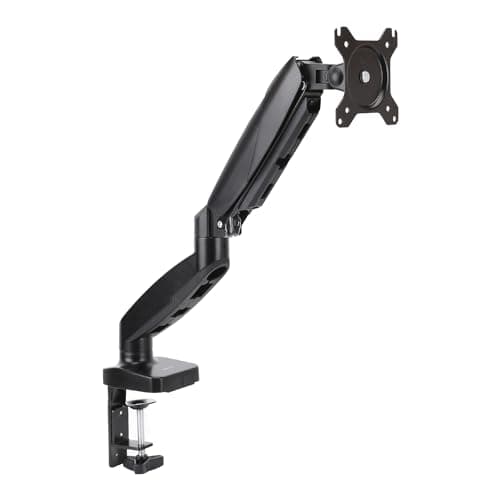
Often not, and this is the part a roundup is supposed to say out loud. If the second surface exists to hold a monitor, an arm does the same job for a fraction of the floor: clamping the screen frees the desktop the base was occupying and lets you push the monitor back over the edge of the desk. Our monitor arms roundup covers the field, and two monitors on a small desk works through the widths involved. A 48-inch rectangular sit-stand desk plus a dual arm will usually beat a 63-inch L in a small room, and it costs less wall.
The L earns its space when the second surface has to hold something that is not a screen: a printer, a tower that will not fit under the main desk, a sewing machine, a second person working beside you. If that is your situation, the corner is the right answer. If it is not, compare against the rectangular small standing desks before you commit five feet of wall to it.
Corner sit-stand on a budget, and the converter alternative
Electric L-shapes now start well under the $200 mark, which was not true two years ago, and that has quietly killed most of the reasons to buy a manual crank version. What it has not killed is the converter: a riser that sits on the corner desk you already own and lifts the monitor and keyboard by themselves. It costs a fraction of a new desk, it is the only option if the desk in the corner came with the apartment, and it is covered in small standing desk converters. The trade is that a converter lifts a work zone, not a whole surface — the printer and the notebooks stay at sitting height. Our standing desk vs converter comparison has the full accounting.
What the corner costs you on moving day
Weight is the spec nobody checks and everybody regrets. The desks here run from 43.3 lb (OffiGo) to 108 lb (Henstatech), and that spread is the difference between a one-person carry and a Saturday with a friend and a trolley. An engineered-wood desk with a cabinet in it does not come apart cleanly the second time, either. If your lease is twelve months, the lighter steel-frame desks are the ones that survive the move intact — and if the corner is temporary in a deeper sense, a fold-down desk disappears entirely in a way that no L-shape ever will.