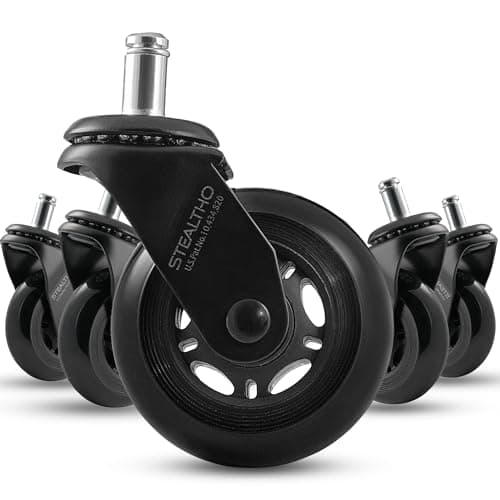
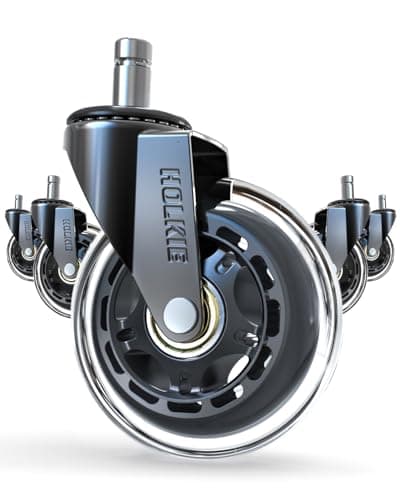
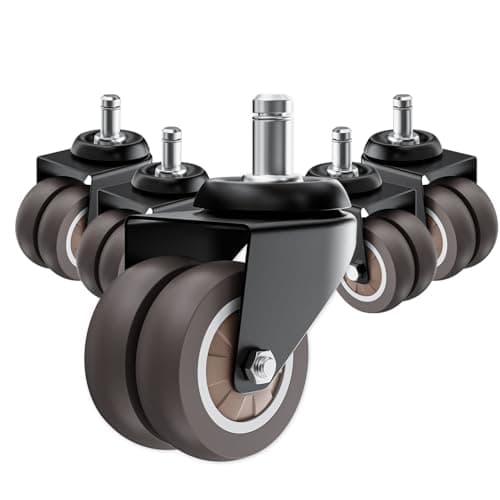
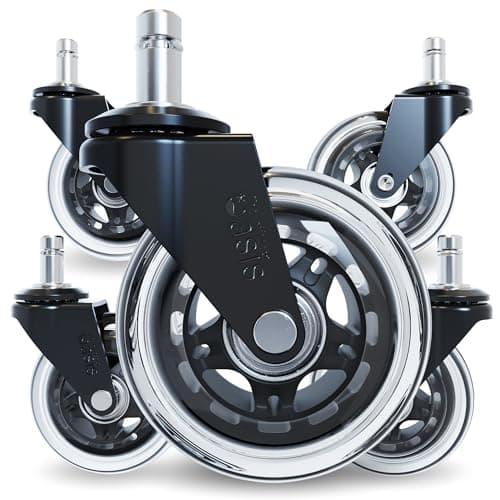
Almost every office chair sold ships on hard nylon casters, and almost nobody mentions why: they were designed for commercial carpet tile. Put the same wheel on laminate, vinyl plank or engineered wood — which is what a rented apartment floor usually is — and it stops rolling cleanly and starts scuffing. The damage arrives slowly and then all at once, as a visible arc in the two feet of floor where the chair actually moves.
For a renter that is not a cosmetic problem, it is a deposit problem, and it is the reason this page exists. Replacement casters are the cheapest fix in the whole small-space workspace, they take about five minutes with no tools, and — the part that matters here — they are completely reversible. The originals pull straight out, go in a drawer, and go back in on the day you hand the keys over. Nothing is drilled, glued or modified.
The alternative everyone suggests is a chair mat, and a mat does work. But our small office chairs roundup makes the case against it already: a mat is a large, rigid object claiming a square yard of the floor you are short of, in the exact spot you need clear. Soft wheels solve the same problem and occupy no floor at all. On a small-space desk that is not a close call.
One spec decides whether any of these fit your chair, and it is not the one the listings shout about. It is the stem— the post that pushes up into the chair base. The industry standard is a grip-ring stem measuring 7/16″ in diameter by 7/8″ long(11 × 22 mm), and The Office Oasis publishes that figure along with the claim that it covers about 95% of office chairs. The famous exception is IKEA, whose chairs use their own fitting; two of the sets below say “not IKEA” on the listing itself. Check your chair before you buy anything on this page — the measuring instructions are in the buying guide below.
We have not tested these. What we have done is read what each manufacturer actually publishes, and rank partly on how muchthey publish — because in a category where the fit spec is the whole ballgame, a listing that states its stem size is worth more than one that says “universal” and leaves you to find out. Live prices below; our methodology explains the scoring.
The stem is the only fit spec that matters
Everything else on a caster listing is marketing. The stem is engineering. It is the post that pushes up into the socket on the chair base, and if it is the wrong diameter or the wrong length the wheel either will not seat or will not stay in.
The overwhelming majority of office chairs use a grip-ring stemat 7/16″ diameter by 7/8″ length — 11 mm by 22 mm. That is the figure The Office Oasis publishes, and the same dimension appears on the STEALTHO listing. A grip ring is a small sprung collar near the top of the post; it is what makes the wheel pop in and stay put without a screw.
To check your own chair, tip it on its side and pull one caster straight out. It comes out with a firm tug — there is no fastener and nothing to unscrew. Measure the post, not the wheel. If it is roughly 11 mm across and 22 mm long with a ring near the top, any of these sets will fit. If it is threaded, or square, or noticeably larger, you have a non-standard chair and you should buy nothing here until you have matched the fitting.
The known exception is IKEA, which uses its own stem on most of its chairs and is called out by name on two of the listings above. It is not the only exception, just the common one.
Wheel diameter, and the seat-height side effect
Three inches is the default for replacement sets and it is the right choice for most rooms: a bigger wheel rolls over a rug edge, a floor transition or a cable more easily than a small one. That is most of the practical difference.
The exception is worth knowing, because it connects to a problem this site writes about a lot. A wheel changes the height of the seat. Going from the small hard casters a cheap chair often ships with to a 3-inch rollerblade set raises the seat slightly; going the other way, to the 2-inch low-profile set above, lowers it. If your chair is already at its lowest setting and your feet still do not sit flat — the classic problem when a standard 29–30in desk forces the chair up — a smaller caster buys back a little of that. It is a small adjustment, not a cure. Our desk height guide has the numbers, and an under-desk footrest is the more direct fix.
Soft wheels or a chair mat?
Both protect the floor. They cost you completely different things.
A chair mat is the conventional answer and it is genuinely effective, but it is a rigid sheet roughly a yard square that lives permanently in the busiest patch of floor in the room. In a studio, a dorm or a bedroom desk setup, that is the floor you were trying to keep clear, and the mat is visible from every angle. It also has to be transported when you move, and cheap ones curl at the edges.
Soft casters move the solution into the chair itself. They occupy no floor, they are invisible, they weigh nothing when you move, and they cost less than most mats. The trade is that they only protect where the chair rolls — they do nothing about a dropped mug or a dragged desk leg. For the specific problem of caster arcs on a rental floor, which is what actually costs people their deposit, the wheels are the better-targeted fix.
Carpet is a different problem
If your floor is carpet, floor damage is not your issue and you should not buy these to fix it. Soft wheels on thick carpet roll worse than hard ones, because the tread deforms into the pile instead of riding over it. The sets above that state hardwood-and-carpet compatibility handle low-pile and commercial-weight carpet fine; deep domestic pile is where a hard caster genuinely belongs. This is the one case where the wheels your chair came with were the correct choice.
The swap itself
It takes about five minutes and needs no tools. Tip the chair on its side or turn it upside down on the bed. Pull each old caster straight out — firm, steady force, no twisting. Push each new one straight into the empty socket until the grip ring clicks home. Stand the chair up and roll it. That is the entire job, and it is why this is the highest return-per-dollar change in a small workspace.
Keep the originals. Put them in a labeled bag with the rest of your renter-friendly setup spares. Refitting them on move-out day takes the same five minutes and leaves the chair exactly as it was sold, which is the whole point of a reversible upgrade.
What new casters will not fix
They will not stop a chair rolling away on its own — that is a floor-level problem, and the answer is a locking caster set rather than a softer one. They will not fix a wobbly or sinking gas lift. They will not make a chair that does not tuck under your desk suddenly fit; that is a footprint question, covered in the small office chairs roundup. And they will not repair a floor that is already scored. If the arc is already there, replacing the wheels stops it getting worse and nothing more. And if your floor is carpet rather than hardwood the problem inverts entirely — a desk on carpet covers which wheels help on pile, and why a softer tread makes it worse.