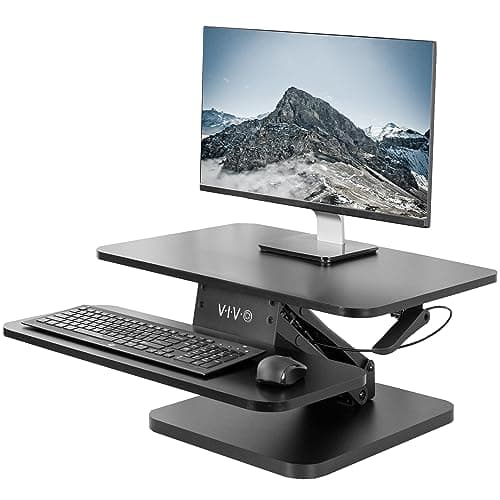
A standing desk converter is the small-space answer to standing desks: it sits on the desk you already own, lifts your screen and keyboard together, and costs roughly a third of a full electric desk. It also adds zero floor area, which is the whole reason it belongs on this site.
What it does cost is desktop. A converter occupies a block of your surface permanently, lowered as well as raised, so the size you buy has to be matched to the desk you have. As a rule: a 24–28 inch riser suits a 31–40 inch desk, a 32 inch riser wants a 47–48 inch desk, and a 36 inch riser needs a full-size desk to leave anything beside it. Buy one size too large and you lose the surface you were trying to keep.
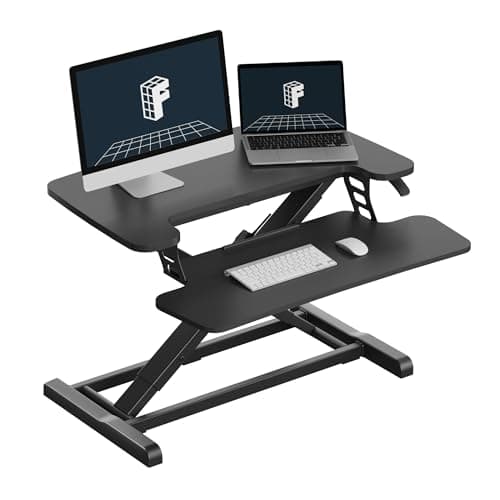
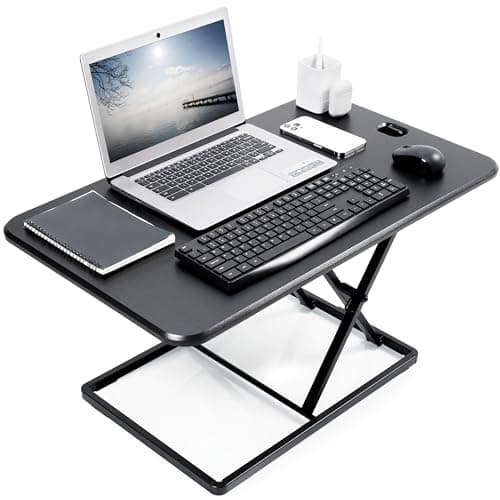
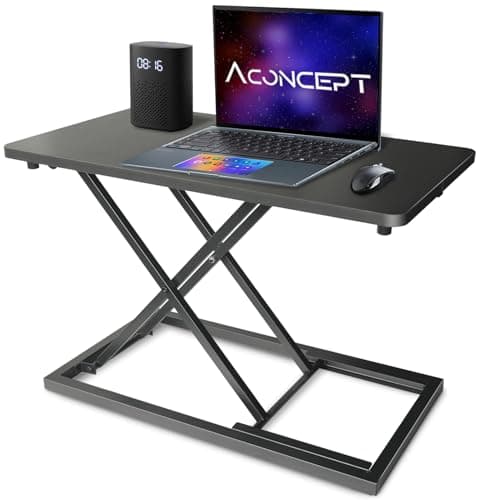
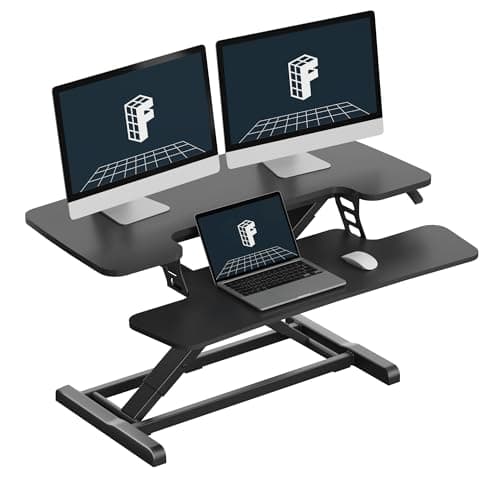
Our pick for a small desk is the VIVO 25″: a 25 × 18-inch upper tier with a separate keyboard shelf, gas-spring lift and a one-touch lock, needing almost no assembly. The FLEXISPOT 28″ is the sturdier spring-lift alternative with double the top capacity, and the Aconcept 24 × 14″is the answer for a genuinely tiny desk. Every capacity and dimension below is the manufacturer’s published figure.
Size the riser to the desk, not the monitor
This is the mistake that produces returns. A converter’s width is the amount of your desktop it claims forever, so the question is not “will my monitor fit on it” — it is “what is left of my desk beside it”. Rough pairings, using the published widths above: a 31–35 inch desk wants the 24-inch Aconcept; a 40 inch desk wants the 25-inch VIVO or the 28-inch FLEXISPOT; a 47–48 inch desk can carry the 32-inch VIVO or the 36-inch FLEXISPOT. Measure your desk width, subtract the riser width, and be honest about whether the remainder is usable.
Check what is underneath before you buy what goes on top
A converter raises weight above your desk, which magnifies any wobble the desk already has. Two checks first. Is the desk level and tight?If it moves when you type, fix that before adding a riser — our wobble guide is a ten-minute job. Can the desk carry it?The FLEXISPOT 36-inch weighs 34.5 lb before your monitor goes on, so a light particleboard desk with no published load rating is a poor host. Desks that publish a figure — the VASAGLE at 110 lb or the SHW Mission— are the safer bases.
Then check what is under you. A converter puts you on your feet at that desk for the first time, and a hard floor is usually what ends the experiment — an anti-fatigue mat costs a fraction of the riser and is the difference between standing sometimes and standing regularly.
One tier or two?
A two-tier converter has a separate keyboard shelf below the monitor platform, which is the ergonomically correct arrangement: screen at eye level, keyboard at elbow level. A single-tierriser (the VIVO Ultra-Slim, the Aconcept) lifts everything together, which is simpler, slimmer when lowered, and fine for a laptop — but it means your keyboard rises with your screen, so it only works if that height suits both. If you type for hours, buy two tiers; if you mostly read and click, one tier is enough.
Where a converter stops being the right answer
Two situations. First, if you want to stand for most of the day with two large monitors, the 33 lb top ratings here become the limit and a full standing desk is the honest upgrade — our converter vs standing desk comparison lays out the cost and footprint. Second, if the reason you are standing is neck pain rather than back pain, the cheaper fix may be getting the screen to the right height in the first place with a monitor arm, which costs less and takes no desktop at all.