A keyboard and mouse occupy roughly two square feetof desk — and they occupy the two square feet closest to you, which is the part of a small desk you most want for a notebook, a coffee or your forearms. An under-desk tray moves that whole zone below the top and slides it away when you are done, which is the cheapest way to make a 40-inch desk feel like a 47-inch one.
It also fixes a real ergonomic problem. Most desks are about 29–30 inches high, which is a table height, not a typing height — typing is comfortable when your forearms are level and your wrists are straight, and for most people that is 1–3 inches lower than the desktop. A tray hangs the keyboard at that height instead of asking your shoulders to come up to meet it.
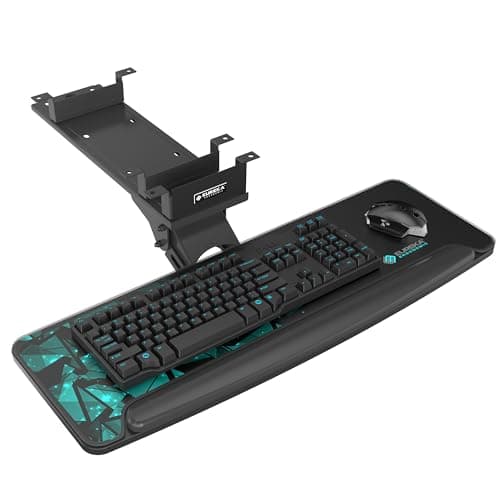
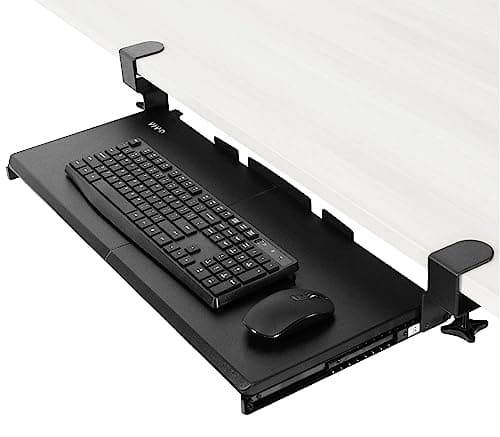
The catch is fit, and it is a hard catch: every tray has a desk-thickness limit or needs a specific amount of clear underside, and desks with a crossbar under the front edge rule most of them out. Our pick, the VIVO MOUNT-KB05E, clamps on with no drilling but needs a top no thicker than 1.25 inches; the EUREKA is the one that fits desks with beams. Every limit below comes from the manufacturer listing.
Take three measurements before you shop
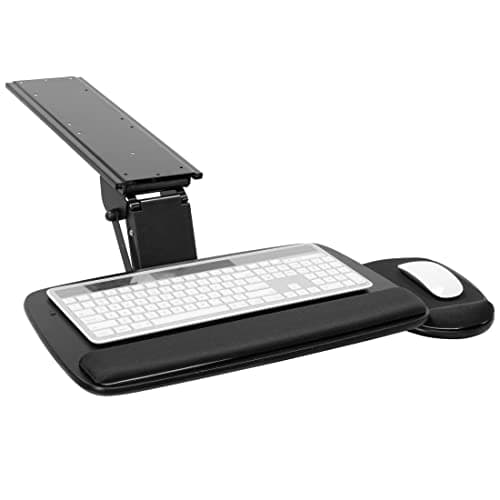
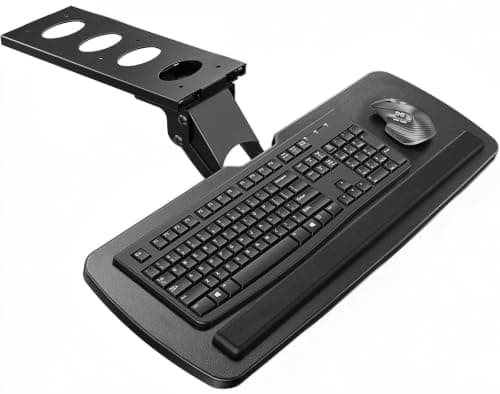
Almost every bad review of a keyboard tray is a fit problem, and all three measurements take a minute. One: desk thicknessat the front edge — clamp trays cap out (1.25 inches on the VIVO). Two: clear underside width— the VIVO needs 32.5 inches for its clamps, the Mount-It needs 5.5 inches of clear mounting strip. Three: distance from the front edge to any crossbar— HUANUO wants no crossbar or 14.17 inches of clearance; EUREKA is the one designed to cope with beams. Write those three numbers down, then compare listings.
Clamp or screw?
A clamp-ontray puts nothing into the desk, which matters if the desk is rented, borrowed or expensive — and it comes off in minutes when you move. The trade is the thickness limit and needing clear space for two clamps. A screw-mounted tray is more solid, adjusts further and takes more weight, but it needs a wood or MDF underside and it leaves holes. On a cheap particleboard desk that is nothing to worry about; on a solid wood desk you might prefer the clamps.
Set the height by your elbows, not the desk
The point of the tray is to put the keyboard where your arms already are. Sit upright with your shoulders relaxed and your upper arms vertical; the height of your hands in that position is where the keyboard should be. For most people that lands 1–3 inches below a standard 29–30 inch desktop, and slightly negatively tilted— the far edge higher than the near edge — which is why the HUANUO’s 22 degrees of downward tilt and the Mount-It’s −25 degrees matter more than their upward tilt.
What this does to a small desk
Combine a keyboard tray with a monitor on an arm and a small desk becomes a genuinely clear surface: no keyboard, no mouse, no monitor base. On a 40-inch desk that is the difference between working on a corner of it and using all of it. If your desk is too shallow or too thick for a tray, the next-best moves are a riser with a keyboard slot underneath or an under-desk drawer to at least get the keyboard out of sight when you finish for the day.