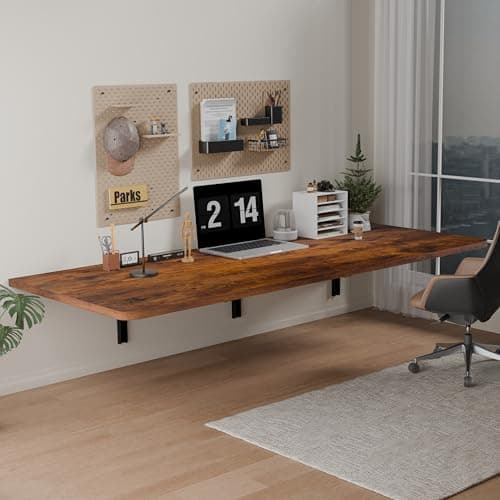
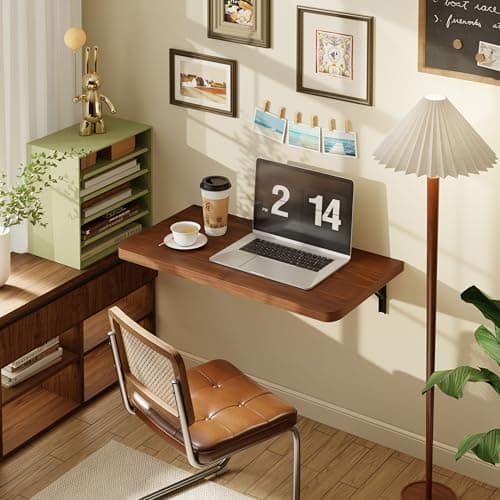
A floating desk is a desk with no legs: brackets go into the wall, the top cantilevers off them, and the floor underneath stays completely clear. In a small room that is worth more than the desktop itself. You can slide a chair fully under it, run a vacuum straight through, park a rolling cart below, and the room reads as bigger because your eye sees floor rather than four legs.
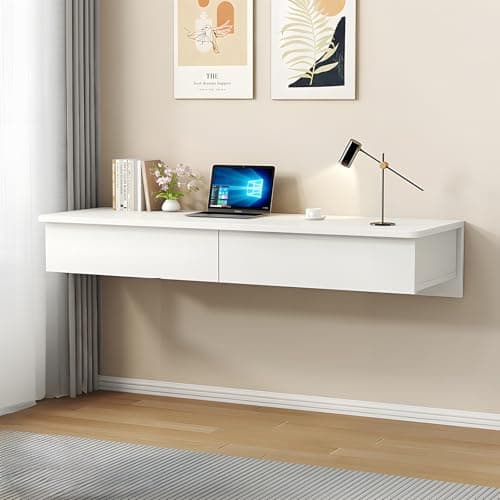
Our pick for most people is the WOOOFA floating desk— a fixed 31.5in top with real drawers on metal runners, the only pick here that gives you hidden storage without a single leg. If your wall run is short, the Dogskyfolds flat to the wall and is rated to 100 lb; if it is long, the IAE 48in gives you a full-width surface. The Giantex is the value pick, and the Tangkula adds a drawer plus six shelves for people who need storage more than desktop.
One honest warning before the picks: a floating desk transfers every pound you put on it into the wall. That is the trade you are making for the floor space, and it is the section most roundups skip — ours is under the picks. We do not run a testing lab; every dimension and load rating below comes from the manufacturer listing, and the methodology explains how we score.
The wall does the work — check it first
Everything a floating desk gives you it takes out of the wall. A legless top is a lever: put 30 lb of monitor and laptop 20 inches out from the wall and the top bracket sees a pull-out force several times that. Two rules keep this uneventful. First, find the studs— a $10 stud finder is not optional, and brackets want at least two of them. Second, believe the listing: the Giantex here specifies concrete or brick, which is the maker telling you plainly that drywall anchors are not the intended install. Where studs will not line up with the bracket spacing, a horizontal cleat screwed into three studs, with the desk mounted to the cleat, spreads the load properly.
If you are renting and holes are the problem, be honest with yourself about scale: four bracket screws are patchable in ten minutes, and most leases treat that as normal wear. If even that is out, the floating format is the wrong one — use a freestanding narrow desk or a leaning ladder desk instead, and the renter-friendly setup guide covers the rest of the swaps.
Fixed or fold-down — pick before you shop
A fixed floating desk (the WOOOFA here) is always ready and can carry real drawers, but the top is permanently in the room. A fold-downdesk (Dogsky, IAE, Tangkula) gives the wall back, at the cost of a small ritual every time you sit down and a hard limit on what can live on the desktop — nothing, because it all slides off when the top folds. That limit is the deciding factor for most people. If a monitor, a lamp and a keyboard are supposed to stay put, buy fixed. We cover the fold-down format in depth in wall-mounted folding desks.
Height is yours to choose — use that
A floating desk is the one format where you set the height, because nothing is dictated by leg length. Most people default to the standard 29–30 inches, which is sized for a six-foot user and too tall for the majority of adults. Mount it to yournumber instead — our desk height guide has the seated figures by height. Mark the bracket line with a level and a pencil before a single hole is drilled; a floating desk that is 2 inches off reads as crooked from across the room in a way a freestanding one never does.
Depth, and the monitor problem
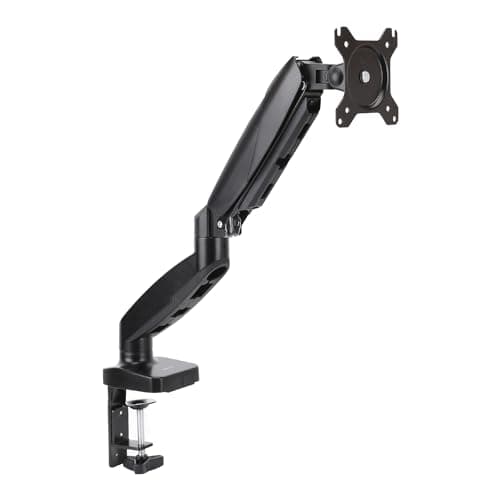
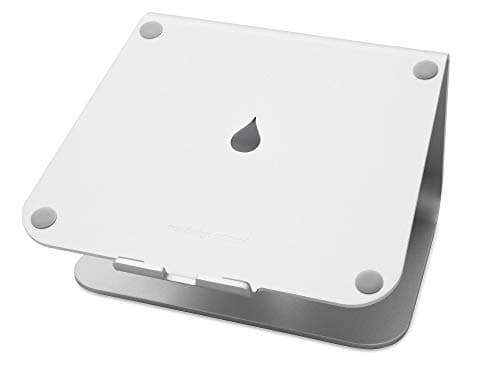
Floating tops run shallow — 14 to 22 inches here. At 21–22 inches a monitor on its factory stand fits. At 14–16 inches it does not: the base eats 8–10 inches and leaves you no keyboard room. On a fixed floating desk the fix is a clamp monitor armon the front edge, which removes the base entirely. On a fold-down desk there is no fix, because the arm would fold with the top — treat those as laptop desks and pair them with a laptop stand.
What to put underneath
The floor you just freed is the point, so use it deliberately. A rolling cart that tucks fully under the top gives you storage that leaves when the desk does. A wall shelf above the desk adds capacity without touching the surface. And because there are no legs or stretcher bars, a floating desk is the easiest format in which to mount a PC tower under the desk— there is simply nothing in the way.