Skip to content
Desk & Dowel

HUB 04 · Space-Saving Accessories

The Best Anti-Fatigue Mats for a Standing Desk

A mat is the difference between a standing desk you use and one you leave down. It is also a large object on the floor you are short of. Five mats ranked on footprint, then comfort.

By Stephen V.Updated How we pick
#ad

We earn a commission when you buy through our Amazon links, at no extra cost to you. It never affects our rankings, and we say so when the cheaper product is the better buy. How this works.

There is a gap in almost every standing-desk recommendation, including the ones on this site until today. We rank the desks on height range, on footprint and on price, and none of that addresses the actual reason most people stop using a standing desk: after about forty minutes on a hard floor, your feet hurt, so you put the desk down and it never goes back up.

An anti-fatigue mat is the fix, and it is a genuinely good one. Standing still on a hard, flat surface is what causes the ache — the load stays in exactly the same place, and the small stabilizing muscles in your feet and calves never get a break. A cushioned or contoured surface keeps those micro-adjustments happening, which is why the effect is noticeable within a week of use rather than being a marginal comfort upgrade.

Here is the tension this site has to be honest about. On the small office chairspage we argue against a chair mat because it is a large rigid object claiming floor you do not have. A standing mat is the same shape of problem — between 2.6 and 5.3 square feet of floor across the five below, all of it directly in front of the desk. The difference is that a chair mat is optional and a standing mat is load-bearing: without it the standing desk you bought stops getting used, and an unused standing desk is the most expensive object in a small apartment.

So we ranked these on footprint first, exactly as we rank desks, and then on whether the thing can be got out of the way when you sit down. A mat with a handle that stands on its edge behind the door costs you floor only while you are standing on it. A five-square-foot slab does not move, and in a studio that is a real decision rather than a detail. Every dimension below is the manufacturer’s published figure; the square footage is ours, calculated from it. We have not tested these — our methodology says exactly what our scores are and are not.

The short answer

Quick picks

#ProductBest forScorePrice
01
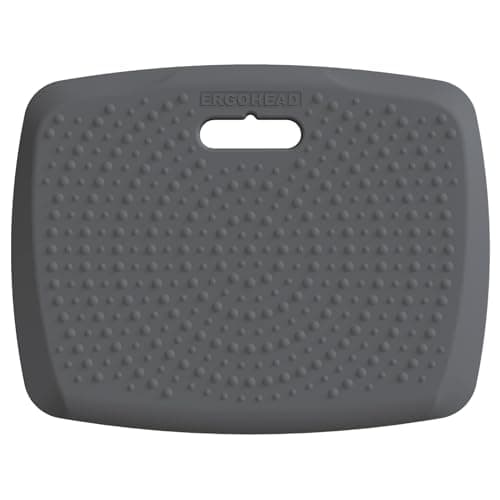
Ergohead Ergohead 3/4 in Portable Standing Mat (17 × 22 in)
Ergohead 3/4 in Portable Standing Mat (17 × 22 in)

The smallest published footprint here and the only one with a built-in handle, which together make it the one mat that does not permanently cost you floor.

Best for a small room
9.1
$27.98Amazon
02
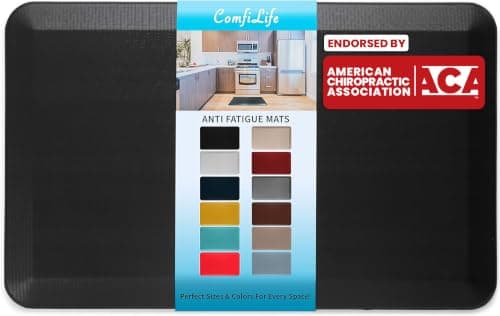
ComfiLife ComfiLife Anti-Fatigue Floor Mat (20 × 32 in)
ComfiLife Anti-Fatigue Floor Mat (20 × 32 in)

The default full-size mat: standard 3/4 inch cushioning at the standard 20 by 32 inch size, with a non-slip bottom that actually matters on laminate.

Best standard size
8.7
$49.99Amazon
03
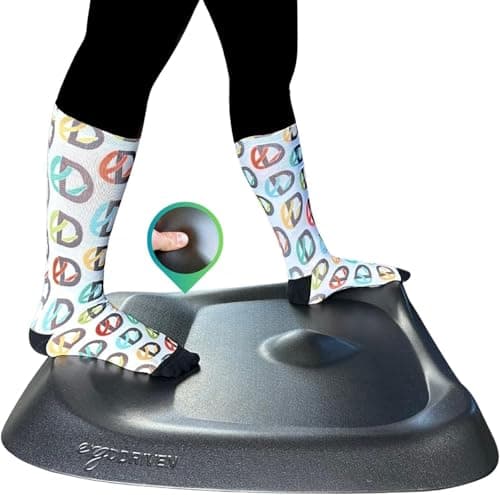
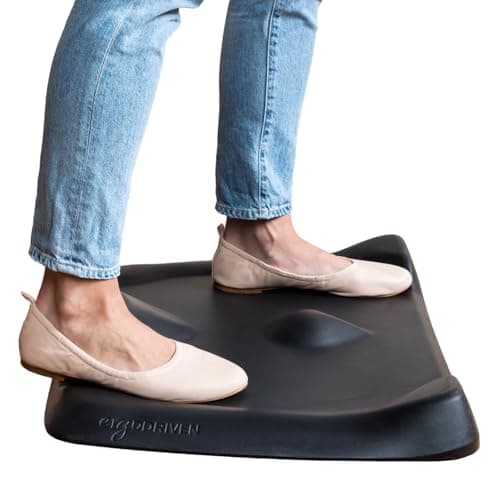
Ergodriven Ergodriven Topo Mini Not-Flat Standing Mat
Ergodriven Topo Mini Not-Flat Standing Mat

A different idea entirely: a contoured surface that gives your feet somewhere to go, in the smaller of the two Topo sizes, with a 16-year warranty behind it.

Best not-flat mat
8.6
$79.00Amazon
04
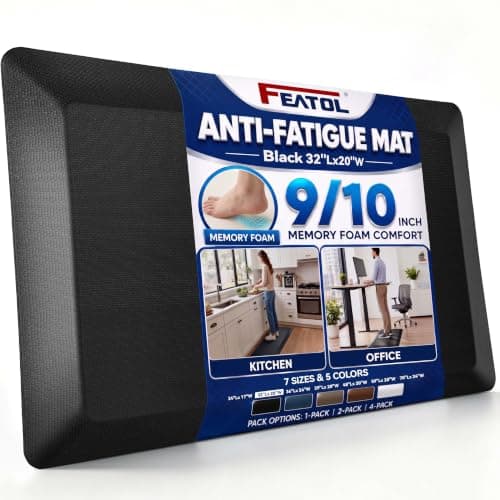
FEATOL FEATOL Extra-Thick Anti-Fatigue Mat (20 × 32 in)
FEATOL Extra-Thick Anti-Fatigue Mat (20 × 32 in)

The same 20 by 32 inch footprint as the ComfiLife with more foam under it — the pick if hard floors are the specific problem.

Best cushioning
8.4
$39.88Amazon
05
Ergodriven Ergodriven Topo Not-Flat Standing Mat (full size)
Ergodriven Topo Not-Flat Standing Mat (full size)

The best mat here and the wrong one for most of this site's readers: 5.3 square feet of permanent floor, which is a luxury a small room usually cannot fund.

Best for a dedicated standing setup
8.1
$109.00Amazon

#ad · Live prices from the Amazon Product API, as of Sep 7, 2026. Where we have no verified live price we show none — we would rather leave a gap than print a number that has rotted.

In detail

The picks, in full

01
Ergohead Ergohead 3/4 in Portable Standing Mat (17 × 22 in)

Best for a small room

Ergohead 3/4 in Portable Standing Mat (17 × 22 in)

Size
17 × 22 in
Footprint
~2.6 sq ft
Thickness
3/4 in
Carry
Built-in handle
Surface
Non-slip, massage points
9.1/10

The smallest published footprint here and the only one with a built-in handle, which together make it the one mat that does not permanently cost you floor.

Footprint
9.8
Comfort
8.4
Storability
9.6
Build
8.2
Value
9.4

Pros

  • Claims roughly 2.6 sq ft — a little over half the floor of the 20 × 32 in mats here
  • Built-in handle is the only storage feature in this roundup; it stands on edge in a gap
  • Cheapest mat on the page by a clear margin
  • Standard 3/4 in thickness, so you are not trading cushioning for the smaller size

Cons

  • 17 in of depth is tight if you shift your feet around a lot while standing
  • Massage points are a preference, not a feature — some people dislike the texture underfoot

Skip this if…

you pace or shift position constantly while standing. You will find the edges, and a 20 x 32 in mat like the ComfiLife gives you somewhere to move to.

$27.98View on Amazon

Price as of Sep 7, 2026. Prices change — Amazon's is the one that counts.

#ad · we may earn a commission from this link to Ergohead 3/4 in Portable Standing Mat (17 × 22 in)

02
ComfiLife ComfiLife Anti-Fatigue Floor Mat (20 × 32 in)

Best standard size

ComfiLife Anti-Fatigue Floor Mat (20 × 32 in)

Size
20 × 32 in
Footprint
~4.4 sq ft
Thickness
3/4 in
Bottom
Non-slip
Finish
Stain resistant
8.7/10

The default full-size mat: standard 3/4 inch cushioning at the standard 20 by 32 inch size, with a non-slip bottom that actually matters on laminate.

Footprint
8.4
Comfort
8.8
Storability
8
Build
8.8
Value
9.4

Pros

  • 20 × 32 in is the size most people find they want once they have stood on one
  • Non-slip bottom is the specification that stops a mat wandering on hard floor
  • Stain resistant, which matters if the desk is also where you eat lunch
  • 3/4 in is the thickness the category has settled on for good reason

Cons

  • 4.4 sq ft is a real claim on a small room's floor and there is no handle to move it
  • No published weight, so how easy it is to lift is unstated

Skip this if…

the desk is in a studio or a bedroom where the floor in front of it has another job in the evening. The Ergohead above stores; this does not.

$49.99View on Amazon

Price as of Sep 7, 2026. Prices change — Amazon's is the one that counts.

#ad · we may earn a commission from this link to ComfiLife Anti-Fatigue Floor Mat (20 × 32 in)

03
Ergodriven Ergodriven Topo Mini Not-Flat Standing Mat

Best not-flat mat

Ergodriven Topo Mini Not-Flat Standing Mat

Size
25.2 × 19.2 in
Footprint
~3.4 sq ft
Height
2.47 in at highest
Weight
4 lb
Warranty
16 years
8.6/10

A different idea entirely: a contoured surface that gives your feet somewhere to go, in the smaller of the two Topo sizes, with a 16-year warranty behind it.

Footprint
8.8
Comfort
9.2
Storability
7.8
Build
9.4
Value
7.8

Pros

  • Contoured terrain encourages position changes rather than only cushioning one position
  • 3.4 sq ft sits between the small and full-size flat mats
  • 16-year published warranty against manufacturing defects is the longest here by far
  • Polyurethane foam stated free of PFAs, PVC and added flame retardants

Cons

  • Costs roughly three times the Ergohead for the same basic job
  • The 2.47 in raised profile means it cannot slide under anything to be stored

Skip this if…

you want a mat that disappears when you sit down. Its shape is the whole point and that shape does not pack away — take the Ergohead if storage matters more than movement.

$79.00View on Amazon

Price as of Sep 7, 2026. Prices change — Amazon's is the one that counts.

#ad · we may earn a commission from this link to Ergodriven Topo Mini Not-Flat Standing Mat

04
FEATOL FEATOL Extra-Thick Anti-Fatigue Mat (20 × 32 in)

Best cushioning

FEATOL Extra-Thick Anti-Fatigue Mat (20 × 32 in)

Size
20 × 32 in
Footprint
~4.4 sq ft
Thickness
9/10 in
Fill
Memory foam
Color
Black
8.4/10

The same 20 by 32 inch footprint as the ComfiLife with more foam under it — the pick if hard floors are the specific problem.

Footprint
8.4
Comfort
9
Storability
7.8
Build
8.4
Value
8.6

Pros

  • 9/10 in is meaningfully thicker than the 3/4 in category standard
  • Memory foam rather than a generic foam core
  • Same claimed floor as the ComfiLife, so the extra cushioning costs no extra space
  • Priced below the ComfiLife despite the extra thickness

Cons

  • A thicker mat is a bigger step up and down, which is a trip point in a tight walkway
  • No published non-slip backing or weight figure, unlike the ComfiLife

Skip this if…

the mat sits in a walkway or beside a bed. Nearly an inch of soft edge is easy to catch a foot on in the dark, and a thinner mat is the safer object in a room you cross at night.

$39.88View on Amazon

$44.9911% off

Price as of Sep 7, 2026. Prices change — Amazon's is the one that counts.

#ad · we may earn a commission from this link to FEATOL Extra-Thick Anti-Fatigue Mat (20 × 32 in)

05
Ergodriven Ergodriven Topo Not-Flat Standing Mat (full size)

Best for a dedicated standing setup

Ergodriven Topo Not-Flat Standing Mat (full size)

Size
29 × 26.25 in
Footprint
~5.3 sq ft
Height
2.7 in at highest
Thickness
0.85 in in the neutral area
Warranty
16 years
8.1/10

The best mat here and the wrong one for most of this site's readers: 5.3 square feet of permanent floor, which is a luxury a small room usually cannot fund.

Footprint
7.4
Comfort
9.4
Storability
7
Build
9.4
Value
7.4

Pros

  • The most room to move of anything here — 29 in of width along the desk
  • Publishes more dimensional detail than any other mat in the roundup
  • Same 16-year warranty and non-toxic foam specification as the Mini
  • 8 lb published weight, so you know what you are moving before you buy

Cons

  • 5.3 sq ft is roughly double the Ergohead's claim on the floor
  • The most expensive mat here, by a wide margin

Skip this if…

your desk is in a bedroom, a studio or any room where the floor in front of it is also a walkway. This is a mat for a room with a dedicated standing station, and most small-space setups are not that.

$109.00View on Amazon

Price as of Sep 7, 2026. Prices change — Amazon's is the one that counts.

#ad · we may earn a commission from this link to Ergodriven Topo Not-Flat Standing Mat (full size)

Footprint first, because the mat is furniture

Every mat here is sold on comfort and none of them are sold on size, which is backwards for a small room. A standing mat lives permanently in the most contested square yard of floor you own — directly in front of the desk, which is also the route past the desk. Here is what each one actually claims, calculated from the published dimensions:

MatPublished sizeFloor claimedStores away?
Ergohead portable17 × 22 in~2.6 sq ftYes — handle
Ergodriven Topo Mini25.2 × 19.2 in~3.4 sq ftNo
ComfiLife20 × 32 in~4.4 sq ftNo
FEATOL extra thick20 × 32 in~4.4 sq ftNo
Ergodriven Topo29 × 26.25 in~5.3 sq ftNo

The spread is the whole story: the largest mat claims roughly twice the floor of the smallest. If your desk is against a wall in a bedroom with a clear walkway, take the size you find most comfortable. If the desk is in a studio, a dorm or the corner of a living room, the 2.6-square-foot mat that hangs on a hook is not a compromise — it is the only version of this product that fits the room.

Flat or not-flat

The category splits in two and the listings rarely explain it. A flat mat is a slab of foam: it cushions the position you are already standing in. A not-flat mat like the Topo is molded with raised edges and mounds, so there are places to put a heel, stretch a calf or shift your weight without stepping off.

Neither is objectively better. Flat mats are cheaper, thinner, easier to store and better if you stand fairly still. Contoured mats cost more and cannot be flattened away, but they address the actual mechanism — standing still is the problem, and a surface that invites movement solves more of it than a softer surface does. If you already know you fidget, the contoured option is the one to spend on.

Thickness, and why thicker is not automatically better

Three-quarters of an inch is where this category has settled, and the FEATOL’s 9/10 inch is a genuine step up in cushioning. But thickness has a cost that no listing mentions: the mat becomes a step. Nearly an inch of soft, compressible edge in a walkway is something to catch a toe on, and in a small bedroom you will cross that floor in the dark.

Beveled edges help and most mats have them. If the mat has to live somewhere you walk, take the thinner one. If it sits in a corner you only enter to work, take the thicker one and enjoy it.

The non-slip question is a hard-floor question

On carpet a mat stays where you put it. On laminate, vinyl plank or engineered wood — which is most rented flooring — a foam mat with no grip on the underside will creep away from you over a morning, and a mat that moves while you shift your weight is worse than no mat. Only the ComfiLife publishes a non-slip bottom outright.

That is the same hard floor that decides your chair, incidentally. If the chair is on hard nylon casters it is scoring the surface every time you sit back down, which is a separate and cheaper fix — see office chair wheels for hardwood floors.

Get the desk height right first

A mat cannot rescue a badly set standing height, and it changes the height slightly by raising you an inch or so — worth knowing if your desk only just reaches your standing elbow height. Standing height lands roughly 16 to 17 inches above your correct seated height; the numbers are in our desk height guide, and if you are short of the range at either end, our standing desks for short people roundup covers the desks that actually go low enough.

What a mat will not fix

It will not make eight hours of standing a good idea. The evidence for standing desks is about alternating, not about standing all day, and people who swap one static posture for another usually end up with sorer feet and the same back. Aim to change position often rather than to stand longer.

It will not fix a wobbly desk — that is a separate diagnosis, and a lifting desk at full extension exaggerates any wobble it has. It will not help while you are seated, where a footrest is the equivalent tool. And it will not substitute for shoes: standing barefoot on a thin mat on concrete is still standing on concrete.
How we picked

We do not run a testing lab

We compiled the published manufacturer specifications, did the footprint and clearance math ourselves, and read aggregated owner reviews, then scored each product against a published rubric. The scores are judgments from documented research — they are not measurements we took, because we do not have a lab and we are not going to pretend we do. Every spec traces back to a listing or manual named in Sources.

Questions

Frequently asked

Do anti-fatigue mats actually work for standing desks?
The mechanism is sound: the problem with standing still is that the load never moves, and a cushioned or contoured surface keeps the small stabilizing muscles in your feet and calves working instead of holding one position. That is why a contoured mat, which invites you to shift, addresses more of the cause than a softer flat one. We have not tested these mats, and no mat makes standing all day a good idea — alternating between sitting and standing is the point.
What size standing desk mat do I need in a small room?
Smaller than the default. The mats here run from about 2.6 square feet (17 × 22 in) to about 5.3 square feet (29 × 26.25 in), and the mat lives permanently in the floor directly in front of the desk. If that floor is also a walkway, take the smallest one that you can stand on comfortably — ideally one with a handle so it goes on a hook when you sit down. If the desk has a dedicated corner, size it for comfort instead.
What is a not-flat or contoured standing mat?
A mat molded with raised edges and mounds rather than a plain foam slab, so there are places to rest a heel, stretch a calf or change your stance without stepping off. Flat mats cushion the position you are already in; contoured mats encourage you to keep changing position. Contoured mats cost more and cannot be stored flat, so the trade is comfort mechanism against packability.
How thick should a standing desk mat be?
Three-quarters of an inch is the category standard and it is enough for most people. Thicker mats — around 9/10 of an inch — cushion better but become a bigger step, which matters if the mat sits in a walkway or in a bedroom you cross in the dark. Beveled edges reduce the trip risk but do not remove it. Thin in a walkway, thick in a corner.
Will a standing mat slide on a hardwood or laminate floor?
It can, and a mat that creeps while you shift your weight is worse than no mat. On hard floors look for a published non-slip backing — of the five here, only the ComfiLife states one outright. The same hard floor is what your chair casters are scoring, which is a cheaper, separate fix covered in office chair wheels for hardwood floors.
Does a standing mat change my desk height?
Slightly — it raises you by roughly the thickness of the mat, so a 3/4 inch mat costs you three-quarters of an inch of usable standing range. That only matters if your desk is already near the top of its travel, which is worth checking before you buy: many budget lifts top out around 47 inches. The desk height guide has the standing numbers by height.

Keep reading

Receipts

Sources

We do not run a testing lab, and we do not pretend to. Specifications come from the manufacturer or retailer listing; the footprint and clearance math is ours and reproducible. Where we could not verify a number, we say so on the page rather than quietly leaving it out. Read our full method.