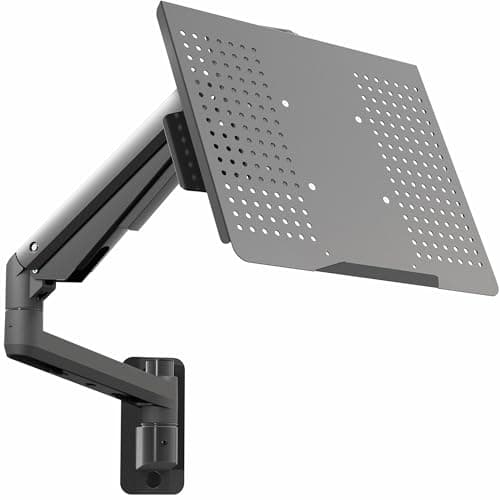
A laptop wall mount does something no stand and no clamp arm can: it takes the laptop off the desk completely, and in a room with no space for a desk at all, it can stand in for one. Every listing in the category sells that the same way, as “free up desk space.” The numbers that decide whether it will actually work with your laptop and your wall are almost never in the title.
Four of them decide it, and they are what this page ranks on:
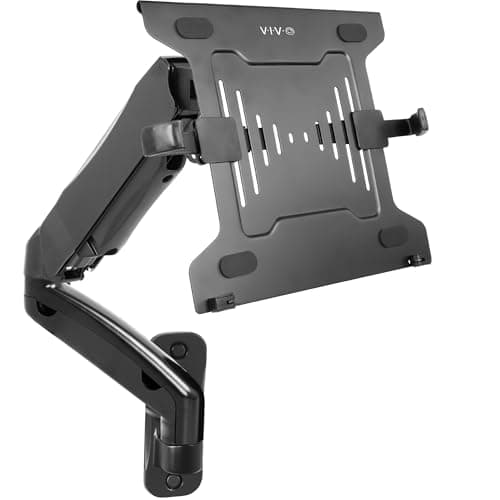
- The tray limit, not the arm rating.Most of these mounts are sold as 2-in-1s: take the tray off and the arm holds a monitor. The headline weight is usually the arm's. VIVO publishes both for its MOUNT-V001GL, and they are not close — the arm is rated 4.4 to 19.8 pounds, the laptop tray 9.9. Mount-It!'s wall-or-pole laptop arm shows the same split, 15.4 pounds for the arm and 9.9 for the tray. A listing that gives one number for “laptop or monitor” has not told you the tray limit.
- The minimum load.A counterbalance arm needs weight to push against. VIVO states it plainly: the arm “must hold at least 4.4 lbs to work properly.” Apple lists the 13-inch MacBook Air at 2.7 pounds, the 15-inch at 3.3 and the 2024 14-inch MacBook Pro at 3.5. Some of the most common laptops sold today weigh less than the 4.4-pound minimum that both the MOUNT-V001GL and the MOUNTUP publish.
- Folded depth. In a small room the question is not only how far the mount reaches, but how far it still sticks out when you are done. The spread is real: 2.1 inches for the flat-folding VIVO tray, 3 inches for the VIVO pneumatic tray folded up, and nothing published at all for the cheapest arm.
- What the wall is made of. All three arms here specify wood studs, concrete or brick, and MOUNTUP says outright that its mount is not recommended for drywall-only installation. That is the same rule as for wall-mount monitor arms, and a laptop tray adds a load a screen does not: you type on it and lean on it.
There is also a decision to make before any of that, because a laptop is a screen and a keyboard joined together. Mount it with the screen at eye level and you need a separate keyboard; mount it at typing height and you are looking down. Cornell's ergonomics group puts it in one line: “if the keyboard is in an optimal position for the user, the screen isn't and if the screen is optimal the keyboard isn't.” The picks below split along exactly that line, and the buying guide under them explains how to choose.
Our pick is the VIVO MOUNT-KB35L, a pneumatic tray that works as a floating laptop desk and folds up to a 3-inch profile. The VIVO MOUNT-V001GL is the best-documented screen-height arm, the MOUNTUP 2-in-1 is the cheapest arm here that takes a 17-inch laptop, the VIVO MOUNT-FDLAP1 is the answer for a laptop too light for any spring, and the ELETIUO holder is the no-drill way to store a closed, docked laptop on the wall or under the desk. Live prices below; the methodology explains the scoring.
The published numbers, side by side
| Mount | Laptop limit | Minimum load | Height travel | Reach / folded | Wall |
|---|
| VIVO MOUNT-KB35L | Up to 17 in, 13.2 lb | Not published | 10.6 in | 15–37.8 in; folds to 3 in | Wood stud, concrete/brick |
| VIVO MOUNT-V001GL | 10–15.6 in, 9.9 lb (arm 19.8 lb) | 4.4 lb | 9.75 in | 3–20.5 in | Wood stud, concrete/brick |
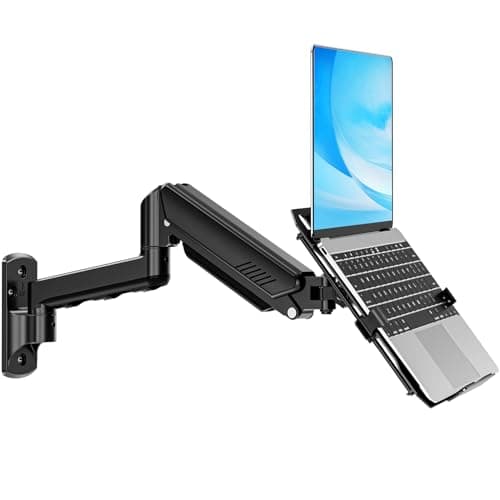
| MOUNTUP 2-in-1 | Up to 17 in; 22 lb covers laptop or monitor | 4.4 lb | 11 in | Up to 20.7 in; folded not published | Wood stud, concrete, solid brick |
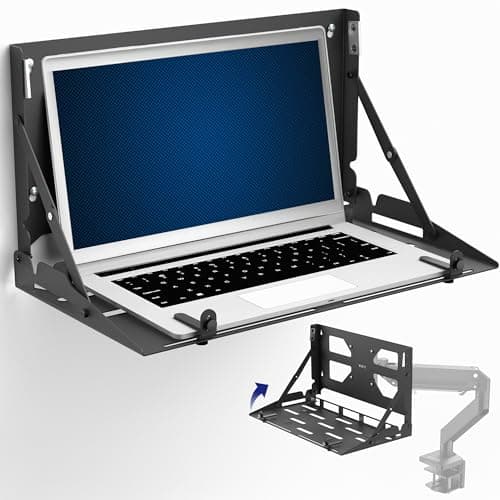
| VIVO MOUNT-FDLAP1 | 13–17 in, 22 lb | None listed (no spring) | None listed | 10.8 in open; folds to 2.1 in | Wood stud, drywall, concrete/brick |
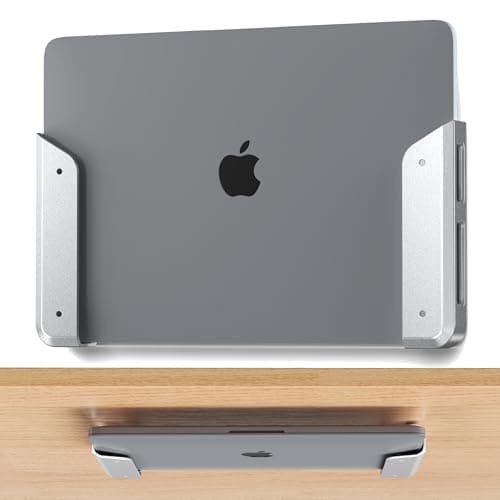
| ELETIUO holder | Closed, up to 1.02 in thick; no weight published | — | — | Not published | Adhesive or screws |
Two things are worth reading off that table. The biggest number in it is the least informative one: the MOUNTUP's 22 pounds covers laptop mode and monitor mode together, while the two VIVO listings that do separate them show the laptop limit sitting well below the arm's. And the minimum-load column matters more than the maximum for most people shopping this category, because a modern laptop is far more likely to be too light for a spring arm than too heavy for one.
The minimum-load problem with thin laptops
A pneumatic or gas-spring arm holds its position by balancing a spring against the load. Put too little weight on it and the spring wins: the tray creeps upward and will not stay where you set it. It is the same failure as a monitor that is too light for its arm, and the published minimum is, in effect, the lightest load the tension adjustment was designed for.
That floor is 4.4 pounds on the VIVO MOUNT-V001GL and the MOUNTUP, and the same 4.4 appears on the MOUNT PRO, PUTORSEN and ErgoFocus arms we also checked. Against it, Apple publishes 2.7 pounds for the 13-inch MacBook Air, 3.3 for the 15-inch and 3.5 for the 2024 14-inch MacBook Pro. None of the listings say whether the tray's own weight counts toward the minimum. So if your laptop is well under 4.4 pounds, you have two honest routes: ask the maker with your exact model before you order, or choose the VIVO MOUNT-FDLAP1, which lists no spring and no minimum at all. Heavier 16- and 17-inch laptops are the easy case — for those, check the tray limit instead.
Decide the job first: screen height or typing height
The ergonomics research is consistent on laptops, and it changes which mount you want. Cornell's guidance separates occasional users, who are “better off sacrificing neck posture rather than wrist posture,” from people who use a laptop as their main computer, who should “use a separate keyboard and mouse.” UCLA's ergonomics program says the same: “If you work regularly on a laptop, you should use an external keyboard,” because that is what lets you raise the screen to a proper height. Translated into mounts:
- The laptop is your main computer and you use it for hours. Buy a screen-height arm (the VIVO MOUNT-V001GL or the MOUNTUP) and put a separate keyboard and mouse on the desk. The mount does the job of a laptop standwithout the stand's footprint.
- Short sessions, standing work, or no desk at all.Buy a typing-height tray (the MOUNT-KB35L or the MOUNT-FDLAP1) and use the laptop's own keyboard. Set it to your working height rather than to eye level; the numbers for that are in the desk height guide.
- The laptop runs closed with an external monitor. You do not need a working mount at all. A holder like the ELETIUO, or a vertical laptop stand on the desk, does the job without an arm.
Find a stud, then measure the swing zone
Start with the wall, because it rules mounts in or out before anything else does. All three arms here want a wood stud, concrete or brick. A stud finder removes the guesswork before you drill; if the only wall you have is drywall with nothing solid where you need it, a wall arm is off the table, and the rental section below is where to go next.
Then think about where the laptop goes when it moves, which is the check that gets missed in a small room. The MOUNT-KB35L reaches 37.8 inches from the wall at full extension — more than three feet into the room — while the two arms reach 20.5 and 20.7 inches. Stand where the tray will be at full reach and make sure you can still walk past it, open the door and get into bed. Then check the stowed position: the two VIVO trays publish a folded depth (3 and 2.1 inches), the V001GL arm retracts to 3 inches, and the MOUNTUP publishes neither.
With the MOUNT-FDLAP1 the height decision is permanent, because nothing adjusts. Before you drill, rest the laptop on a stack of books at the height you are planning, work at it for a while, and only then mark the wall. For the charging cable, route it down the wall rather than letting it hang from the tray; the damage-free way to do that is in cable management without wall damage.
Renting? Two ways around the drill
The first is not to mount to the building at all. The ELETIUO holder can go up with adhesive strips for a light device, or be screwed into the underside of a desk you own rather than the wall you rent — check that the desktop is thicker than the 16 mm screws first. Before trusting adhesive with anything valuable, read what damage-free mounting can actually hold, because the ELETIUO listing publishes no weight rating for its strips.
The second is to keep the laptop on the desk but off its surface. A clamp arm with a laptop tray grips the desk edge, needs no holes anywhere, and still clears the desktop — that field is ranked in monitor arms with a laptop tray. And if what you really want on the wall is a full work surface rather than a tray, a wall-mounted folding desk holds a laptop, a keyboard and a mouse at once and folds away the same way. Whether a few screw holes in a stud are acceptable in your apartment is a lease question, not a product one, so check yours before you choose.
What we checked and did not rank
- Mount-It! MI-1765LT wall-or-pole laptop arm.The same 10–15.6-inch, 9.9-pound tray class as the VIVO MOUNT-V001GL, at a higher price and with no published height-travel figure. Its pole clamp only helps if you already have a pole, which is sold separately.
- MOUNT PRO 2-in-1 laptop wall mount.A published spec very close to the MOUNTUP's — one 4.4–19.8-pound range for both modes, with 11.8 inches of height travel — for more money, and the same missing tray limit.
- ErgoFocus 2-in-1 laptop wall mount. A similar spec again, but the listing showed only five units left in stock when we checked availability, and we do not feature a product we cannot confirm is reliably purchasable.