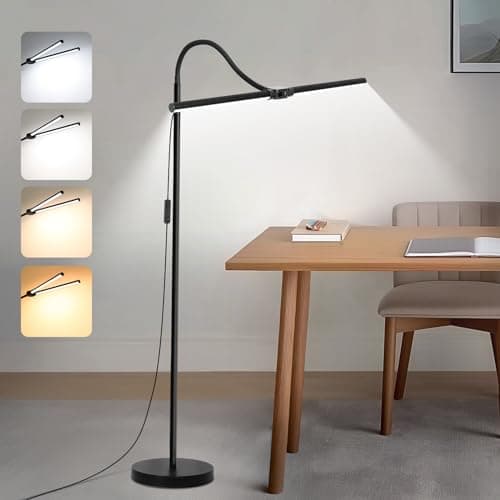
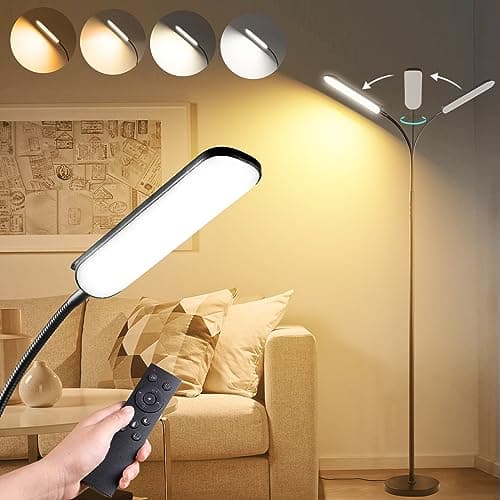
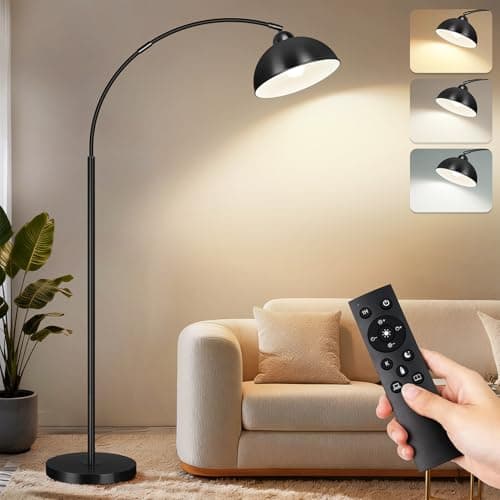
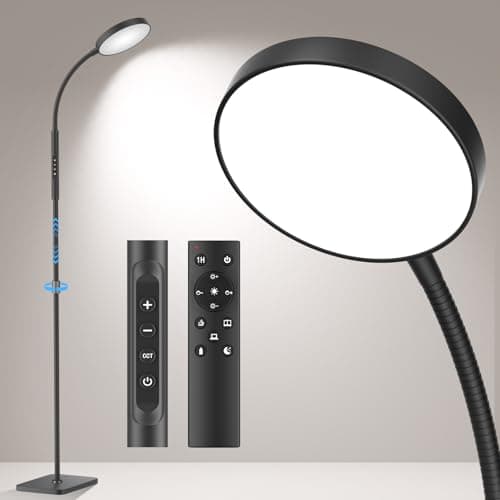
If your desk has no room for a lamp, buy the PACOVY: 1,800 published lumens, the smallest base on this page at 8.6 x 6.3 inches, and a pole that telescopes from 56.7 to 67.5 inches so the head can be set over the work rather than beside your ear. For the most light, the Seaside village double-head lamppublishes 2,000 lumens and splits them across two goosenecks — one on the desk, one on the wall behind the monitor, which is the cheapest glare fix in this category. The marctronic matches the PACOVY on output with better documented safety. And if you want the light coming from directly overhead, only an arc lamp like the LANICHO does that.
A floor lamp is the one lighting class that costs you nothing on the desk. On a 40 x 20 inch top where a monitor, a keyboard and a laptop already account for most of the surface, a lamp base is a real sacrifice — our lamp placement guide ranks desk lamps on exactly that, the footprint they claim. A floor lamp claims none of it. What it claims instead is floor, and in a studio apartment floor is not free either. That is the whole trade, and it is the reason this page ranks on a different set of criteria than our desk lamp roundup.
Why a floor lamp needs more lumens than a desk lamp
This is the thing to understand before you compare any two numbers on this page. Light spreads, so what reaches your desk depends on how far the source is from it — and the fall-off is steeper than most people expect. A desk lamp puts its head 12 to 15 inches above the surface. A floor lamp standing beside a 29-inch desk puts its head 30 to 38 inches above it, two to three times further. Our desk lamp lumens guide works through the arithmetic; the practical consequence is simple: a 600-lumen desk lamp and an 1,800-lumen floor lamp are roughly comparable on the desk, and that is why the useful floor lamps in this category publish four-figure outputs while a good desk lamp does not need to.
It also explains the ranking. Published output comes first because it is the only comparable brightness figure any of these listings give. Then reach — whether the head can physically get over the work, which a telescoping pole or an arc allows and a fixed 60-inch pole does not. Then the base footprint. Then dimming and color temperature, which decide whether the lamp is usable in the evening in a room you also sleep in.
The spec nobody lists: where the base goes
Floor lamp listings publish height and lumens and almost never make a feature of the base, and the base is what you will live with. The published footprints here run from 8.6 x 6.3 inches up to 10.25 x 9 inches, which sounds trivial until you remember what else occupies that strip of floor: the five-star base of your chair, which is wider than the seat and which rolls. A lamp base beside a desk is in the chair’s swing path, and a lamp you knock weekly gets relegated to the bedroom within a month.
Three placements work in a small room. Behind the desk, in the corner— safest, needs a gooseneck or an arc to get light forward. Beside the desk, on the side away from your writing hand— best for the work, worst for the chair, and it only fits if there is a clear foot of floor there. Behind your chair — good for ambient light and for killing screen-to-wall contrast, poor for the desk itself. If your floor is carpeted, read desk on carpet before you place anything: a weighted base on deep pile is less stable than it looks, and running the cord under a rug is the one thing you must not do.
Arc lamps: the only fixture that gets overhead
Our placement guide’s first target is light arriving from above and behind the plane of the screen. On a desk with no clampable edge and a landlord who dislikes drilling, almost nothing achieves that — a desk lamp sits on the surface, a clamp lamp needs an edge, a light bar needs a monitor. An arc floor lamp reaches out from a base on the floor and hangs its shade over the desk, which is structurally the same position as a pendant without the wiring. That is a genuinely useful trick and the reason the LANICHO is on this page.
The honest catch is that arc lamps almost never publish an output figure, because the bulb is a standard user-replaceable one. The LANICHO includes a 9W LED and publishes nothing about its lumens, which is why it ranks fourth here on our criteria rather than first on its position. If you buy an arc, budget for a known bright bulb and check its lumens on the box — the fixture is the useful part.
When a floor lamp is the wrong answer
If your desk has a clampable edge and you are allowed to use it, a clamp lamp is cheaper, brighter at the work and claims no floor at all — see clamp desk lamps and clamp vs base lamp. If the screen is the problem rather than the desk, a monitor light barsits on the bezel and lights the desk without touching either surface. A floor lamp wins in three specific cases: the top is glass or thin or rented and cannot take a clamp, the desk is already full, or the light has to come from overhead. Glass is the most common of the three — see our glass desk roundup, where a reflective top makes a floor lamp standing to the side the best-behaved light in the room.
What each lamp publishes
| Lamp | Output | Height | Base footprint |
|---|
| PACOVY | 18W / 1,800 lm | 56.7–67.5 in, adjustable | 8.6 x 6.3 in |
| Seaside village double-head | 18W / 2,000 lm | 63 in | 9 x 9 in |
| marctronic | 18W / 1,800 lm | 60 in | 9 x 9 in |
| LANICHO arc | 9W bulb, lumens not published | 72 in | Not published |
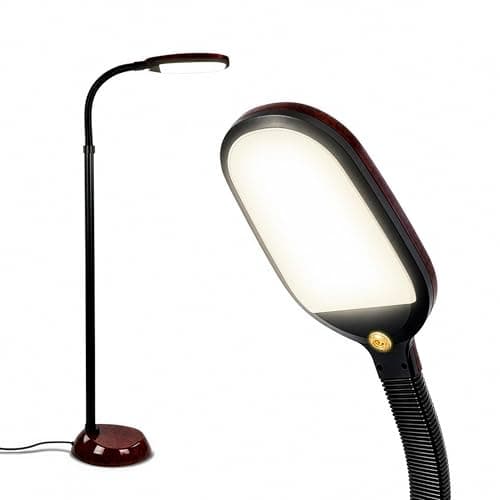
| Brightech Litespan | 12W / 850–950 lm | 42 in | 10.25 x 9 in |
Published figures only. Two cells say “not published” rather than carrying an estimate, and both belong to the arc lamp — which is characteristic of the class, not a fault of this particular model.
How to choose, in four checks
One: measure the floor beside your desk, at chair height.If there is less than about a foot of clear floor between the desk edge and the wall, you want the smallest base here and you want it behind the desk rather than beside it. If there is no clear floor at all, a floor lamp is not your answer — a no-drill desk light is.
Two: decide whether you need the head to move up, or just to aim. Only the PACOVY adjusts its height. Everything else fixes the head at 42, 60, 63 or 72 inches and lets you aim it. If your desk is unusually tall or you are unusually short, that single specification decides the shortlist.
Three: match the color temperature to the room, not the task. A floor lamp in a studio lights the room as well as the desk, so a fixed daylight-white head is doing double duty it is bad at after dark. Three of these lamps run 2700K to 6500K; our color temperature guide has the numbers worth setting.
Four: plan the cord.A floor lamp’s cord crosses open floor, which is the one cable run in a home office that is a trip hazard rather than an eyesore. Route it along a wall or a desk leg, tape or clip it down, and never tuck it under a rug. Our cable management picks include the clips and sleeves that do this for a few dollars.
The two-head trick, and why it is worth the extra few dollars
Most evening eye strain at a desk is not caused by a dim room. It is caused by contrast: a 300-nit screen in front of a dark wall, so your pupils fight the difference all evening. The standard fix is bias lighting behind the monitor, which is what LED strips and light barsexist for. A double-headed floor lamp does both jobs from one plug: one gooseneck down onto the desk, the other up at the wall behind the screen. On a small desk, where every extra device means another cable and another object, collapsing two fixtures into one is worth more than the spec difference suggests — and it is why the Seaside village lamp ranks second here despite the widest base of the three panel lamps.
What none of these lamps publish
No lamp on this page publishes a CRI figure, and none publishes an illuminance number at a stated distance — which is the figure that would actually let you compare them on the desk. That is normal for the category and it is worth saying plainly rather than implying our scores substitute for it. We rank on what is published, plus footprint arithmetic and placement reasoning you can check yourself; our methodology says so in those words. If light quality for detailed work is your priority rather than desk space, the lamps on our eye strain page publish more of the specifications that matter, at the cost of a footprint on the desk.