Skip to content
Desk & Dowel

HUB 05 · Small-Space Setups

Your Desk Is Too High: How to Fix It

A desk that is too low can be raised. A desk that is too high cannot be lowered, which is why the fix starts with your chair and ends with the keyboard, not with the desk.

By Stephen V.Updated How we pick
#ad

We earn a commission when you buy through our Amazon links, at no extra cost to you. It never affects our rankings, and we say so when the cheaper product is the better buy. How this works.

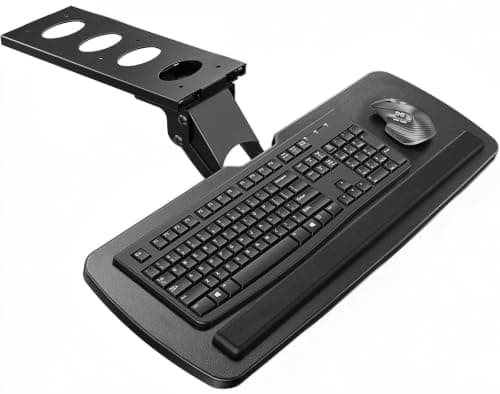
Raise the chair until your elbows are level with the desk top, then put a footrest under your feet. If your elbows still sit below the surface, add a keyboard tray — the HUANUO tray drops the typing surface by up to 6.3 inches with 22 degrees of negative tilt, which is more correction than any other fix on this page. If the desk is badly wrong and will be yours for years, the real answer is a frame that goes low: the low-range adjustable desk here starts at 18.9 inches.

The asymmetry with the opposite problem is the thing to understand first. A desk that is too lowcan be raised — by leg risers, a converter, a new frame. A desk that is too high cannot be lowered at all unless its legs are adjustable, and almost none are. So every fix below works on the two things you can move: how high you sit, and how low the keyboard sits.

Step one: measure your actual desk height, in inches

Sit in your chair with your feet flat on the floor and your upper arms hanging vertically. Bend your elbows to about 90 degrees. Measure from the floor to the underside of your forearm. That number is your correct desk height. Now measure your desk top from the floor. The difference is the deficit, and it decides which fix you need:

DeficitThe fix
Up to about 2 inRaise the chair; add a footrest if your feet lift off
2–4 inChair and footrest, plus a keyboard tray if the screen then sits too low
4–6 inKeyboard tray is doing the main work; chair as high as it goes
Over 6 inThe desk is the problem. A low-range adjustable frame is the honest answer

For context: most mass-market desks are built at 29 to 30 inches, a height that suits someone around 6 feet tall. A 5′4″ adult generally needs something closer to 25 or 26 inches. That is a three-to-five-inch gap built into almost every desk sold, and it is why this is one of the most common complaints in the category. Our desk height guide has the full table by height, and standing desks for short people covers the same problem in the standing range.

Step two: why the chair goes first

Because it is free, and because it is the only fix that changes nothing about the desk. Raise the seat until your forearms are level with the top. Two things will happen, and both have cheap answers. Your feet will leave the floor — that is what the footrest is for, and it is not optional, because dangling feet put the whole weight of your legs on the front edge of the seat. And your screen will now be lower relative to your eyes, because you went up and it did not. If the top of the panel ends up below eye level, a riser or an arm fixes that in one step.

If your chair is already at its highest, the chair is the wrong chair rather than the wrong setting. Chairs vary by several inches in their seat range, and the ones with a usefully high top end are not always the expensive ones — office chairs for short people covers the range question, and office chair fit covers it alongside the tuck-under problem a small room also has.

Step three: the keyboard tray, and what it demands

A tray is the only accessory that moves the typing surface belowthe desk, which is the one direction a too-high desk needs. The HUANUO’s 6.3 inches of adjustment is a bigger correction than any chair can give you, and its negative tilt matters more here than in any other application: when the keyboard sits below elbow height, tilting the far edge down keeps your wrists straight instead of cocked back.

Three things to check before ordering one. The clearance under the top: a drawer, an apron or a front crossbar can leave nowhere to mount. The desk depth: some trays require 18 inches to mount at all. And whether you can put screws into the desk, because the cheapest trays are screw-mounted and the clamp-on models have their own thickness limits. Our installation guide runs through the measurements in order, and keyboard tray versus desk extender explains why the extender — which looks like a similar product — cannot help with height at all.

The short answer

Quick picks

#ProductBest forScorePrice
01
HUANUO HUANUO Under-Desk Keyboard Tray
HUANUO Under-Desk Keyboard Tray

The single most useful object for a desk that is too high: 6.3 inches of height adjustment and 22 degrees of negative tilt, which between them put the typing surface wherever your elbows actually are. No other fix here moves the keyboard that far.

Best overall — the most drop available
8.7
$59.99Amazon
02
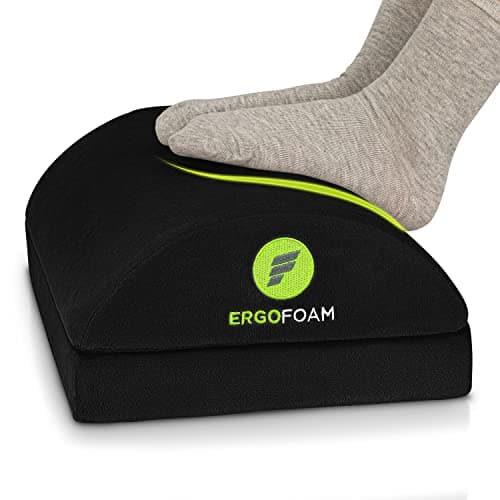
ErgoFoam ErgoFoam Adjustable Under-Desk Foot Rest
ErgoFoam Adjustable Under-Desk Foot Rest

The other half of the cheapest fix there is. Raising the chair until your elbows meet the desk leaves your feet off the floor; a footrest puts the floor back under them. Two heights from one cushion by flipping it, and 17.3 inches wide so both feet fit.

Best cheapest fix — pairs with raising the chair
8.6
$41.95Amazon
03
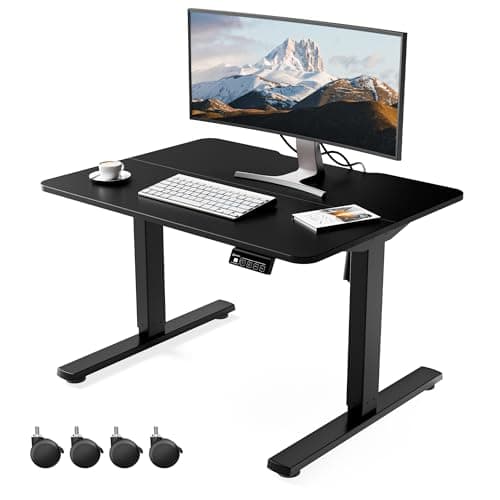
Low Height Adjustable Desk Low Height Adjustable Small Desk (18.9–29.5in)
Low Height Adjustable Small Desk (18.9–29.5in)

The permanent answer, and the only product here that solves the problem at its source: a frame whose range starts at 18.9 inches, so it can be set to the 25 or 26 inches a shorter adult actually needs rather than to the 29.5 the furniture industry defaults to.

Best permanent fix — a desk that goes low enough
8.2
$126.88Amazon

#ad · Live prices from the Amazon Product API, as of October 17, 2026. Where we have no verified live price we show none — we would rather leave a gap than print a number that has rotted.

In detail

The picks, in full

01
HUANUO HUANUO Under-Desk Keyboard Tray

Best overall — the most drop available

HUANUO Under-Desk Keyboard Tray

Tray size
25 × 9.84 in
Height adjust
6.3 in
Tilt
6° up, 22° down
Swivel
180° left/right
Clearance needed
14.17 in from edge to crossbar
8.7/10

The single most useful object for a desk that is too high: 6.3 inches of height adjustment and 22 degrees of negative tilt, which between them put the typing surface wherever your elbows actually are. No other fix here moves the keyboard that far.

Height correction
9.6
Wrist angle
9.4
Fit range
7.8
Install effort
7.4
Value
9.2

Pros

  • 6.3 inches of height adjustment covers nearly any realistic deficit
  • Negative tilt to 22° is what wrists want once the keyboard is below desk height
  • Swivels 180° out of the way rather than only sliding
  • The cheapest full-featured tray we rank

Cons

  • 25 × 9.84 in is narrow for a full keyboard plus a separate mousepad
  • Needs no crossbar, or 14.17 inches of clearance to one
  • Screws into the underside, so it is not the pick for a landlord's desk

Skip this if…

…your desk has a deep apron or a drawer under the top, or you use a full-size keyboard with a number pad and a mousepad. A wider tray or a clamp-on model is the better fit — our tray roundup splits them by clearance.

$59.99View on Amazon

$89.9933% off

Price as of October 17, 2026. Prices change — Amazon's is the one that counts.

#ad · we may earn a commission from this link to HUANUO Under-Desk Keyboard Tray

02
ErgoFoam ErgoFoam Adjustable Under-Desk Foot Rest

Best cheapest fix — pairs with raising the chair

ErgoFoam Adjustable Under-Desk Foot Rest

Dimensions
17.3 × 11.5 × 5.9 in
Material
High-density foam
Adjustment
Flip for a second height/angle
Cover
Velvet
Shape
Arched support surface
8.6/10

The other half of the cheapest fix there is. Raising the chair until your elbows meet the desk leaves your feet off the floor; a footrest puts the floor back under them. Two heights from one cushion by flipping it, and 17.3 inches wide so both feet fit.

Height correction
7
Comfort
9
Fit range
9.4
Install effort
9.8
Value
9.4

Pros

  • High-density foam holds its shape instead of flattening in a fortnight
  • 17.3 in wide gives both feet room, which the small plastic platforms do not
  • Two heights and angles from one cushion by flipping it
  • Silent, unlike a plastic tilting platform on a hard floor

Cons

  • Foam cannot be set to an exact height like a stepped platform
  • Velvet cover picks up dust in a carpeted room
  • It fixes your feet, not the keyboard — on a badly high desk you need both

Skip this if…

…you want a precise, repeatable height. A stepped platform with fixed settings is better for that, and our footrest roundup ranks both types.

$41.95View on Amazon

Price as of October 17, 2026. Prices change — Amazon's is the one that counts.

#ad · we may earn a commission from this link to ErgoFoam Adjustable Under-Desk Foot Rest

03
Low Height Adjustable Desk Low Height Adjustable Small Desk (18.9–29.5in)

Best permanent fix — a desk that goes low enough

Low Height Adjustable Small Desk (18.9–29.5in)

Height range
18.9–29.5 in
Travel
10.6 in
Drive
Electric
Lowest point
18.9 in
Class
Small adjustable desk
8.2/10

The permanent answer, and the only product here that solves the problem at its source: a frame whose range starts at 18.9 inches, so it can be set to the 25 or 26 inches a shorter adult actually needs rather than to the 29.5 the furniture industry defaults to.

Height correction
9.8
Wrist angle
9
Fit range
8.6
Install effort
6
Value
6.8

Pros

  • 18.9 in floor is well below any adult seated requirement — nothing else here goes there
  • 29.5 in top end still suits a taller housemate at conventional height
  • 10.6 in of travel is generous for a low-range frame
  • Removes the problem rather than working around it, so no tray or footrest is needed

Cons

  • Still a sit-only range — 29.5 in is nobody's standing height
  • Listed stock has been running thin, so availability is less dependable
  • Costs many times what a tray and a footrest cost together

Skip this if…

…you need one desk to serve a short user sitting and a tall user standing. No low-range frame does that; a two-stage frame trades the bottom of the range for the top.

$126.88View on Amazon

Price as of October 17, 2026. Prices change — Amazon's is the one that counts.

#ad · we may earn a commission from this link to Low Height Adjustable Small Desk (18.9–29.5in)

What not to do

Do not cut the legs. It sounds obvious and it is still the most common piece of advice on the internet. On a flat-pack desk the legs carry the load through a fitting at the top and a foot at the bottom; sawing an inch off a tapered or threaded leg usually destroys the foot, voids any rating the desk had, and cannot be undone. On a solid-wood desk it can work, and it is still irreversible on an item you may want to sell when you move.

Do not fix it by sitting on a cushion.A cushion raises your hips but not the backrest or the armrests, so the chair stops supporting your back at the point it was designed to. Use the chair’s own gas lift, which raises everything together.

Do not stop at the chair. Raising the seat without a footrest trades a wrist problem for a thigh-and-lower-back problem. The footrest is part of the fix, not an upsell.

The three fixes compared

FixCorrection availableWhat it demandsReversible
Raise the chairWhatever the gas lift has leftA footrest, and often a monitor riserYes, instantly
FootrestTwo heights on the ErgoFoamNothingYes
Keyboard trayUp to 6.3 in, plus 22° of tiltClear underside; screws or a clampScrew holes remain
Low-range adjustable deskDown to 18.9 inReplacing the deskN/A

One honest gap: neither the chairs nor the footrests in this category reliably publish the numbers you would want here. Most office chair listings state no seat-height range at all, and a footrest’s effective height depends on how your feet sit on it. We quote the figures makers publish — 5.9 inches of ErgoFoam cushion, 6.3 inches of HUANUO tray adjustment, the 18.9-inch floor on the adjustable frame — and do not estimate the rest.

The small-apartment version of this problem

Two wrinkles specific to this site’s readers. First, a shared desk: if two people of different heights use the same surface, the chair-and-footrest route is the one that resets in five seconds, and a keyboard tray is the one that does not. Second, a desk that is also a dining table — dining tables are usually 28 to 30 inches, built for eating rather than typing, and nothing clamps or screws to a table you also eat on. There the honest answer is the chair, a footrest and a laptop stand for the screen, which is exactly the setup our kitchen table office guide is built around.

When the desk is the thing to replace

If the deficit is more than about six inches, or if you are shopping for a desk anyway, buy for height rather than fixing for it. The product to look for is a frame whose bottomof range is published and low — most adjustable desks advertise their standing height and bury the seated floor, which is the number that matters here. The pick above starts at 18.9 inches; our small standing desk roundup lists the ranges for the rest, and whether a standing desk is worth it covers the case for spending the budget on a frame at all.

Prices render from the live price layer with their own “as of” date. On deficits under four inches, the chair-plus-footrest route costs a fraction of the others and should be tried first — it is the only fix here you can undo in ten seconds if you were wrong about the measurement.
How we picked

We do not run a testing lab

We compiled the published manufacturer specifications, did the footprint and clearance math ourselves, and read aggregated owner reviews, then scored each product against a published rubric. The scores are judgments from documented research — they are not measurements we took, because we do not have a lab and we are not going to pretend we do. Every spec traces back to a listing or manual named in Sources.

Questions

Frequently asked

What do you do if your desk is too high?
Raise your chair until your forearms are level with the desk top, then put a footrest under your feet so your legs are supported. If your elbows still sit below the surface, add an under-desk keyboard tray — the HUANUO here drops the typing surface by up to 6.3 inches. A fixed-height desk cannot be lowered, so those are the three levers.
What height should a desk be?
The height of your forearms when you sit with feet flat and elbows at about 90 degrees — for most adults that is 25 to 27 inches, and for someone around 5'4" closer to 25. Mass-market desks are built at 29 to 30 inches, which suits someone near 6 feet tall. That built-in gap is why this question comes up so often.
Can you cut down desk legs to lower a desk?
On a solid-wood desk sometimes; on a flat-pack desk, no. The legs carry load through a fitting at the top and a foot at the bottom, and cutting a tapered or threaded leg usually destroys the foot and any published load rating. It is also irreversible on an item you may want to sell when you move.
Does a keyboard tray fix a desk that is too high?
It is the most effective single fix, because it is the only one that puts the typing surface below the desk. Look for height adjustment (6.3 inches on the HUANUO) and negative tilt — once the keyboard is below elbow height, tilting the far edge down is what keeps your wrists straight.
Is it bad to sit at a desk that is too high?
It pushes your shoulders up and your wrists back, and it is usually the shoulders that complain first. The mechanism is simple: if the surface is above your elbows you must either raise your arms to reach it or raise the chair, and if you raise the chair without a footrest your legs lose their support. Fixing the height removes the choice.
What if my chair is already at its highest setting?
Then the chair is the limiting part, not the setting. Seat-height ranges vary by several inches between models and the useful ones are not always expensive. A keyboard tray is the alternative route — it brings the desk down to you instead of lifting you to the desk.

Keep reading

Receipts

Sources

We do not run a testing lab, and we do not pretend to. Specifications come from the manufacturer or retailer listing; the footprint and clearance math is ours and reproducible. Where we could not verify a number, we say so on the page rather than quietly leaving it out. Read our full method.