Start with the part no “under $400” roundup usually says out loud: a standing desk does not get better at standing as you spend more in this band. The $100 to $200 class already gives you a motorized 48 by 24-inch desk with memory presets and a published 176 to 220 lb capacity — our standing desks under $200 page ranks five of them. If the only thing you want is a surface that goes up and down, read that page instead and keep the difference.
What the $200 to $400 band buys is narrower and more specific than “better”, and it comes down to four things. A lower minimum height, which is a function of the leg having three stages rather than two. A top that is one piece, or in one case solid hardwood, rather than two laminate halves bolted together over a crossbar. Storage built into the desk — a drawer, a cabinet, a shelf. Or a corner, which in this band means one desk rather than two. Those four are the whole list, and the ranking above follows them in that order.
The spec that actually separates the classes: the bottom of the range
Every desk on this page publishes a height range, and almost every buyer reads the top of it. The top is the easy half — everything here reaches at least 45 inches, which stands up a 6-foot adult. The half that decides whether the desk works is the floor, and the floors here are not close together:
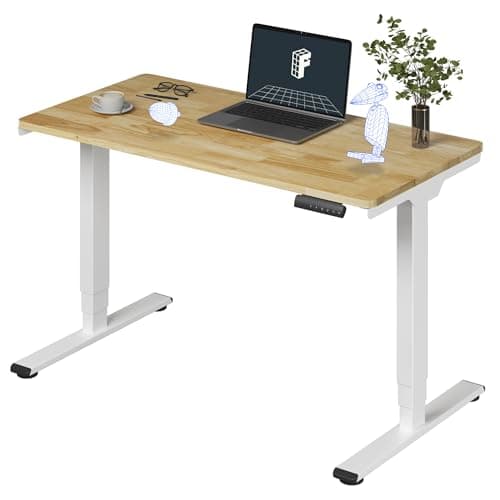
- 23.6 in— FLEXISPOT E6, three-stage dual motor
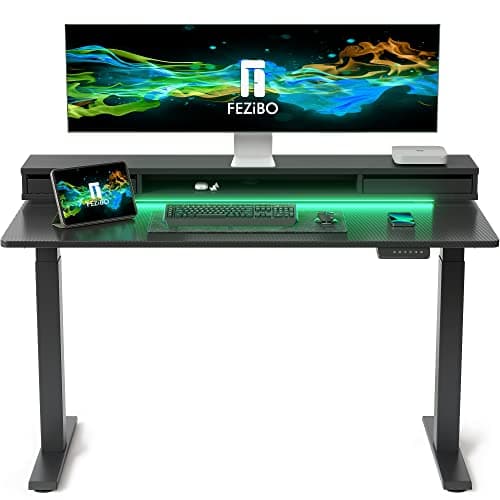
- 27.16 in— FEZIBO 48 with double drawers
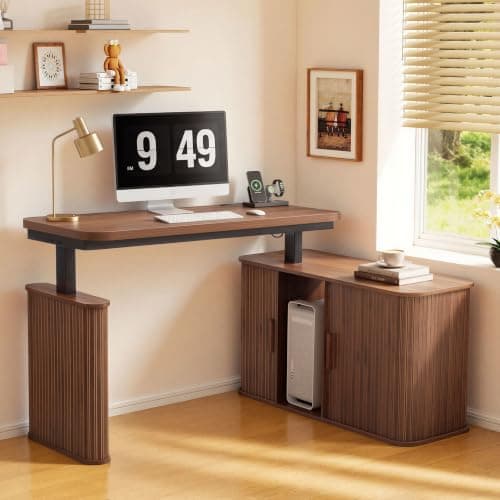
- 27.56 in— Henstatech 47 L-shape
- 28.9 in— FLEXISPOT Comhar 48
- 29.3 in— VIVO solid 1-piece 43
That is a spread of 5.7 inches, and it is almost entirely the three-stage leg. A two-stage leg has one telescoping section per leg, so its collapsed height is set by the length of the two tubes; a three-stage leg has two, which both lowers the floor and raises the ceiling. In practical terms: a 5ft4in adult needs a typing surface around 25 to 26 inches, which only the E6 reaches. Every other desk here bottoms out above that and leaves you solving the gap with a chair and a footrest — which is exactly the problem our desk too high guide exists for, and the reason standing desks for short people is a separate page on this site.
If you are between about 5ft6in and 6ft2in, none of this applies to you and you can rank on the other three criteria. If you are shorter than that, the floor is the only spec on the page that matters and it collapses the shortlist to one desk.
One-piece tops, and what a seam actually costs
Three of the five desks here publish a one-piece desktop, and FLEXISPOT states plainly that a whole-piece top is more stable than a split one. That is true, and it is also less dramatic than it sounds. A spliced top is two panels that meet over a steel crossbar, and the seam is not a weak point in the sense of breaking — it is a line that sits under your keyboard, collects crumbs, and gives the top two independent flex zones instead of one stiff plane. On a 40-inch desk you will probably never think about it. On a 48-inch desk carrying a monitor arm clamped near the rear edge, the stiffer plane is worth having.
The material underneath matters more than the seam. Four of these tops are particle board or engineered wood with a laminate face; one, the E6, is solid finger-jointed rubberwood. For a monitor armthat difference is real, because a clamp concentrates its whole load on an inch or two of edge — our will a monitor arm damage my desk guide covers which tops bruise and which do not, and desk thickness for clamp-on gear has the numbers to measure before you order anything that clamps.
Storage: up, down, or inside
Three of these desks include storage and they solve it in three different directions, which is the useful way to compare them. The Comhar puts a drawer under the near edge: handy, and it is the direction a shallow desk can least afford, because that is where your knees are. The FEZIBO puts two drawers in a shelf above the back edge: costs nothing in knee room, but it occupies the rear edge a monitor arm clamps to, and it raises the screen by a fixed amount, which a desk that moves cannot use. The Henstatech puts a cabinet inside the desk: the most storage of the three and the reason it weighs 108 lb.
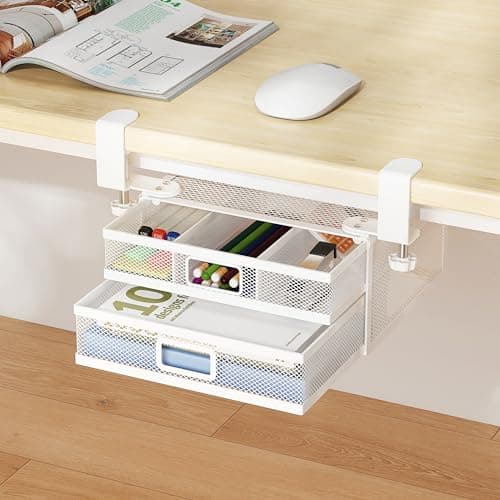
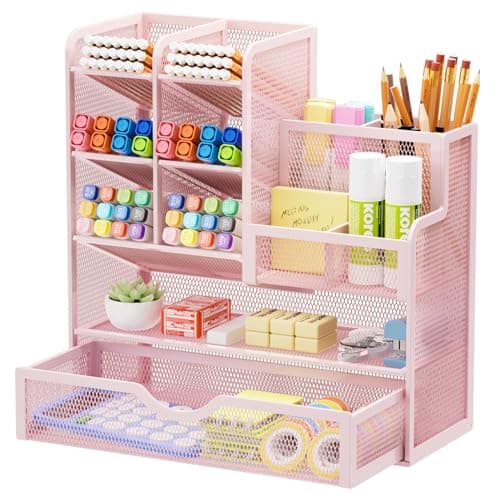
If none of those compromises appeal, the fourth option is to buy a desk with no storage and add it afterwards — our under-desk storage picks are clamp-on and adhesive, so they come off when you move, which built-in storage does not.
Depth is the one thing this band does not fix
The five desks here are 19.68 to 24 inches deep. So is the under-$200 class. So is almost every compact standing desk sold. If your problem is that a 24-inch monitor sits too close to your face, spending another $150 in this band does not help — our monitor size and distance guide has the viewing distances, and the actual fix is a monitor arm, which pushes the screen back over the rear edge and returns the eight to ten inches a factory monitor foot occupies. That purchase does more for a shallow desk than any desk upgrade in this band, and it costs a fraction of the difference.
Where this page sits next to the others
This site has four other standing-desk pages and they answer different questions. Small standing desks ranks the 40 to 48-inch class on footprint regardless of price. Under $200 is the budget band and the page most readers should start on. Shallow standing desks ranks on depth, for desks that have to live in under 20 inches. Convertersare the answer when you keep the desk you own. This page is the only one that asks what an extra $150 buys, and the honest answer is on the list above rather than in the word “premium”.
If you have not decided whether a standing desk belongs in a small apartment at all, is a standing desk worth it in a small apartment is the page to read first — it is a footprint question before it is a budget one.
What each desk publishes
| Desk | Top | Height range | Published load | Storage |
|---|
| FLEXISPOT E6 solid wood | 48 × 24 in, solid rubberwood | 23.6–49.2 in | 220 lb | None |
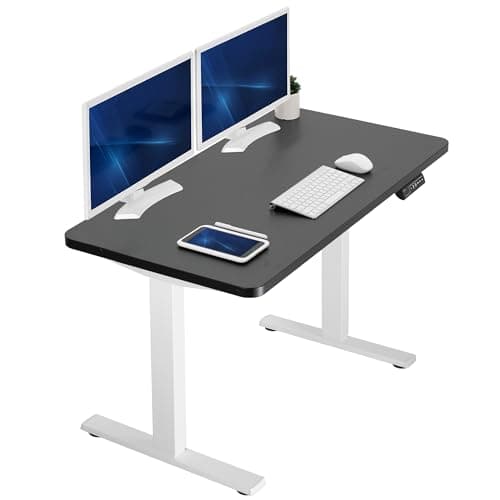
| VIVO solid 1-piece 43 | 43 × 23.6 in, one-piece | 29.3–48.5 in | 220 lb | None |
| FLEXISPOT Comhar 48 | 47.3 × 23.7 in, one-piece | 28.9–46.5 in | Not published | Drawer + USB |
| FEZIBO 48 double drawers | 48 × 24 in | 27.16–46.06 in | 176 lb | Shelf, 2 drawers |
| Henstatech 47 L-shape | 47.24 × 19.68 in main top | 27.56–45.27 in | 198 lb | Cabinet + USB |
Published figures only, captured 2026-10-21. One cell reads “not published” rather than carrying an estimate: FLEXISPOT states a capacity for its E6 frames and does not state one for this Comhar configuration, and we are not going to invent it.
How to choose, in five checks
One: measure your seated elbow height before you compare anything else. Sit in the chair you will actually use, feet flat, elbows at 90 degrees, and measure the floor to the underside of your forearm. That number is your seated desk height. If it is below about 28 inches, only the E6 reaches it and the shortlist is over. Our desk height guide has the bands by height.
Two: measure the wall, including the door swing. 48 inches of desk needs more than 48 inches of room, because the chair has to come out past the near edge. The VIVO's 43 inches is the only genuinely narrow option here; below that you are back in the narrow desk class, which does not move.
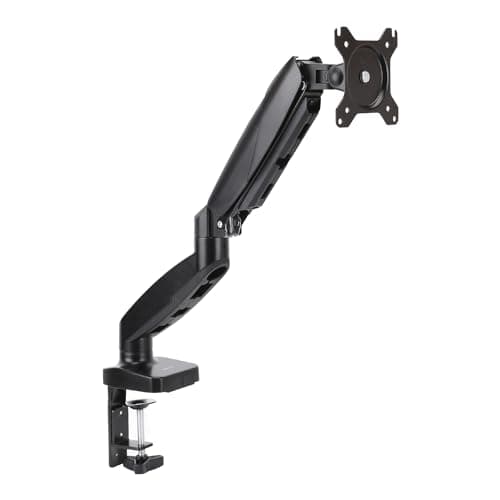
Three: decide about a monitor arm now, not later.An arm needs a free rear edge and a top it can clamp. That rules out the FEZIBO's shelf, and it makes the E6's solid wood top worth something. If the arm is definitely happening, buy the desk that accepts it — and read will a monitor arm fit my desk first.
Four: count what you are actually storing.“Storage” here means two 13-inch drawers, one pull-out drawer, or one cabinet. None of them holds a printer. If the printer is the problem, the Henstatech's open bay is the only pick that answers it, and otherwise the answer is a cart rather than a desk.
Five: plan the cable slack at full extension.This is the one mistake that bites everyone on their first electric desk, and it has nothing to do with which desk you buy: route every cable with the desk at its highest, leave a visible loop, and never cable-tie anything to the frame — the frame is the part that changes length. Our standing desk ergonomics guide covers it, and cable management has the clips.
Is the band worth it at all? An honest comparison
Here is the case against this entire page. For about $110 you can buy a one-piece 48 × 24 electric desk with four presets and a 176 lb published capacity. For about $170 you can buy a two-piece 43 × 24 with 220 lb. Both lift, both hold presets, both are on our under-$200 page. The upgrade path from there, in order of how much difference it makes per dollar, is:
- A monitor arm(roughly $30–60). Returns 8–10 inches of depth and fixes screen height in both desk positions. Nothing in this band competes with it.
- A three-stage dual-motor frame (the E6, about $260). Only worth it if your seated height is below 28 inches, or you are sharing the desk with someone much taller.
- Built-in storage(the Comhar or the FEZIBO, about $230–250). Worth it if the alternative is a second piece of furniture in a room with no space for one.
- A corner (the Henstatech, about $300). Worth it if you genuinely need two surfaces and have exactly one corner.
That order is deliberate and it is not the order that pays us best. It is the order we would spend our own money in — see our editorial policy for why that is the rule.
What none of these listings publish
No desk on this page publishes a deflection figure — how far the top moves sideways at full extension when you lean on it — and that is the specification that would actually separate them on stability. Two publish a noise figure, three do not. One publishes no load rating at all. We rank on what is published plus footprint and height arithmetic you can check yourself with a tape measure; our methodology says so in those words. We have not stood at these desks, and a page that implied otherwise would be worth less to you, not more.