Skip to content
Desk & Dowel

HUB 03 · Desk Lighting

Desk Lamp vs Floor Lamp: Which Surface Can You Spare?

The honest answer starts with a third option. If your desk has a clampable edge, neither format wins — a clamp lamp costs no desk and no floor. Only when it does not does this comparison begin.

By Stephen V.Updated How we pick
#ad

We earn a commission when you buy through our Amazon links, at no extra cost to you. It never affects our rankings, and we say so when the cheaper product is the better buy. How this works.

“Desk lamp or floor lamp?” sounds like a question about light. It is a question about which surface you can afford to give up— and on a small desk the answer usually starts with a third option that neither name covers.

A base lamp costs you desk. A floor lamp costs you floor. A clamp lamp costs you neither— it hangs off an edge you were not using — and so does a monitor light bar, which sits on the bezel. So the first question is not desk versus floor. It is: does your desk have a free, flat edge thinner than about two inches?If yes, clamp, and you are done. If no — a glass top, a lipped or rolled edge, a desk flush to a wall, a hutch in the way — then this comparison begins in earnest.

The published numbers that settle it

Light does not travel for free. It spreads, and the fall-off with distance is steeper than people expect. A desk lamp puts its head 12 to 15 inches above the work. A floor lamp standing beside a 29-inch desk puts its head 30 to 38 inches above it — two to three times further.

That one geometric fact explains every published output figure in this category, and you can read it straight off the listings:

  • Base lamp on this page: 9.5W / 750 lm
  • Floor lamps on this page: 18W / 1,800 lm and 18W / 2,000 lm

Roughly a factor of three, from the same category of maker at similar prices. The floor lamps are not three times brighter where you work — they are three times brighter at the source in order to be comparable where you work. Our desk lamp lumens guidehas the arithmetic and the targets by task; the short version is that 300–500 lm at desk-lamp distance covers screen work and 500–700 covers paper, and those are figures at 12 to 15 inches, not at the top of a pole.

The number neither category publishes honestly

Here is the gap worth knowing before you shop. The question this page asks is how much surface does it claim— and the two categories answer that question very differently.

The floor lamps publish their base dimensions. 8.6 by 6.3 inches, 9 by 9 inches. You can measure the gap between your desk and the wall and know whether it fits.

The base lamps publish an overall size and no base footprint.The lamp on this page publishes 15.1 by 3.9 by 13.4 inches, which is the whole fixture including its reach, and tells you nothing about the disc sitting on your desk. That is not one bad listing — it is true of every base lamp on this site. The category would rather you looked at the brightness.

We are not going to invent a figure for it. What we can tell you is the practical rule a tape measure gives you: a base lamp wants roughly a hand's width of clear desk, in a corner you are not working in, and on a top under about 20 inches deep there usually is not one — which is why shallow desks and base lamps are a bad pairing.

When the floor lamp is clearly right

Four cases, and they are common in exactly the apartments this site is written for:

  • A glass top.It takes no clamp and reflects anything above it straight back up at you. A floor lamp standing to the side arrives at an angle the surface does not bounce into your eyes — see our glass desk roundup.
  • A desk that is already full. If there is no corner to put a base on, the argument is over.
  • A desk that is also a dining table.A lamp that stays put while the surface gets cleared is the only lamp that survives — kitchen-table office setup covers that whole pattern.
  • You need the light to double as room light. 1,800 to 2,000 lumens at pole height lights a studio corner. 750 lumens at desk height lights a keyboard.

When the desk lamp is clearly right

Also four, and they are not about style either. Close detail work— a head 15 inches from the page beats a panel at 67 inches, every time. A wide desk, where a floor lamp beside it cannot reach the far end. No clear floor at all— a studio where the desk is wedged between a bed and a wall has no strip for a base and a chair that needs the rest. And a shared or rented room where nothing may stand around: a lamp you can put in a drawer is a different kind of flexible from a 67-inch pole.

If that last case is yours and the desk is small, the honest recommendation is neither format: a light bar on the monitor bezel claims no desk and no floor and no edge. Our light bar vs desk lamp comparison runs that pair properly, and minimalist desk setup treats the lamp as one of four objects to subtract from a small top.

How this page differs from the other lighting comparisons

Four pages on this site compare two lights, and each turns on a different axis, which is worth stating so you land on the right one:

And if you have already decided on a floor lamp, best floor lamps for a desk ranks five of them against each other on published output, reach and base footprint.

The short answer

Quick picks

#ProductBest forScorePrice
01
EYOCEAN EYOCEAN 31.5in Clamp Desk Lamp
EYOCEAN 31.5in Clamp Desk Lamp

The format that ends the argument: a 31.5-inch bar on a C-clamp costs zero desk surface and zero floor, and a bar that wide lights the whole top with no shadow line. If your desk has a free edge under 2.1 inches thick, this is the answer and the rest of this page is academic.

Best overall — no desk cost, no floor cost
8.8
$59.99Amazon
02
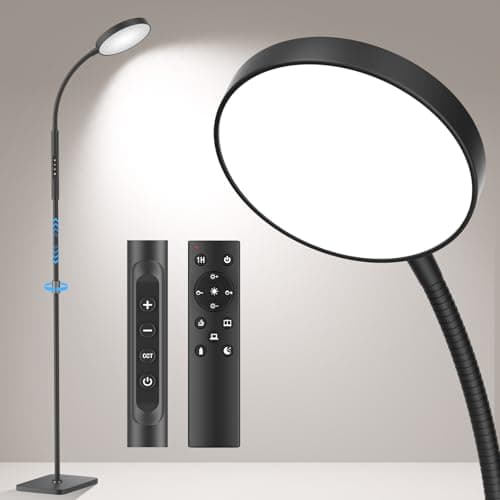
PACOVY PACOVY Adjustable-Height LED Floor Lamp
PACOVY Adjustable-Height LED Floor Lamp

The best floor-lamp answer, and the one that shows why floor lamps publish four-figure outputs: 1,800 published lumens on the smallest published base here, with a pole that telescopes from 56.7 to 67.5 inches so the head can sit over the desk rather than beside your ear.

Best if you can spare floor but not desk
8.9
$29.97Amazon
03
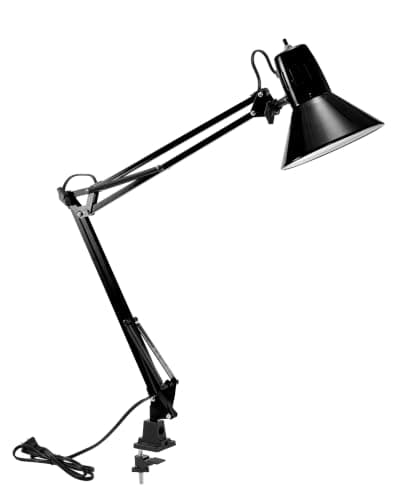
Bostitch Office Bostitch Office VLF100 LED Swing-Arm Clamp Lamp
Bostitch Office VLF100 LED Swing-Arm Clamp Lamp

The cheapest way to claim neither surface. A published 36-inch reach on an all-metal swing arm clears a monitor and puts light over the work from a clamp on the back edge — and it takes a replaceable bulb, which is the only lamp here you can change the light in rather than replace.

Cheapest zero-footprint option
7.1
$20.53Amazon
04
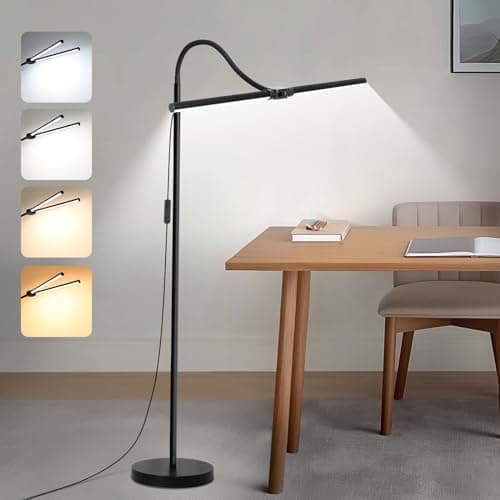
Seaside village Seaside village 18W/2000LM Double-Head LED Floor Lamp
Seaside village 18W/2000LM Double-Head LED Floor Lamp

The most published light on the page, 2,000 lumens, and two independent gooseneck heads that spread to 180 degrees — so one head lights the desk and the other lights the wall behind your screen. That second job is the cheapest fix for evening screen glare there is.

Most published output, and glare control
8.6
$32.99Amazon
05
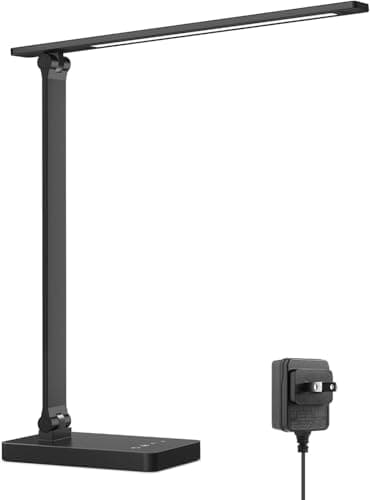
Lepro Lepro 9.5W/750LM LED Desk Lamp
Lepro 9.5W/750LM LED Desk Lamp

The only lamp here that costs you desk surface, and the only one that publishes an honest output figure for the distance it works at: 750 lumens at 15 inches lands more light on a keyboard than 1,800 lumens at 67 inches does. If you have the surface to spare, it is the best light per dollar on the page.

Best light per dollar — if you have the surface
7.6
$22.99Amazon

#ad · Live prices from the Amazon Product API, as of October 28, 2026. Where we have no verified live price we show none — we would rather leave a gap than print a number that has rotted.

In detail

The picks, in full

01
EYOCEAN EYOCEAN 31.5in Clamp Desk Lamp

Best overall — no desk cost, no floor cost

EYOCEAN 31.5in Clamp Desk Lamp

Desk footprint
None — C-clamp to the edge
Light source
31.5 in bar, 128 LEDs (64 warm / 64 cool)
Power
24W, double head
Settings
5 color temps × 5 brightness levels
Clamp limit
Tabletop up to 2.1 in
8.8/10

The format that ends the argument: a 31.5-inch bar on a C-clamp costs zero desk surface and zero floor, and a bar that wide lights the whole top with no shadow line. If your desk has a free edge under 2.1 inches thick, this is the answer and the rest of this page is academic.

Surface claimed
10
Published output
6
Coverage of the work
9.6
Controls
9.4

Pros

  • Claims no desk surface at all and no floor — the only format on this page that costs you neither, which on a 40 by 20 inch top is the whole point
  • A 31.5-inch source across a small desk means no hard shadow line across the keyboard, which is the thing a single-head lamp cannot do at any brightness
  • Published asymmetric optical design, so light goes forward onto the work instead of bouncing off the panel back at you — the spec that separates a desk light from a strip light
  • 128 LEDs split into 64 warm and 64 cool, giving 5 color temperatures across 5 brightness levels with memory and a timer
  • Remote control plus a flexible gooseneck, so the head position and the settings are both adjustable without reaching behind the screen
  • A published 2.1 inch clamp limit, which is a real number you can measure your desk against before ordering

Cons

  • No published lumen figure. EYOCEAN gives a wattage and an LED count and no output, which is normal for the clamp category and still a gap
  • Needs a free rear or side edge with clearance behind it. A desk flush to a wall, a hutch, or a lipped edge all rule it out
  • A 31.5-inch bar wants the airspace above the desk, which a shelf or a monitor on a tall arm may already be using
  • The most expensive pick here, and roughly double the price of the cheapest clamp option below
  • Less pinpoint than an architect-style arm if your work is close detail rather than a keyboard and paper

Skip this if…

…your top is glass or has a rolled or lipped edge, or there is no clear span to clamp to. Then the choice really is desk versus floor, and the floor lamp below is where to start.

$59.99View on Amazon

Price as of October 28, 2026. Prices change — Amazon's is the one that counts.

#ad · we may earn a commission from this link to EYOCEAN 31.5in Clamp Desk Lamp

02
PACOVY PACOVY Adjustable-Height LED Floor Lamp

Best if you can spare floor but not desk

PACOVY Adjustable-Height LED Floor Lamp

Desk footprint
None — stands on the floor
Base
8.6 × 6.3 in, weighted metal
Output
18W / 1,800 lm (120 LEDs)
Height
56.7–67.5 in, telescoping
Control
2700–6500K, 10–100% stepless, 50 ft remote
8.9/10

The best floor-lamp answer, and the one that shows why floor lamps publish four-figure outputs: 1,800 published lumens on the smallest published base here, with a pole that telescopes from 56.7 to 67.5 inches so the head can sit over the desk rather than beside your ear.

Surface claimed
8.6
Published output
9
Coverage of the work
8.4
Controls
9.6

Pros

  • 1,800 published lumens — and that figure is the point of the format, because a head at pole height is two to three times further from the work than a desk lamp's
  • An 8.6 by 6.3 inch published base is the smallest floor claim here, and base footprint is the spec that decides whether a floor lamp survives next to a rolling chair
  • The only lamp on this page whose height adjusts (56.7 to 67.5 in), which is the only way to get the head over a desk rather than behind your shoulder
  • Full 2700–6500K with stepless 10–100% dimming and five preset modes, so the same lamp does cool white at full output for work and warm at 15% in a studio at night
  • 50 ft remote that clips magnetically to the pole, plus touch controls on the pole itself, a timer and a memory function
  • Published UL, FCC, CE and RoHS marks, a 50,000-hour LED rating and a stated 5-year after-sales service — unusual disclosure in this price class

Cons

  • It costs floor, and floor beside a desk is where a five-star chair base wants to roll. Measure the clear strip before you buy, not after
  • A flat panel head throws a wide soft pool rather than a tight task beam. Good for a keyboard and paper, poor for close detail work
  • 1,800 lm is a ceiling, not a promise at the desk: at 67 inches up, far less of it lands on the work than a 750 lm desk lamp at 15 inches does
  • No published CRI, which is true of every floor lamp on this site
  • A 2-minute tool-free assembly and a light pole mean a knock moves it — the weighted base and anti-slip pads do the work, not mass

Skip this if…

…the gap between your desk and the wall is under about a foot. The base will be in your chair's path, and a lamp you kick weekly ends up in another room.

$29.97View on Amazon

$39.9925% off

Price as of October 28, 2026. Prices change — Amazon's is the one that counts.

#ad · we may earn a commission from this link to PACOVY Adjustable-Height LED Floor Lamp

03
Bostitch Office Bostitch Office VLF100 LED Swing-Arm Clamp Lamp

Cheapest zero-footprint option

Bostitch Office VLF100 LED Swing-Arm Clamp Lamp

Desk footprint
None — clamp mount
Reach
36 in (published)
Build
All-metal swing arm
Bulb
Replaceable LED, included
Weight
2.07 lb
7.1/10

The cheapest way to claim neither surface. A published 36-inch reach on an all-metal swing arm clears a monitor and puts light over the work from a clamp on the back edge — and it takes a replaceable bulb, which is the only lamp here you can change the light in rather than replace.

Surface claimed
10
Published output
3.4
Coverage of the work
8.6
Controls
6.4

Pros

  • A published 36-inch reach is the longest on this page by a wide margin, and reach is what lets a clamp at the back edge put light over the front of the desk
  • All-metal construction on a swing arm, which is the mechanism that survives being repositioned several times a day
  • Takes a standard replaceable LED bulb, so the color and output can be changed later — every other lamp here has its LEDs built in for life
  • Costs less than any other pick on this page and claims no desk and no floor
  • The listing states a flicker-free light zone clear of shadows, halos and glare

Cons

  • No published lumens, no published color temperature range and no CRI. Because the light comes from a replaceable bulb, the fixture's output depends on what you put in it — which is honest but leaves you comparing nothing
  • A swing arm at 36 inches of reach needs airspace, and it will collide with a monitor on a tall arm unless you plan the geometry
  • Clamp only. No base option at all, so a desk with no clampable edge cannot use it
  • Stock was showing in the teens at capture, which on a lamp is worth knowing before you plan a pair of them
  • 2.07 lb of all-metal arm hanging off a desk edge is a point load on a soft or veneered top

Skip this if…

…you want to compare brightness on paper. This fixture publishes none, and if a specific output matters to you, the floor lamps here publish 1,800 and 2,000 lumens and the base lamp publishes 750.

$20.53View on Amazon

Price as of October 28, 2026. Prices change — Amazon's is the one that counts.

#ad · we may earn a commission from this link to Bostitch Office VLF100 LED Swing-Arm Clamp Lamp

04
Seaside village Seaside village 18W/2000LM Double-Head LED Floor Lamp

Most published output, and glare control

Seaside village 18W/2000LM Double-Head LED Floor Lamp

Desk footprint
None — stands on the floor
Base
9 × 9 in, metal
Output
18W / 2,000 lm (160 LEDs)
Heads
2, spread to 180°, 360° gooseneck
Control
2700–6000K, 5 brightness levels (5–100%)
8.6/10

The most published light on the page, 2,000 lumens, and two independent gooseneck heads that spread to 180 degrees — so one head lights the desk and the other lights the wall behind your screen. That second job is the cheapest fix for evening screen glare there is.

Surface claimed
7.6
Published output
9.8
Coverage of the work
9
Controls
7.8

Pros

  • 2,000 published lumens is the highest figure on this page and the floor-lamp format needs every one of them, because of the distance the light has to travel
  • Two heads is the genuinely useful feature: one on the desk, one on the wall behind the monitor, which kills the bright-screen-against-dark-wall contrast that causes most evening eye strain
  • Each head is a 360-degree gooseneck, so the light can be set over the desk from a lamp standing beside it
  • Five brightness steps from 5% to 100% across 2700–6000K, on an inline switch you can find without a remote
  • Works with a smart outlet, so it can join a routine without buying a smart lamp
  • 160 LEDs rated past 50,000 hours with no bulb to replace, on a metal base

Cons

  • A 9 by 9 inch base is the widest floor claim here, and that is exactly the strip of floor a desk chair's five-star base wants
  • Inline switch only — no remote, no timer, no memory, all of which the PACOVY has for less money
  • Fixed height. The published height does not adjust, so head position is set by the gooseneck alone
  • No published CRI, same as every floor lamp on this site
  • Two heads at full output is a lot of light for a bedroom at 11pm; you will use the dimmer, which is on a cord rather than a remote

Skip this if…

…your desk is wedged against a wall with under a foot of clearance beside it. This is the widest base on the page and a floor lamp in the chair's path does not stay there.

$32.99View on Amazon

$38.9915% off

Price as of October 28, 2026. Prices change — Amazon's is the one that counts.

#ad · we may earn a commission from this link to Seaside village 18W/2000LM Double-Head LED Floor Lamp

05
Lepro Lepro 9.5W/750LM LED Desk Lamp

Best light per dollar — if you have the surface

Lepro 9.5W/750LM LED Desk Lamp

Desk footprint
Weighted base sits on the desk
Output
9.5W / 750 lm (published)
Overall size
15.1 × 3.9 × 13.4 in (published)
Settings
5 color modes × 5 brightness = 25
Head
Flexible body + adjustable top light bar
7.6/10

The only lamp here that costs you desk surface, and the only one that publishes an honest output figure for the distance it works at: 750 lumens at 15 inches lands more light on a keyboard than 1,800 lumens at 67 inches does. If you have the surface to spare, it is the best light per dollar on the page.

Surface claimed
4
Published output
8
Coverage of the work
9
Controls
9.4

Pros

  • 750 published lumens at desk-lamp distance is more usable light on the work than either floor lamp delivers, because the inverse-square fall-off beats the wattage every time
  • 25 settings from 5 color modes and 5 brightness levels, on a touch panel — the most granular control here for the money
  • A frosted shade and a long head spread soft light across the top rather than throwing a hot spot, which is what reduces the contrast between a bright screen and a dark desk
  • Flexible body AND an adjustable top bar, so the light can be aimed at the page rather than at you
  • 1.65 lb and nothing to mount, so it moves to another desk, another room, or into a drawer
  • Cheapest full-featured lamp on this page

Cons

  • It claims desk surface, which on a small desk is the whole reason this comparison exists
  • Lepro publishes an OVERALL size (15.1 × 3.9 × 13.4 in) and no base footprint. That is the number that would settle this page, and the base-lamp category does not give it — the floor lamps do
  • 750 lm is a third of what the floor lamps publish, so as room light it is not in the same conversation
  • No published CRI, which is the category norm and still worth knowing
  • A base lamp on a desk under about 20 inches deep crowds the one band of surface your hands need

Skip this if…

…your desk is under about 20 inches deep or already full. Everything above claims no desk at all, and on a shallow top that matters more than any light-quality difference.

$22.99View on Amazon

$26.9915% off

Price as of October 28, 2026. Prices change — Amazon's is the one that counts.

#ad · we may earn a commission from this link to Lepro 9.5W/750LM LED Desk Lamp

What each one publishes

LampFormatPublished outputFootprint claimed
EYOCEAN 31.5inClamp24W, no lumens publishedNone (edge up to 2.1 in)
PACOVYFloor18W / 1,800 lmFloor: 8.6 × 6.3 in
Bostitch VLF100ClampBulb-dependent, none publishedNone (36 in reach)
Seaside villageFloor18W / 2,000 lmFloor: 9 × 9 in
LeproBase9.5W / 750 lmDesk: base not published

Published figures only. Three cells say so rather than carrying an estimate: two clamp lamps publish no lumens, which is characteristic of the format, and one base lamp publishes no base footprint, which is characteristic of the entire category.

Decide it in four measurements

One: the thickness of your desk edge, measured at the edge.Under about 2 inches and the clamp options are open, which makes the rest of this easy. Over it — or a glass, lipped or hollow top — and they are closed. Our desk thickness for clamp-on gear page has the published limits per class.

Two: the clear floor beside the desk, at chair height. Under about a foot and a floor lamp is in your chair's path. The published bases here are 8.6 by 6.3 and 9 by 9 inches; a five-star chair base is wider than its seat and rolls.

Three: your desk depth. Under about 20 inches, a base lamp crowds the band your hands occupy, and no light-quality argument outweighs that. See desk size for small spaces.

Four: does the lamp also have to light the room?If yes, you need four-figure lumens and that means the floor format. If no, 750 lm at desk distance is plenty — the lumens guide has the targets.

Where to put whichever one you buy

The placement rules are the same for both formats and they are not obvious. Light should arrive from the side opposite your writing hand, from above and slightly behind the plane of the screen, and never from directly in front of you behind the monitor. A floor lamp has three workable positions in a small room — behind the desk in a corner (safest, needs a gooseneck or an arc to bring light forward), beside the desk away from your writing hand (best for the work, worst for the chair), or behind your chair (best for killing screen-to-wall contrast, weakest on the desk itself). Our where to put a desk lamp guide covers all of them, including the three positions to avoid.

One extra rule that only applies to the floor format: its cord crosses open floor, which is the one cable run in a home office that is a trip hazard rather than an eyesore. Route it along a wall or a desk leg, clip it down, and never tuck it under a rug. If your floor is carpeted, read desk on carpetfirst — a weighted base on deep pile is less stable than it looks.

The contrast problem both formats can solve

Most evening eye strain at a desk is not caused by a dim desk. It is caused by contrast: a bright panel in front of a dark wall, so your pupils fight the difference all evening. A base lamp does nothing about it. A double-headed floor lamp does both jobs from one plug — one head down onto the desk, the other up at the wall behind the screen — which is why the Seaside village lamp ranks where it does despite the widest base here. The purpose-built alternatives are LED strips behind the monitor, and they cost nothing on either surface.

What this page does not claim

We have not measured lux at any distance, and no lamp in either category publishes an illuminance figure at a stated distance — which is the number that would let you compare them properly at the work. None of them publishes a CRI either. We rank on published output, published footprint and placement arithmetic you can reproduce with a tape measure; our methodology page says so in those words. If light quality for detailed work is the priority rather than surface, the lamps on our eye strain pagepublish more of the specifications that matter — at the cost of a footprint on the desk.
How we picked

We do not run a testing lab

We compiled the published manufacturer specifications, did the footprint and clearance math ourselves, and read aggregated owner reviews, then scored each product against a published rubric. The scores are judgments from documented research — they are not measurements we took, because we do not have a lab and we are not going to pretend we do. Every spec traces back to a listing or manual named in Sources.

Questions

Frequently asked

Is a floor lamp good enough for desk work?
Yes, if it publishes enough output. The catch is distance: a floor lamp's head sits two to three times further from the work than a desk lamp's, so it needs roughly three times the rated lumens to land comparable light. That is exactly what the figures on this page show — 1,800 and 2,000 lumens for the floor lamps against 750 for the base lamp. Treat anything under about 1,000 lumens as room lighting that happens to be near a desk. Our lumens guide has the targets by task.
Which saves more space, a desk lamp or a floor lamp?
A floor lamp, on a small desk — it claims zero desk surface and spends 8.6 by 6.3 to 9 by 9 inches of floor instead. But neither is the space champion: a clamp lamp on the desk edge or a light bar on the monitor bezel claims no desk and no floor at all. If your desk has a free edge thinner than about two inches, that is the format to buy and this comparison does not apply to you.
Can I use a floor lamp instead of a desk lamp in a small apartment?
Often it is the better choice, and there are four cases where it is clearly right: a glass top that takes no clamp and reflects overhead light back at you, a desk with no spare corner, a desk that is also a dining table, and a room where the same fixture has to light the space as well as the work. The constraint is floor rather than desk — measure the clear strip beside the desk at chair height first, because a lamp in your chair's path does not stay there. Best floor lamps for a desk ranks the options.
How much desk space does a desk lamp actually take?
Nobody publishes it, which is the honest answer and the most useful thing on this page. Base-lamp listings give an overall size including the arm's reach — the one here publishes 15.1 by 3.9 by 13.4 inches — and not the footprint of the disc that sits on your desk. The floor lamps, by contrast, publish their base dimensions. Measure the lamp you are considering if you can, and assume a base lamp wants roughly a hand's width of clear desk in a corner you are not working in.
Do I need a clampable edge for a clamp lamp?
Yes, and it has to be free, flat and within the published thickness limit — the wide clamp lamp here states tabletops up to 2.1 inches. Glass tops, rolled or lipped edges, a desk flush against a wall with no gap, and hutch desks all rule it out. Check before you order: desk thickness for clamp-on gear has the figures, and best clamp desk lamps ranks the format.
Is a floor lamp or desk lamp better for a glass desk?
A floor lamp, clearly. A glass top takes no clamp lamp and no clamp-on anything, and it reflects light placed above it straight back up at you. A floor lamp standing to the side arrives at an angle the surface does not bounce into your eyes, and it costs the desk nothing. See our glass desk roundup for the rest of that trade-off.
Can one lamp light both my desk and the room?
A floor lamp can; a desk lamp cannot. Four-figure published lumens at pole height will light a studio corner and the desk, and a double-headed floor lamp does it deliberately — one head down on the work, one up at the wall behind the screen, which also fixes the bright-screen-against-dark-wall contrast that causes most evening eye strain. A 750-lumen base lamp lights a keyboard and nothing else.

Keep reading

Receipts

Sources

We do not run a testing lab, and we do not pretend to. Specifications come from the manufacturer or retailer listing; the footprint and clearance math is ours and reproducible. Where we could not verify a number, we say so on the page rather than quietly leaving it out. Read our full method.