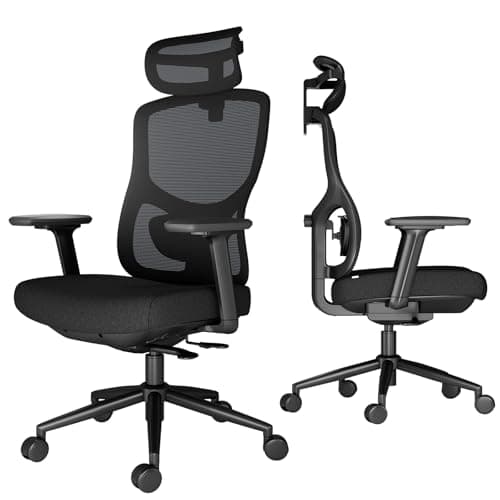
A chair that is comfortable for twenty minutes tells you almost nothing about the eighth hour. The specifications that decide a long day are not the ones in the headline — they are whether the lumbar support can be moved to yourlower back rather than an average one, whether the seat’s front edge can be set to stop short of the back of your knees, and whether the recline locks somewhere other than upright. Four published adjustments decide it, and this page ranks on those four.
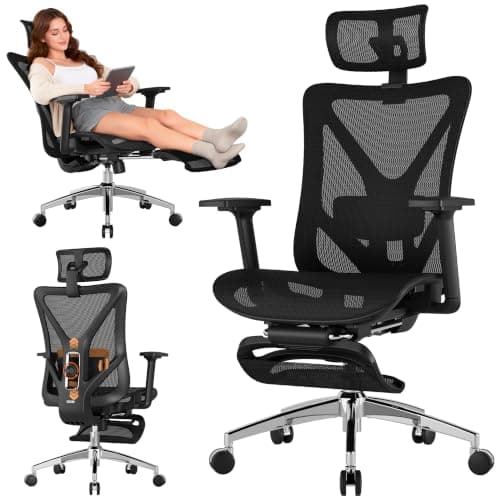
There is a catch, and on this site it is the whole story: the adjustments that carry a long day are the ones that make a chair big.The two most adjustable chairs below publish product widths of 27.5 and 27.7 inches, and the GABRYLLY’s footrest extends another 18.1 inches into the room when it is out. Our office chair fit guide puts a five-star base at 24 to 26 inches across, which is already the largest single object in most small workspaces. So footprint is used here as a gaterather than as the ranking — and the chair at the top is the one that passed both.
That is the clean separation from our best small office chairs roundup, which ranks the opposite way round: on footprint, on whether the chair tucks fully under the desk, and on what support survives the shrinking. If your room decides the question, start there. If your working day decides it, start here. If you are short, the fit problem is a different one again and office chairs for short people has it. None of the five chairs on this page appears on either of those pages.
Every number quoted below is the listing’s own published figure, captured on 4 November 2026, and availability was confirmed before any chair was featured. Two of the five publish no seat-depth adjustment at all; where that is the case the spec row says so rather than guessing, because a seat depth you cannot change is a very different product from one you can. We have not sat in these chairs — the ranking is built from published specifications, the standards each maker names, and the footprint arithmetic a small room forces. The methodology explains how the scoring works.
The four adjustments that decide an eight-hour day
1. Lumbar support that moves in two axes, not one
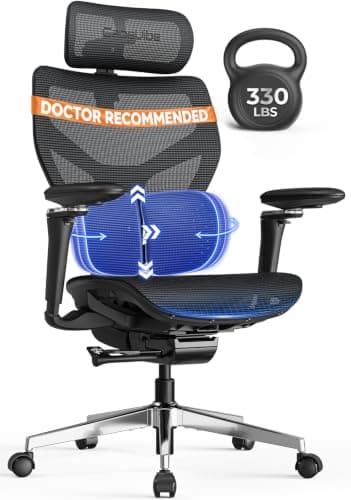
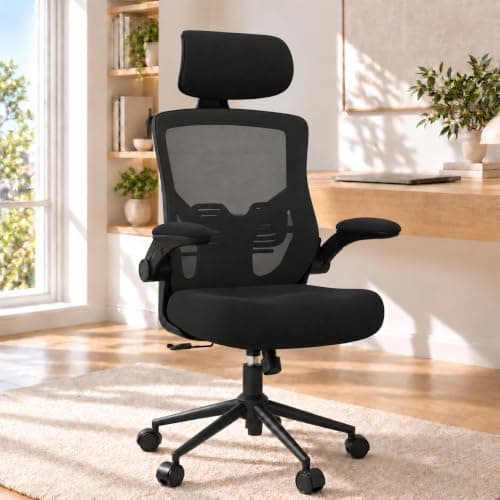
Almost every chair over $120 now advertises “adjustable lumbar support”, and most of the time that means the pad slides up and down. Up-and-down is the easier half. The half that decides whether the support actually meets your back is depth— how far the panel pushes forward into the curve — and far fewer chairs publish a figure for it. On this page the GABRYLLY publishes both (3 inches vertical, 1.6 horizontal), the CabeVibe publishes both (3.5 inches of height, 1 inch of depth) and the TRALT publishes depth only. The FOKESUN publishes height only.
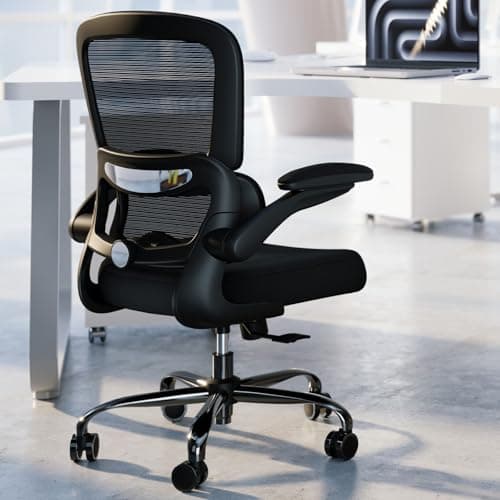
The DEXYNORD solves it a different way and it is worth understanding, because it is the reason it leads the page: rather than moving a pad on a fixed frame, the whole backrest adjusts through five height positions over a 2.4-inch range, independently of the seat. The lumbar curve is part of the backrest, so moving the backrest moves the curve. The listing is explicit about why — it is how a chair fits torsos from 5 ft 0 in to 6 ft 6 in without a separate pad.
2. Seat depth, which is the adjustment nobody shops for
If the seat is too deep for your thigh, the front edge presses behind your knee, and over several hours that is the pressure most people misread as a back problem. The rule of thumb is two to four fingers of clearance between the seat edge and the back of the knee. Two chairs here let you set it: the DEXYNORD has a 10 cm slider (about 3.9 inches of travel) and the CabeVibe publishes 2.36 inches. The TRALT does not adjust, but it is the only chair on the page that publishes its seat depth as a number — 17.3 inches, chosen, its listing says, to leave that finger gap — which is more useful than an unstated depth you cannot change either.
This is also the specification that interacts with a small desk. A deeper seat pushes you further from the desk edge, which pushes the keyboard further away, which is the start of the reach problem described in seated desk ergonomics. On a 20-inch-deep top there is not much room to absorb that.
3. A recline you can lock, at an angle you will actually use
Free-swinging tilt is not rest; you are still holding yourself up. What helps on a long day is a locked angle you can drop into for ten minutes. The published ranges here differ in kind, not just degree: the GABRYLLY gives three fixed stops (90, 110 and 135 degrees), the DEXYNORD gives three (96, 120 and 135), and the CabeVibe locks anywhere between 90 and 125. Fixed stops are easier to find again; a continuous lock is easier to fine-tune. Either beats a chair that only locks upright.
A caution specific to a small room: a chair reclined to 135 degrees occupies substantially more floor than the same chair upright, and with a footrest extended it is close to four feet of depth in front of the desk. Measure the walkway before you buy the recline — desk dimensions by room size has the 30-inch walkway figure these layouts are planned around.
4. Armrest travel, and the small-room clause
“4D” means up/down, forward/back, side-to-side and pivot; the CabeVibe’s “630 degrees” is a marketing way of adding a 360-degree rotation to a 270-degree swing. What matters for a long day is that the armrest can be set to carry your forearm at the same height as the desk, because an unsupported arm loads the shoulder all day. What matters in a small room is the opposite: armrests are the single reason a chair stops four to six inches short of tucking under the desk, which is why our small-chairs page favours flip-up and armless designs. If the chair must disappear under the desk when you are not in it, that page is the right one and this one is not.
The published figures, side by side
| Chair | Lumbar axes | Seat depth | Recline lock | Capacity | Published width | Warranty |
|---|
| DEXYNORD | Backrest height, 2.4 in | 10 cm slider | 96° / 120° / 135° | 300 lb | 19.29 in | 2 years |
| CabeVibe C3 | Height 3.5 in + depth 1 in | 2.36 in | 90°–125° | 330 lb (BIFMA) | 27.5 in | 2 years |
| FOKESUN | Height only | Not published | Not published | 350 lb | 20 in | 5 years |
| GABRYLLY | 3 in vertical + 1.6 in horizontal | Not published | 90° / 110° / 135° | 300 lb (SGS, BIFMA) | 27.7 in | 3 years |
| TRALT | Depth only | Fixed 17.3 in (published) | Not published | 330 lb | 25.7 in | 2 years |
Read the last two columns together and the pattern of this category appears: the longest warranty on the page belongs to the chair with the fewest adjustments, and the two widest chairs have the shortest warranties despite costing the most. Published capacity, meanwhile, tracks nothing at all — the 350 lb figure sits on the second-cheapest chair here.
What a chair cannot fix
Two of the commonest “my chair hurts” problems are not chair problems. If your feet do not rest flat, the chair is being used at the wrong height and the fix is a footrest, not a different chair — raising the chair to reach the desk and leaving the feet hanging transfers the load to the thighs. If your shoulders are up around your ears, the desk is too high for you, and desk too high covers the three fixes for a desk that does not adjust. Set the desk and the footrest first, then judge the chair.
And no chair makes sitting for eight hours a good idea. Cornell’s ergonomics guidance is that variety is the point rather than any one posture, which is the argument for a perch stoolas a third option or for getting the desk itself to move — standing desk alternatives lays out the cheapest routes to that in a small room.
What we checked and did not rank
- MUXX.STIL office chair with flip-up armrests. In stock, a published 15-year warranty and a waterfall seat edge, and the flip-up arms let it slide fully under a desk. It is not here because flip-up arms are the small-chair criterion rather than the long-hours one, it publishes no seat-depth adjustment, and its 264 lb capacity is the lowest of the shortlist. It belongs on the small-chairs page, not this one.
- Marsail and MALOL big-and-tall mesh chairs.Both in stock and both publishing sliding seats and multi-axis armrests, but both are big-and-tall designs whose published widths put them further outside a small room than the CabeVibe — and this page already carries one chair that fails the footprint gate to make the point.
- Chairs with no published lumbar adjustment.Excluded as a class. A fixed lumbar bulge is a guess at the average spine, and for an eight-hour day the ability to move it is the first thing on this page’s list rather than a bonus.